White-collar worker, Hair, Head, Glasses, Suit, Furniture, Interaction, Coat, Chair, Meeting

2025 Annual Report

Best viewed in desktop or tablet mode

Draft version for
UIAA Management Board meeting

Contents

President's Report

One of my personal highlights from 2025 was attending the 50th anniversary of the UIAA Safety Commission, held in Chamonix in April. I was last in Chamonix in 1979 when backpacking. And one thing had not changed, the weather was atrocious and I never saw Mont Blanc. Does it really exist? Or is a tourist attraction fabricated by the French, Swiss and Italians? It remains a mythical mountain for me.

It was really nice to observe the massive turnout for the SafeCom event and listen to many complex and technical discussions. The dedication and skill that supply that particular Commission is outstanding. And it is typical of many areas of the UIAA.

My own climbing activities have been hit hard by the fires in Canada over the past year, another reminder of the impact of climate change. Most of the backcountry in Northwest Ontario, in Manitoba, and in the Canadian Shield, was closed until really the end of June. I guess this has given me more time for meetings…

I’d like to also reflect on the change of Chief Executive Officer. Andre von Rotz succeeded Nils Glatthard as CEO in January. I was worried when Nils left because he had performed a great job and was very skilled at dealing with people and many challenging situations. Andre has really hit the ground running and not only ensured continued stability but brought his own personality and different interpretation to the role.

Over the past year, I have really enjoyed both the Executive Committee and Management Board meetings. I always did, but over the past year, they have taken on a new kind of persona. Everybody is involved, everybody is interested, bringing lots of good ideas. And I attribute a lot to the fact that we’ve set strategic priorities rather than a strategic plan. People have found the path clearer.

Here are my reflections on the seven strategic priorities:

Greater concentration, greater focus and progress of the seven strategic priorities

As I outlined at the 2025 UIAA General Assembly in Kosovo, delegates hopefully picked up on both my optimism and my reflections on the positive direction that the UIAA is heading. We are more concentrated and more focused, thanks significantly to our new strategic priorities.

Words from Peter Muir, President of the UIAA

Autograph, Handwriting

Part 1: Executive Review - President's Report

Thanks to our Working Group, efforts continue to strengthen the UIAA’s global reach beyond its traditional Northern Hemisphere base. Significant growth has been observed in Central and South America, with progress in Asia and in Africa too.

Regional meetings and recruitment of new members are ongoing and attention given to membership fee structures to support smaller federations. The UIAA has a stated ambition of representation from 100 member countries by 2032. We are well on track but wider global representation is not only about numbers. We need to support the financial and logistical barriers that remain challenges for some regions. Overall engagement and inclusivity are improving.

And these new members, they bring in different perspectives. It strengthens them and it strengthens us. It also leads to wider representation in our various structures including boards and commissions.
After being in some tight spots, the situation is now very encouraging. We’ve established partnerships of various levels with Lenovo, Fixe, Namah Ropes, Altezza Travel and Mammut as well as our continued relationship with the Petzl Foundation. These are steps to further developing sponsorships which will continue throughout 2026.

Although some deficits remain, projections indicate a balanced budget in 2026.

Efforts led by Yolanda de Both, Andre von Rotz, and the Finance and Audit team have improved fiscal management and sponsor relations. We need to continue looking at some service offerings to achieving greater financial self-sustainability. The overall financial outlook is positive, showing steady improvement since 2024.
This is another area where the trend is positive. The Commissions – Safety, Medical and Legal Affairs, which form a natural part of the Safety Centre of Excellence are producing some great work. Likewise the Accident Reporting working group.

We had two new standards published and revisions to several others; we have a testing lab in North America for the first time; we witnessed a great collaboration between the Medical and Safety Commissions for the Mountain Sports Symposium in Kosovo and the Medical Commission engaged in a number of international events. I’d also like to credit the Mountaineering Commission for their support on a number of topics ensuring the UIAA has been more efficient and responsive to certain questions and tasks. In 2026, the Safety Commission meetings in Kalymnos, Greece will feature a number of important workshops notably on rock anchors, stress corrosion cracking and bolting.

Our communication team tells me that, through podcasts, social media and other campaigns, that safety is a massive draw in terms of people coming to the UIAA for information. It is a natural entry point for climbers to enter the world of the UIAA. And a word on the Mountain Voices podcast, which has seen us bringing a range of leading climbers and mountaineers under the UIAA umbrella. I have really enjoyed sending them my messages of thanks through Canada Post.
This is a key priority and one which was in good shape even before it was defined as one of the seven priorities. The Mountain Protection Commission and its various working groups are doing a fine job. Partnerships with Lenovo and the King Albert Memorial Foundation for the Mountain Protection Award highlight tangible progress.

The Mountain Protection Award, and its new biennial model, remains an iconic project for us. We committed significant resources to marking the International Year of Glacier Preservation and the inaugural World Glacier Day.

At the GA we hosted another Climate Change Summit, where the UIAA continued to work with member federations, large and small, in their own climate action plans and journeys. There is a maturity to what we are doing including with the Carbon Footprint Reporting, where we run the full report biennially allowing more time to conduct analysis.

In my mind, in-person occasions like this remain crucial. Online meetings are not as effective. However, online meetings allow us to remain in closer contact, to meet more regularly, to make quicker progress and when we meet in-person to be more efficient and streamlined.
Like finance, ice climbing was a contentious subject one year ago. It has been a remarkable turn-around. The newly-formed World Ice Climbing structure has exceeded expectations under its new governance model. It was a big mountain to climb. Led by JoAnne Carilli-Stevenson, World Ice Climbing Board Chair, and Rob Adie in the office, they have achieved a lot. It’s a testament to finding the right people, delegating responsibility and letting them run with it and do it.

I have been impressed with the improved collaboration with event organizers and the clarity of responsibilities which have strengthened overall operations. The World Ice Climbing structure is made up entirely of experts and a broad range of stakeholders. The sport benefits from increased stability, with athlete representatives, organizers, and staff aligned under shared goals.

In terms of the Olympic Winter Games, we are not in a position to make promises or define targets but the World Ice Climbing Board remains in close discussions with the organizers of the 2030 Games in the French Alps.

More important is continuing to deliver a great UIAA Ice Climbing World Tour and thanks to the professional management, and clear direction and delegation within World Ice Climbing, we witnessed significant growth in terms of athletes, member federations and span of medallists during the 2025-2026 season. More in next year’s report on this.
A decision was made to halt training activities in July. This was to allow a review of its operational and administrative structure to ensure that future training programme development would be built on stronger foundations. The first step in this approach was to create a Working Group with the remit to implement such a review.

Thanks to the work of this group, Training Commission activities will relaunch in the spring of 2026 thanks to a more structured approach than in the past and working closely to respond to the needs of our member associations. Training has been a success in the past and will be again in the future. Our plan is to integrate it more closely into the Safety Centre of Excellence. However, we need to ensure the model is sustainable.

Likewise, on the subject of development, we have been conducting a review of our activities in youth and have received valuable input from our members. Youth activities, under a new Commission President and structure, will also relaunch in 2026. The future for training and youth programmes is positive. The framework for both will include standardised global certification procedures.
Until now we have largely spoken about impressive or at least incremental progress. We need to focus more on delivering on rock climbing and hiking pledges in 2026. Work is already underway thanks to a number of dedicated focus groups.

Our UIAA Declaration, approved at the 2024 GA, includes a clear reference to hiking. Hiking initiatives within the Mountaineering Commission are currently in development and projects should soon come to fruition, thanks also to the support of delegates from the Italian Alpine Club, CAI.

Likewise rock climbing will witness some positive steps in 2026 chiefly in terms of the visibility provided by the UIAA. Both hiking and rock climbing have a critical mass which leads me back to my first point in terms of wider global representation.
One thing which is clear is how many of the seven strategic priorities rely on each other and are interlinked. In general terms, progress across these seven areas reflects a clear trajectory towards a stronger global presence, financial sustainability, and significant operational improvements.

There are areas to develop but the key thing is we know what they are. The focus is on continued collaboration and using our resources as efficiently as possible.

Thank you to the EC and MB for our enjoyable and fruitful collaboration, leadership and ensuring that the strategic priorities have remained on track. Thank you to all of the Commissions and volunteers who support the UIAA with countless hours of expertise and dedication. Thank you to the Office for your professionalism and commitment. Thank you to all member associations for supporting us and allow us to support your work.

Strategic Priorities

At the 2024 General Assembly, agreement was reached on the new UIAA Strategic Priorities for the period 2025-2028. A reminder of these guidelines can be found here.

Part 1: Executive Review - Strategic Priorities

Part 1: Executive Review : Strategic Priorities

For the years 2025-2028 the UIAA has set seven priorities for development:

The UIAA will strive to better serve its member federations in all parts of the world by providing leadership in matters of global concern and by building its relevance to the wider climbing and mountaineering community.

By clearly defining and more actively promoting the benefits of membership based on the needs of individual federations, the UIAA will aim to grow beyond 100 member federations by its 100th anniversary in 2032.
Recognising that rock climbers and hikers constitute
a significant segment of the membership base, the UIAA will devote more resources towards addressing matters important to rock climbers and identifying opportunities for growth in relation to hiking, thereby supporting the needs and expectations of its member federations while increasing its relevance to potential new members.
The UIAA is fully committed to developing ice-climbing as a sustainable, global sport. The objectives for 2025 - 2028 are twofold:

1.That the UIAA Ice Climbing World Tour grows to achieve sporting excellence and develops in a sustainable manner, with secured financing, stable regulations, organising body and business model ensuring its future.

2. That ice climbing becomes an Olympic sport - "The Olympic Dream"
The UIAA will focus its long-standing and globally recognised work on continual improvement of climbing safety and standards through a Safety Centre of Excellence, encompassing equipment standards and certification, medical and safety advice, accident
reporting and analyses, legal analyses, educational content and content reviews and communication.
Building on its widely recognised training standards and certificates and the pool of knowledge and experience among its larger member federations, the UIAA will aim to promote more widely its standard programmes and supporting the efforts of member federations to develop their training structures according to their needs.
With our commitment to the UNFCCC Sports for Climate Action framework and recognising the serious global challenges of climate change and degradation of the natural environment, the UIAA will lean on the best available research, data and practices to relate how climate change affects our activities in the mountains and the mountain communities, how to adapt, and how to act responsibly.

The UIAA will work by itself and with our member federations to minimalise the impact of our activities on the climate and natural environment. To support these actions, we will provide realistic climate change and sustainability guidance adapted to the nature, needs and size of our member federations.
The UIAA will develop its financial resources and its financial stability by renewing existing partnerships, by developing new ones, and by encouraging specific Commissions to develop and expand their income generating services.

2025 UIAA General Assembly

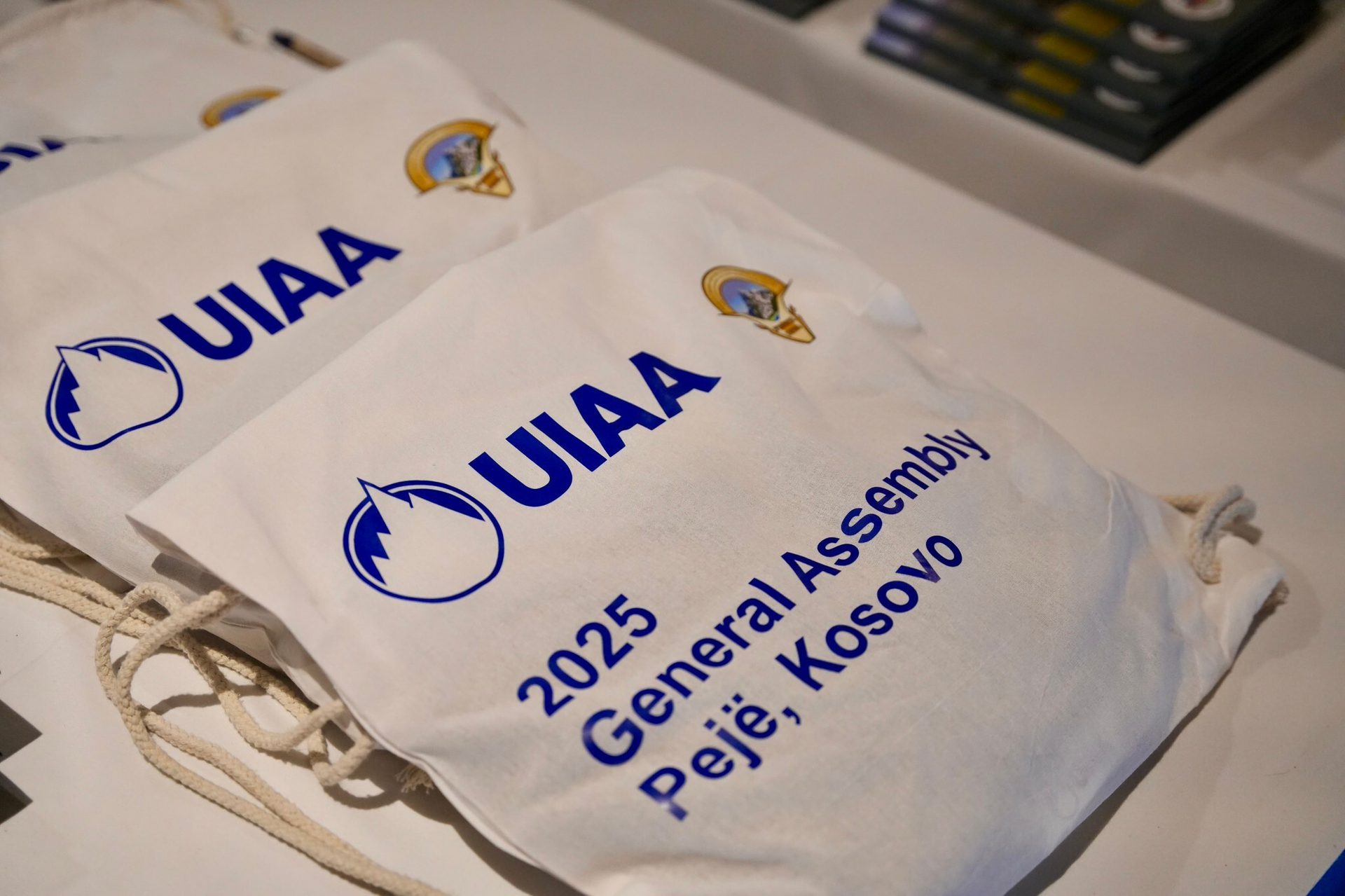
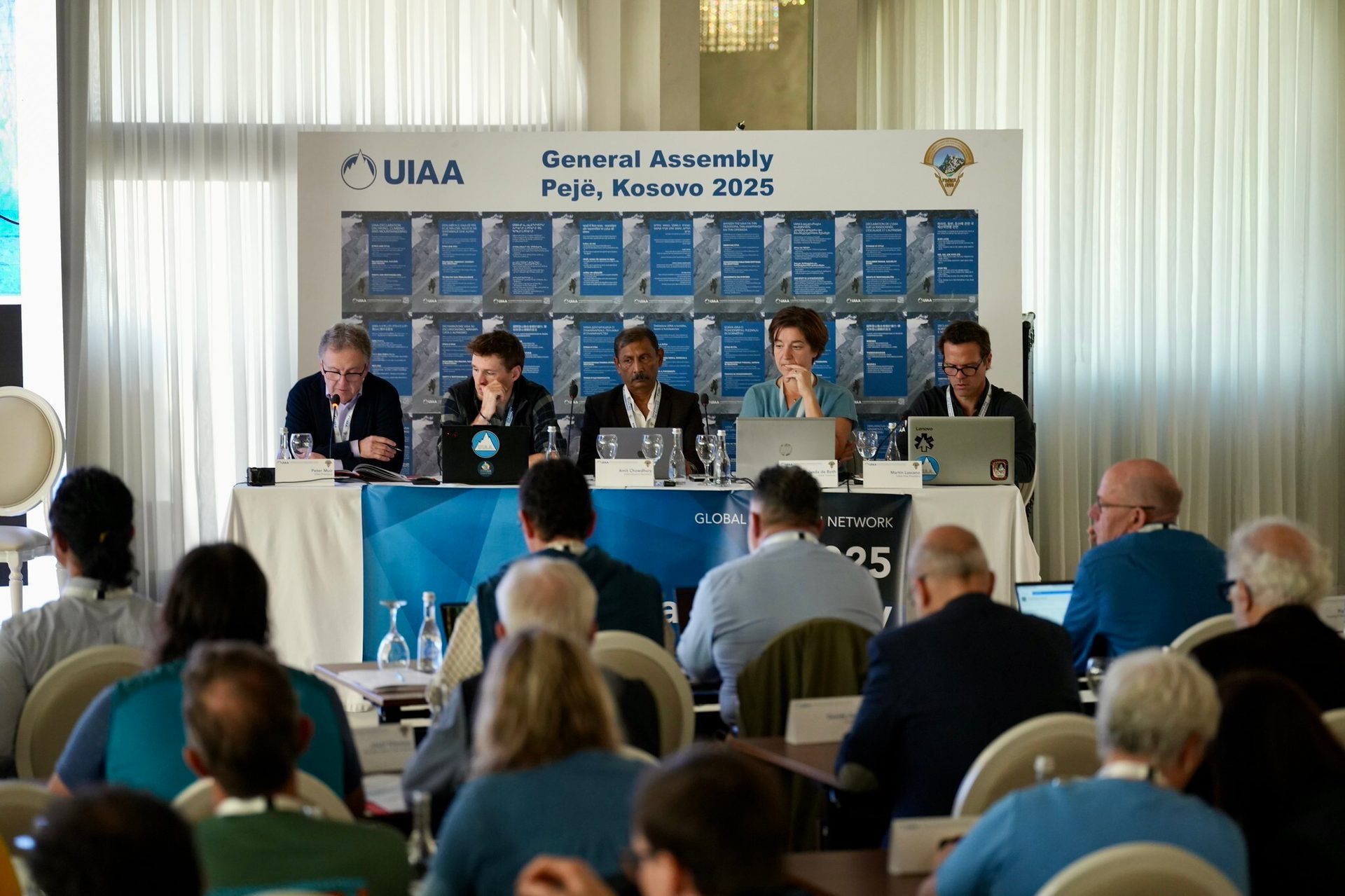
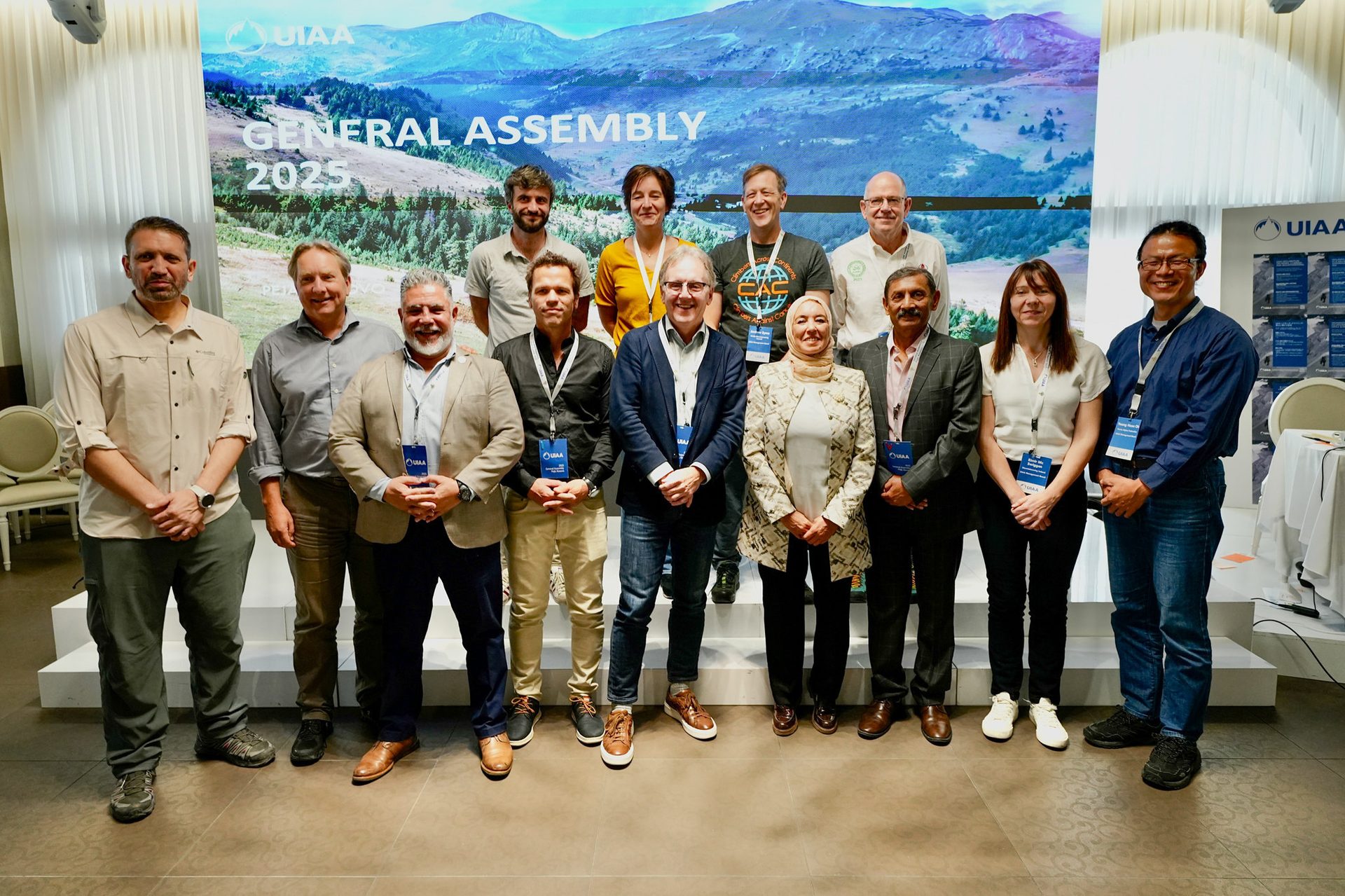
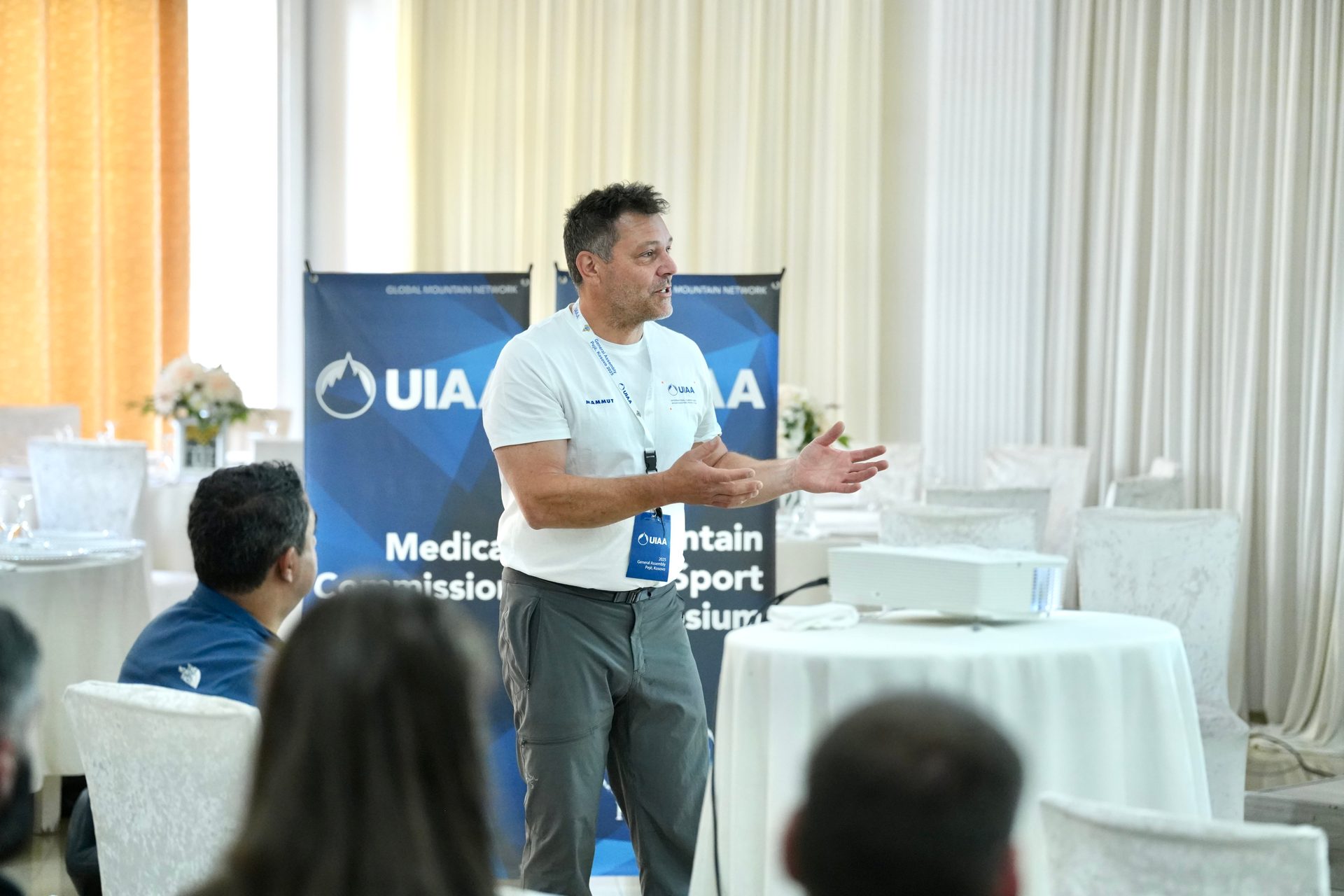
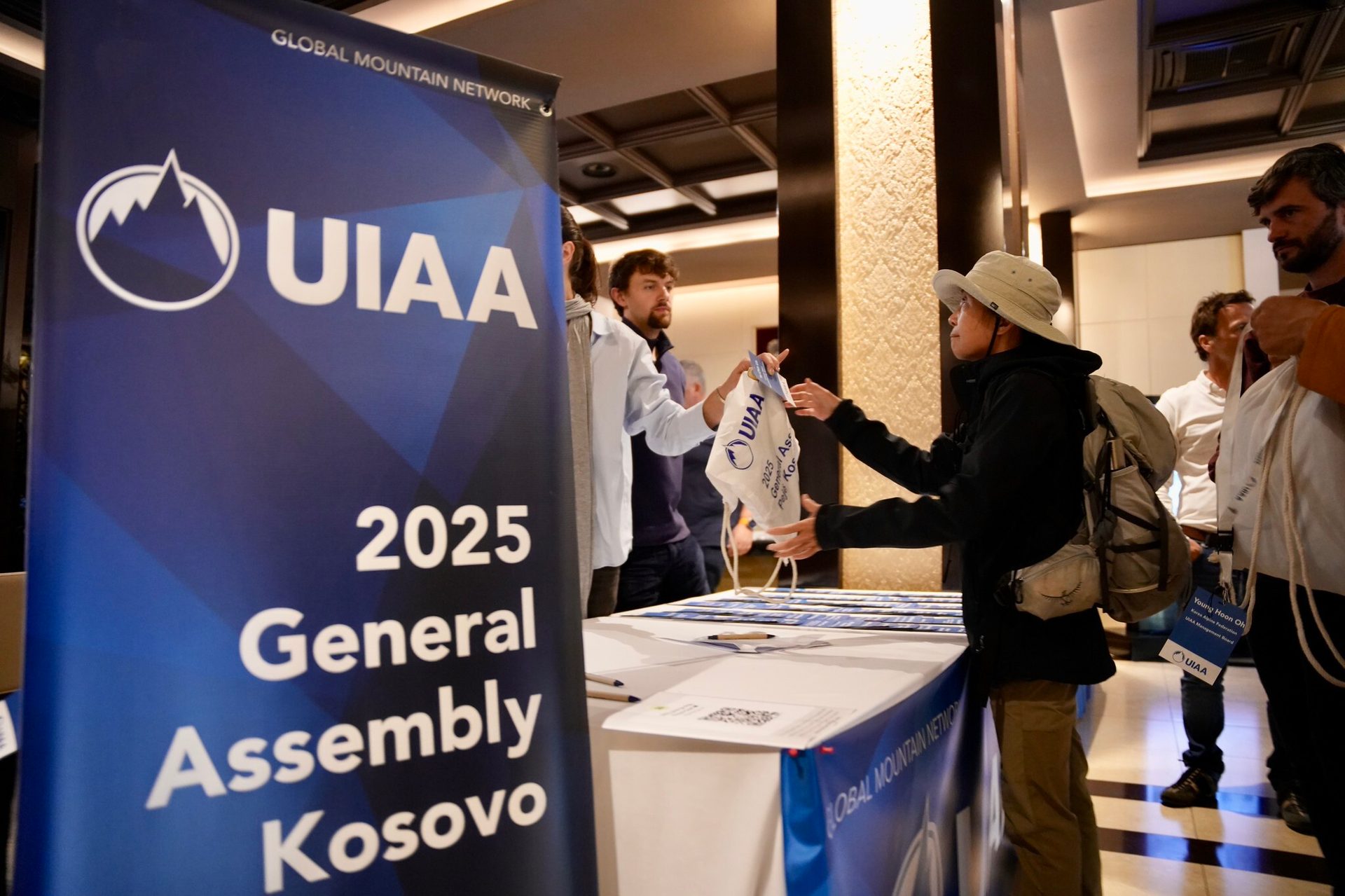
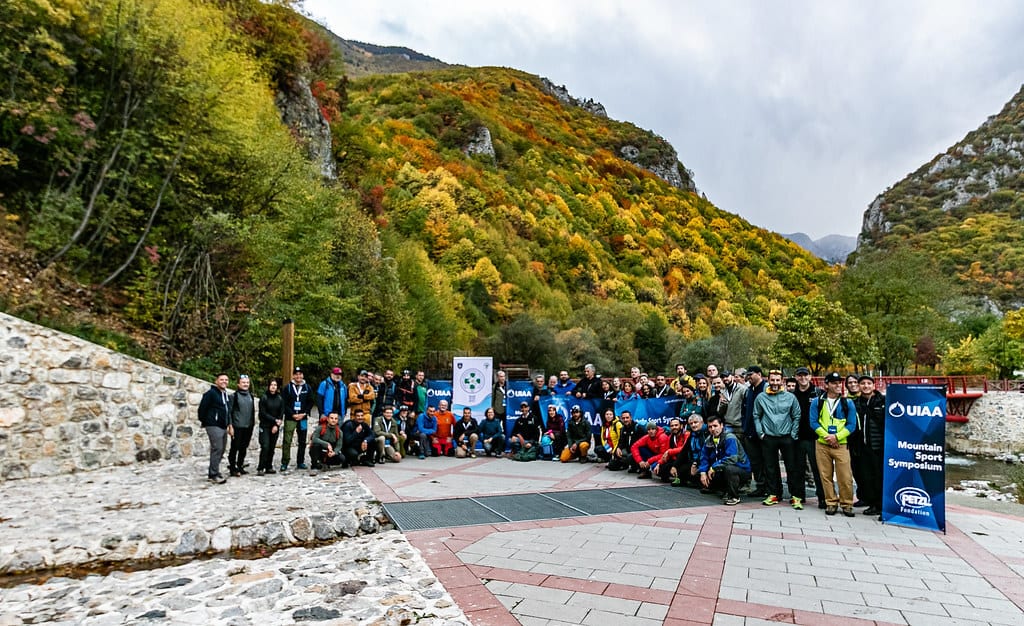
The 2025 UIAA General Assembly took place in Peja, Kosovo from 24-26 October and was hosted by the Kosovo Mountaineering and Sport Climbing Federation. Kosovo became the 35th country to host a UIAA GA. Annexed to the GA programme was the second edition of the UIAA Mountain Sports Symposium.

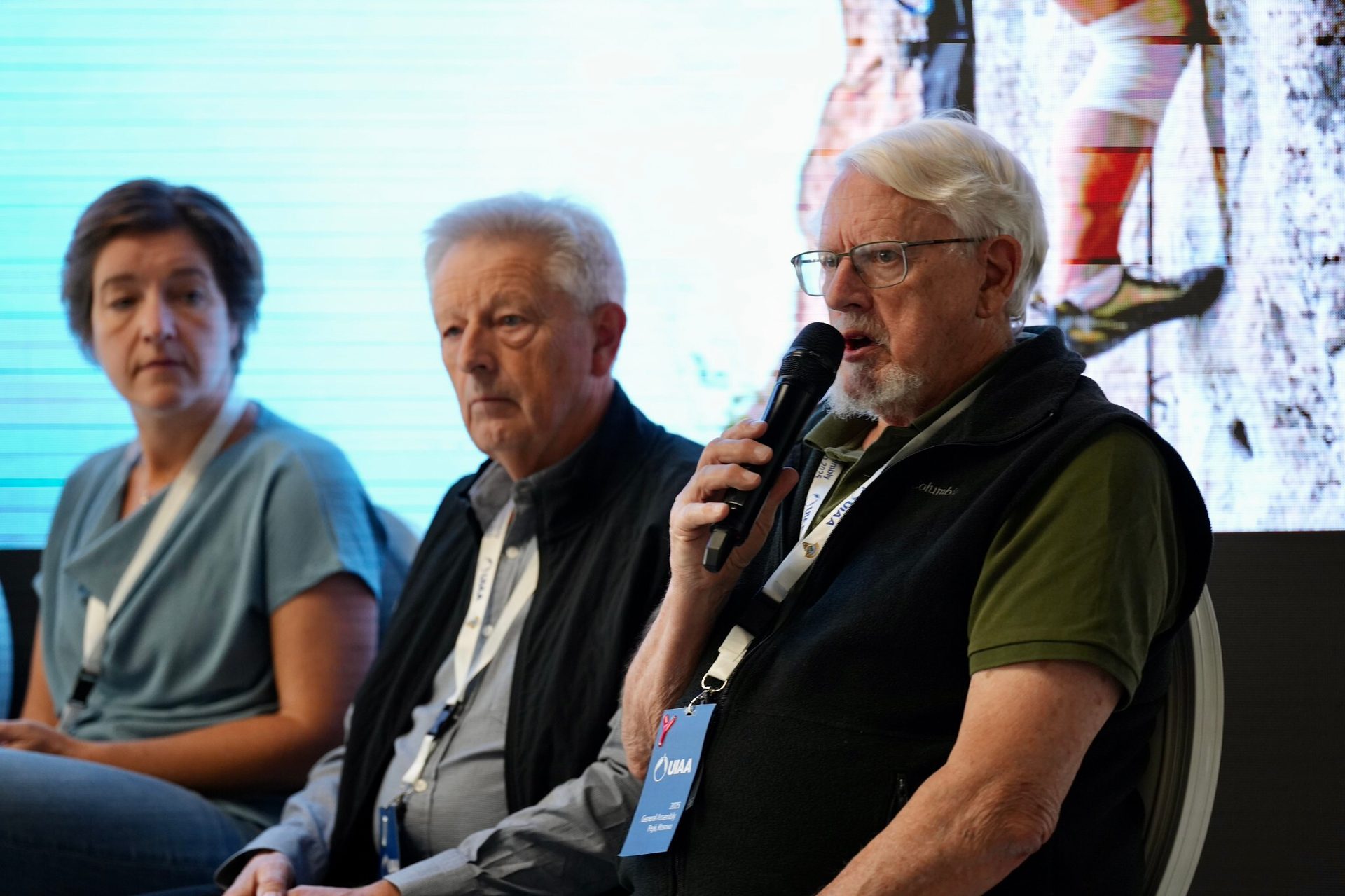
Over 90 delegates representing 54 member associations attended the GA. The GA programme, as has become tradition, included a Climate Change Summit and panel discussions dedicated to the UIAA Strategic Priorities, the role of innovations and ethics, and the development of climbing and mountaineering in emerging federations.

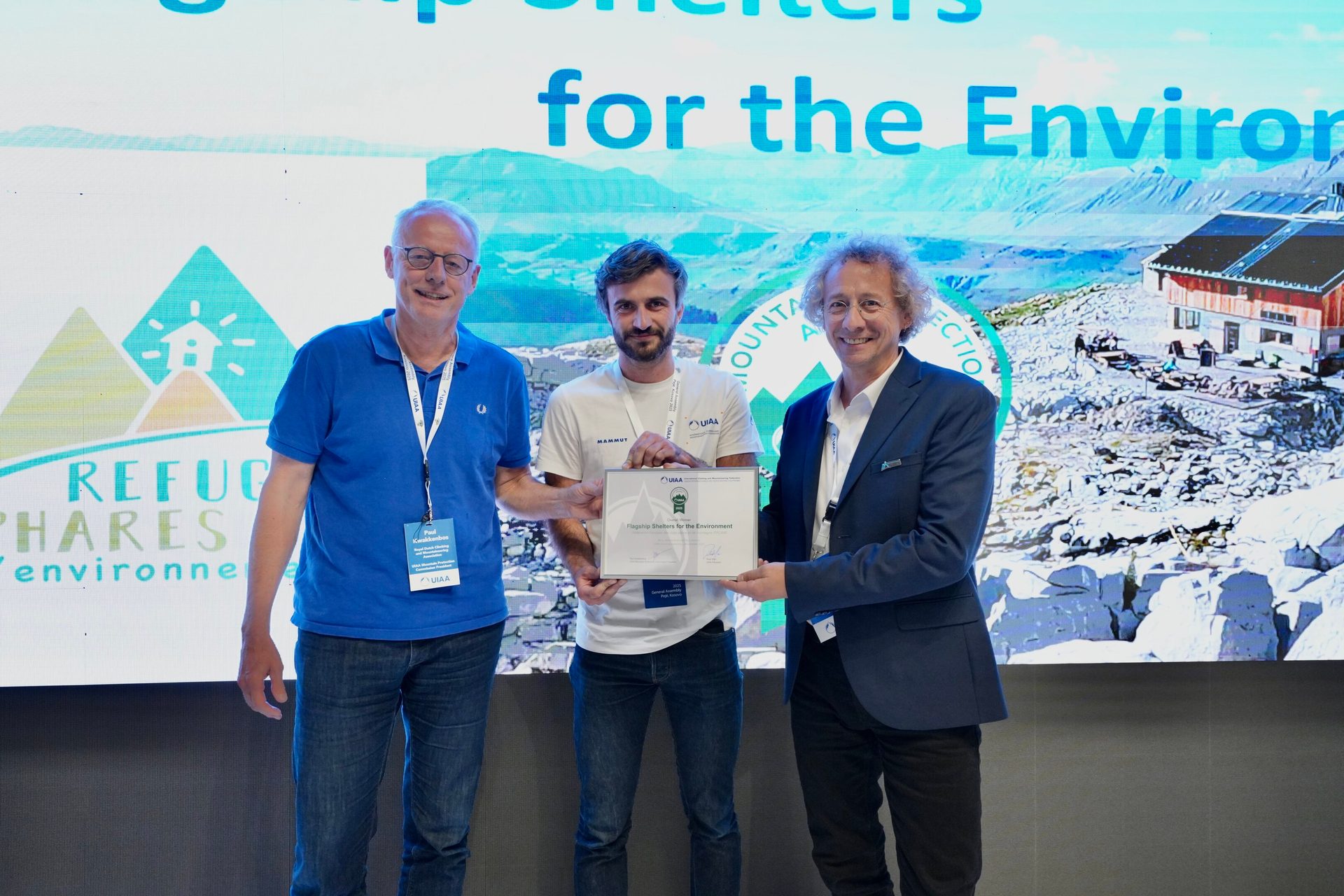
During the GA, the two main prizes awarded as part of the 2025 UIAA Mountain Protection Award, partnered by Lenovo and Altezza Travel, were granted. Flagship Shelters for the Environment from UIAA member association FFCAM (Fédération française des clubs alpins et de montagne) was confirmed as the overall winner and Walking the Tra Tra by fellow UIAA active/full member Mountain Club of South Africa (MCSA) as the Best New Initiative.  The official prizegiving for the 2025-26 Mountain Protection Award will take place at the Alpine Museum in Bern, Switzerland held on 23-24 October, 2026 and jointly to the ceremony of the Albert Mountain Awards.

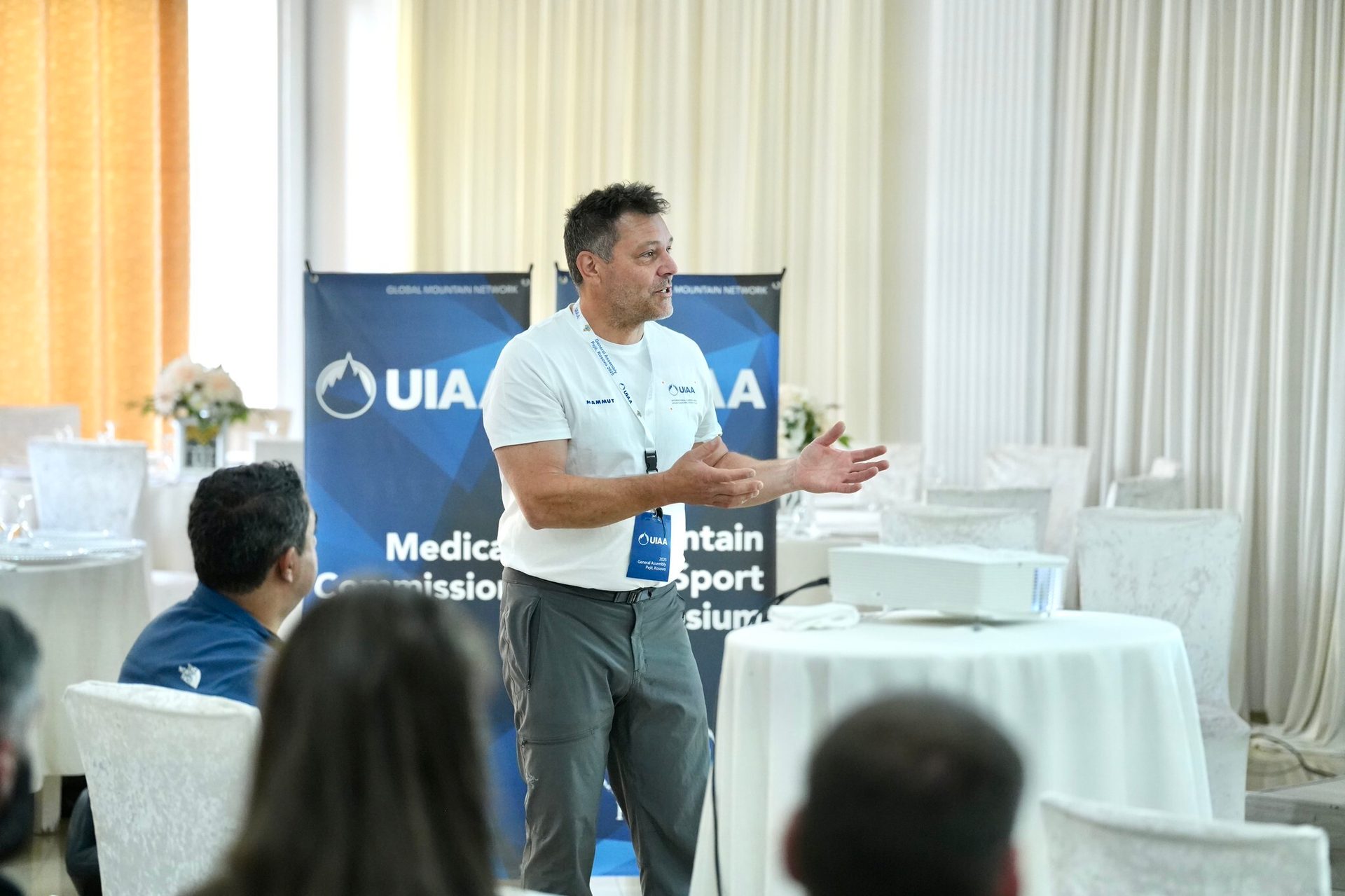
In addition to the GA, the autumn UIAA Management Board meeting was held as well as meetings for the Mountaineering, Safety and Medical Commissions as well as for the World Ice Climbing Board. The Mountain Sports Symposium, a two-day course focused on topics related to mountain medicine, safety and training with a particular focus on the Balkan region attracted over 60 attendees. A full review of this event is available in Part 2.

Future UIAA General Assemblies

Next year’s GA will be held in Kathmandu, Nepal, from 29-31 October. The Nepal Mountaineering Association (NMA) will be the hosts. The 2027 UIAA GA will visit Santiago, Chile and be hosted by FEACH. Dates are to be confirmed.

Part 1: Executive Review - General Assembly

Communication

The Communication team is responsible for the federation’s external communications, the UIAA’s digital platforms, social media, and supporting UIAA commissions, working groups and member federations with all communication-related needs. It is also the main contact point for media requests.

In numbers:

The calendar year 2025 witnessed impressive growth across a number of communication platforms.

Episodes of Mountain Voices podcast

Views on YouTube

(-3.2 million from 2024)

Website news stories

Audience growth on Instagram

Posts on Instagram

Total views on Instagram

Total views on Facebook (+2.7 million from 2024)

Number of countries Mountain Voices podcast has been downloaded

Website page views

1
1
1
1
1
1%
1
1
1

Part 1: Executive Review - Communication

Top performing content:

Media coverage

The UIAA continues to proactively work with international media titles - both providing material related to topical climbing and mountaineering issues and responding to queries.

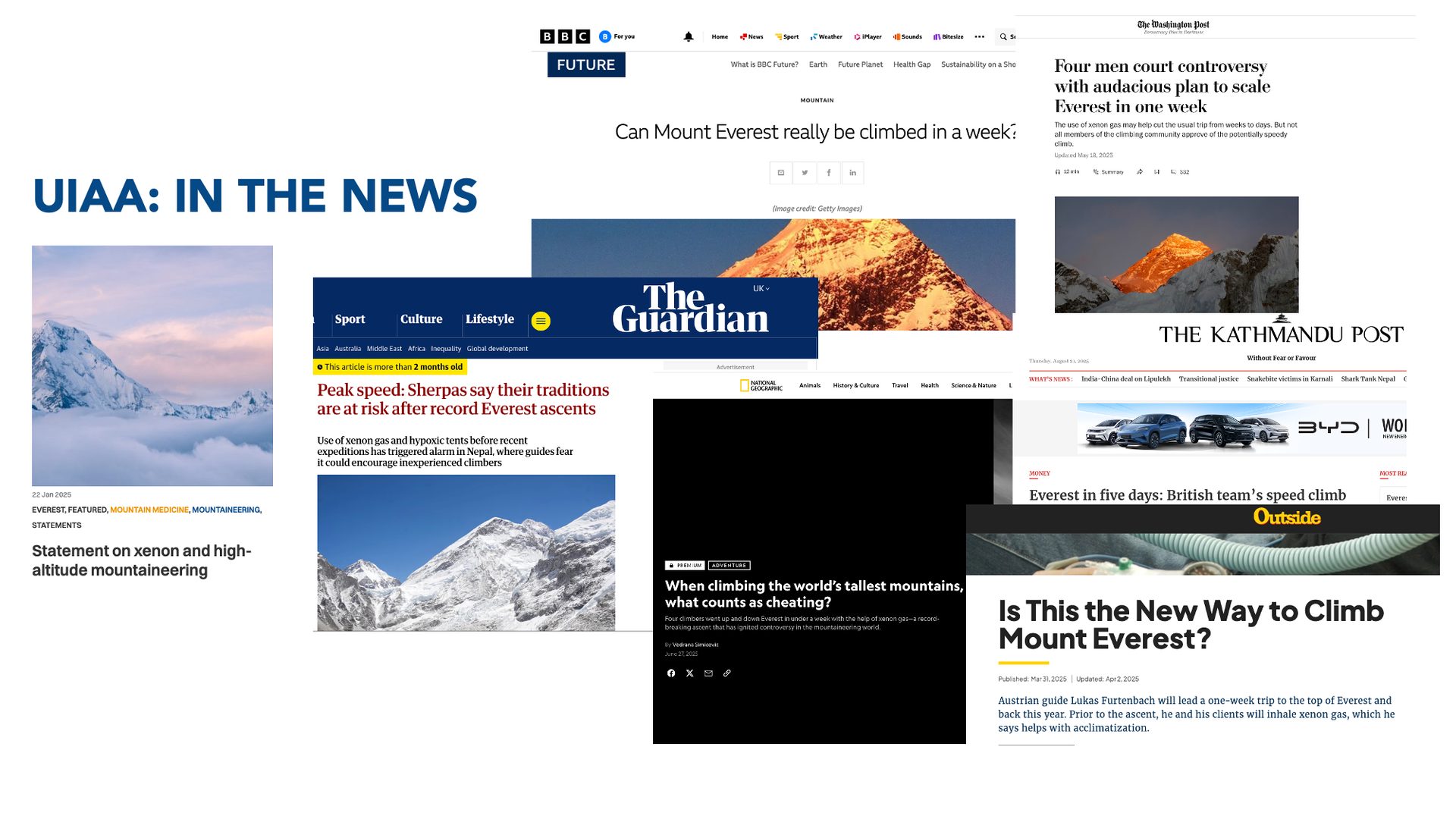
One example in 2025 of a UIAA communication which performed significantly across the global media was the UIAA statement on the use of Xenon gas in high-altitude mountaineering. Below is a spread of international media coverage:

Traffic to the UIAA website remains consistent with previous years. The website itself saw very few upgrades across the year 2025 owing to the hard work and resources spent in 2023 and 2024. Some more significant projects are forecast for 2026 given then developments in certain projects such as rock climbing, training and youth. There are also plans for a fully coded world map.
UIAA Website
Following its launch in 2024, the Mountain Voices podcast return with Season 2 in 2025. Again six episodes were released. These covered a range of topics including bolting, glaciers, mountain huts as well as an exclusive interview with Kilian Jornet.

Following an extensive creative session and analysis of the first two seasons, the format of the podcast will change for 2026 with an increase in episodes (ten) and a greater focus on one-to-one interviews with leading climbers and mountaineers.

This is also partly in response to the 2025 Communication survey (see below) and a desire to ensure the podcast is a more regular part of the UIAA communication offering allowing more time to nurture an audience.
Mountain Voices podcast
The UIAA's social media strategy more closely aligned with the communication plan and with a more consistent and measured approach to social media content. Instagram was a particular success with a 30% audience growth and impressive figures registered for safety-related content. Plans in 2026 are to expand the UIAA's social media offering with more focused campaigns, greater video content as well as exploring WhatsApp and TikTok channels.
At the close of the year, the UIAA Communication team produced a survey which was made open to delegates, member federations as well as followers on social media. The response was impressive and really useful. In general, all of the UIAA's communication tools received at least a 7.5/10 mark with feedback more related to refinement of certain areas. The UIAA Communication team thanks everyone who contributed.
The UIAA releases a monthly newsletter dedicated to its latest news and services as well as a global newsletter released quarterly covering news from its member associations.
Subscribe to the UIAA newsletter here
From April-June 2025, the UIAA shared a digital toolkit with all member associations. This included a package of assets such as UIAA logos, affiliation texts for members to share on their websites and information related to member benefits. This package will be shared on an annual basis and with all newly onboarded member associations.
Download the latest UIAA logos and view other branding assets
Significant work and resources went into producing the 2024 Annual Report most notably the new platform. The Annual Report was well received with over 75% of those surveyed preferring the format to the previous PDF version. Some refinements have been made this year and the work produced in 2025 has made the process of producing this year's Annual Report a lot simpler.
View a full archive of UIAA Annual Reports
One of the main focuses of the 2026 communication plan is for the UIAA to produce more of its own video content. Over recent years, videos have been produced to mark certain events such as Commission meetings, General Assembly reviews and safety-related courses. However, there is a desire for the UIAA to produce more advice-related material, inspired by the impressive numbers gathered on social media for extracts from the Alpine Handbook and other safety topics. In 2026, some additional budget has been made available to produce more video with a focus on leveraging the UIAA Safety Commission activities in Kalymnos in May and the UIAA Medical Commission meetings in the UK later that same month.

How to follow the UIAA:

Report by

Peter Bourne, UIAA Communication Manager

Tom Tushaw, UIAA Social Media Manager

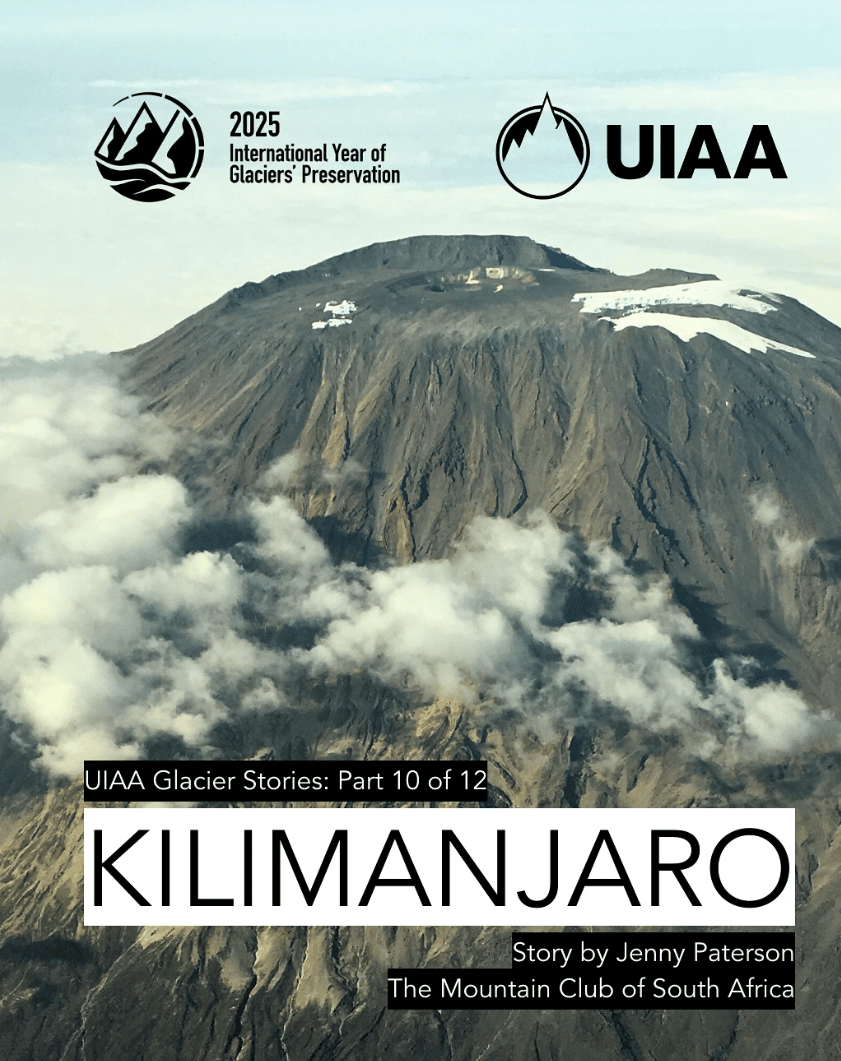
An evocative eleven-part series that brought glaciers - and their urgent climate stories - into global focus. The campaign ran exclusively on the UIAA's Facebook and Instagram channels. A selection of same posts are available to view on the right.

A wrap-up review article provided a summary of the stories and key messages. The series spanned five continents, uniting the voices of scientists, geographers, photographers, artists, mountain guides, climbers and mountaineers, in a sweeping portrait of glaciers as symbols of both fragility and resilience.

Each contributor offered a deeply personal and place-based perspective and what the loss of glaciers means for communities, ecosystems, economies, cultures and indeed climbing and mountaineering as activities.

In parallel, the UIAA produced a dedicated Mountain Voices podcast episode titled Glaciers: What Future? which was released on 21 March, the newly dedicated World Day for Glaciers. The episode featured contributions from a number of experts who also provided stories for the UIAA's glacier campaign.

Other Glacier-related stories

The UIAA also communicated on other glacier-related initiatives including those from member associations and partners.

Mountain Voices: Gripping essays from mountaineers, artists and mountain researchers

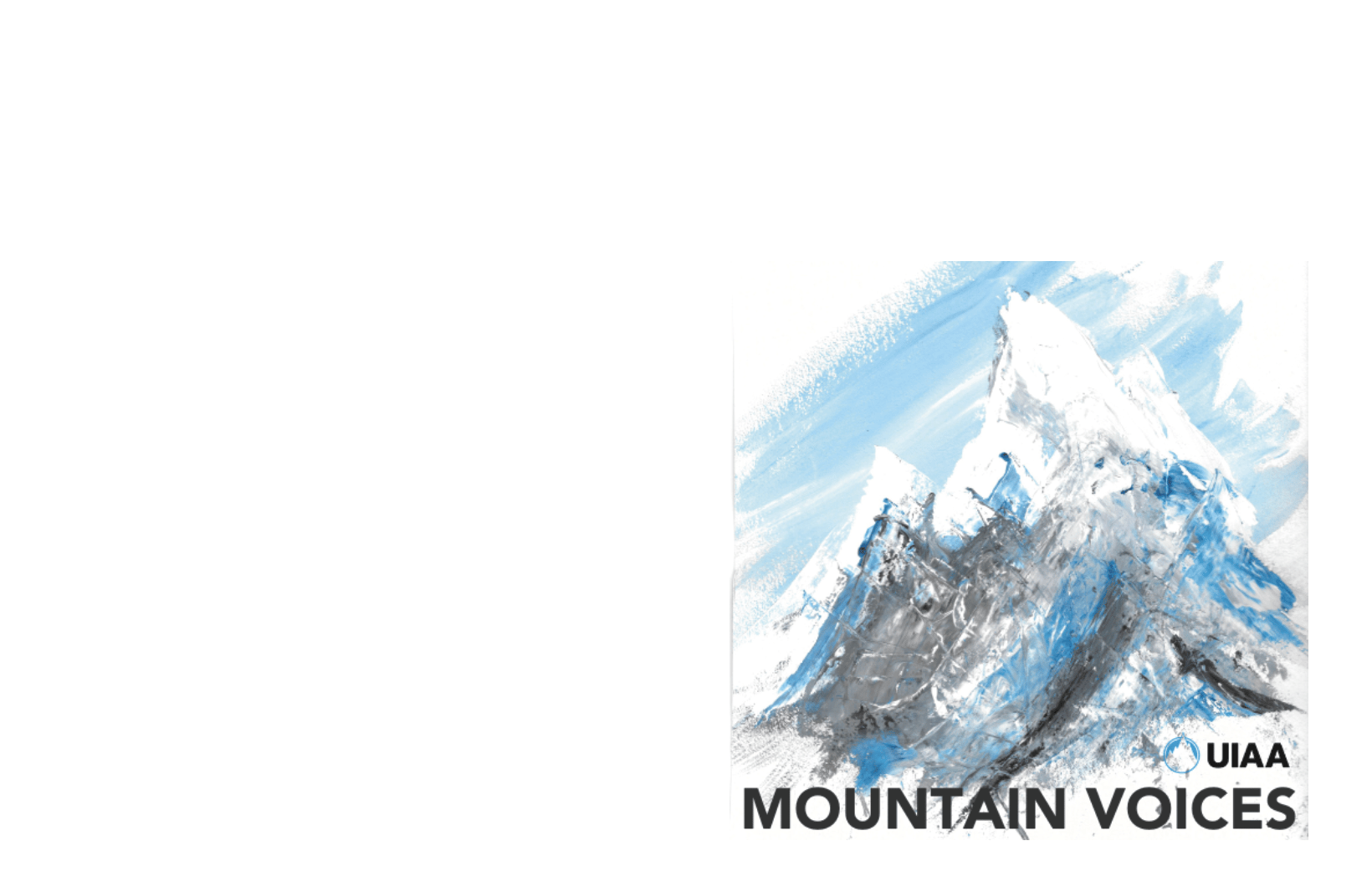
In a newly published book Mountain Voices, alpinists, activists, artists, and mountain researchers (including individuals working closely with the UIAA) share the ways Canadian mountains have impacted their lives. Each contributor brings a unique and fascinating perspective to the mountain landscape with short essays accompanied by a pair of photographs from the remarkable archive of the Mountain Legacy Project, illustrating the history, geography, and lasting inspiration of the mountains.

Mountain Voices draws on the vast bank of historic and repeat photographs produced by the Mountain Legacy Project, the world's largest systematic and comprehensive collection of mountain photographs, spanning more than a century. From fragile glass plate negatives to modern, high-resolution photography, these images document a mountain landscape during times of drastic change.

Read the full story, and buy the book, here.

Glacier preservation is the focus of the 2025 State of the Mountains Report

UIAA member association, Alpine Club of Canada (ACC), recently published its annual State of the Mountains Report for 2025. This latest edition pays hommage to 2025 as the International Year of Glaciers' Preservation and includes essays by contributors who have spent countless hours researching the alpine environment, offering their firsthand experiences, expertise and photographs to tell the stories of how change in Canadian mountain environments is affecting people and ecosystems.

Read the full story.

The calendar year was marked by a number of initiatives related to glacier awareness. On 21 March, the inaugural World Glacier Day was observed and on 11 December, International Mountain Day, the theme was "Glaciers matter for water, food and livelihoods in mountains and beyond". The UlAA produced, and collated, a number of assets related to the International Year of Glaciers' Preservation including:

UIAA supports UN International Year of Glaciers' Preservation 2025 and inaugural World Glacier Day

Glaciers

Part 2: Featured Stories - Glaciers

Advert - Namah Ropes (UIAA Supporting Partner)

2025 Mountain Protection Award:

Flagship Shelters for the Environment by UIAA member association Fédération française des clubs alpins et de montagne (FFCAM) was announced as the winner of the 11th edition of the UIAA Mountain Protection Award (MPA) at the UIAA General Assembly (GA) in Peja.

It is the second time a French project has won the Award following Mountain Wilderness France in 2016. The Best New Initiative was awarded to Walking the Tra Tra by Mountain Club of South Africa.

A total of 20 international projects operational on five continents and in 19 countries were showcased as part of 2025 MPA nominee list.

While the two prize winners were confirmed at the General Assembly, the official award ceremony will take place in 2026, specifically at the Alpine Museum in Bern, Switzerland held 23-24 October and jointly to the ceremony of the King Albert I Foundation's Mountain Awards.

As of 2025, the MPA functions on a two-year cycle with one year being an adjudication and award year; with the alternate year having a focus on community building and associated knowledge sharing. The MPA Award is sponsored by presenting partner Lenovo and Altezza Travel as supporting partner.

Return of the MPA, winners announced

Part 2: Featured Stories - MPA 2025

Discover more about the 2025 UIAA Mountain Protection Award winner

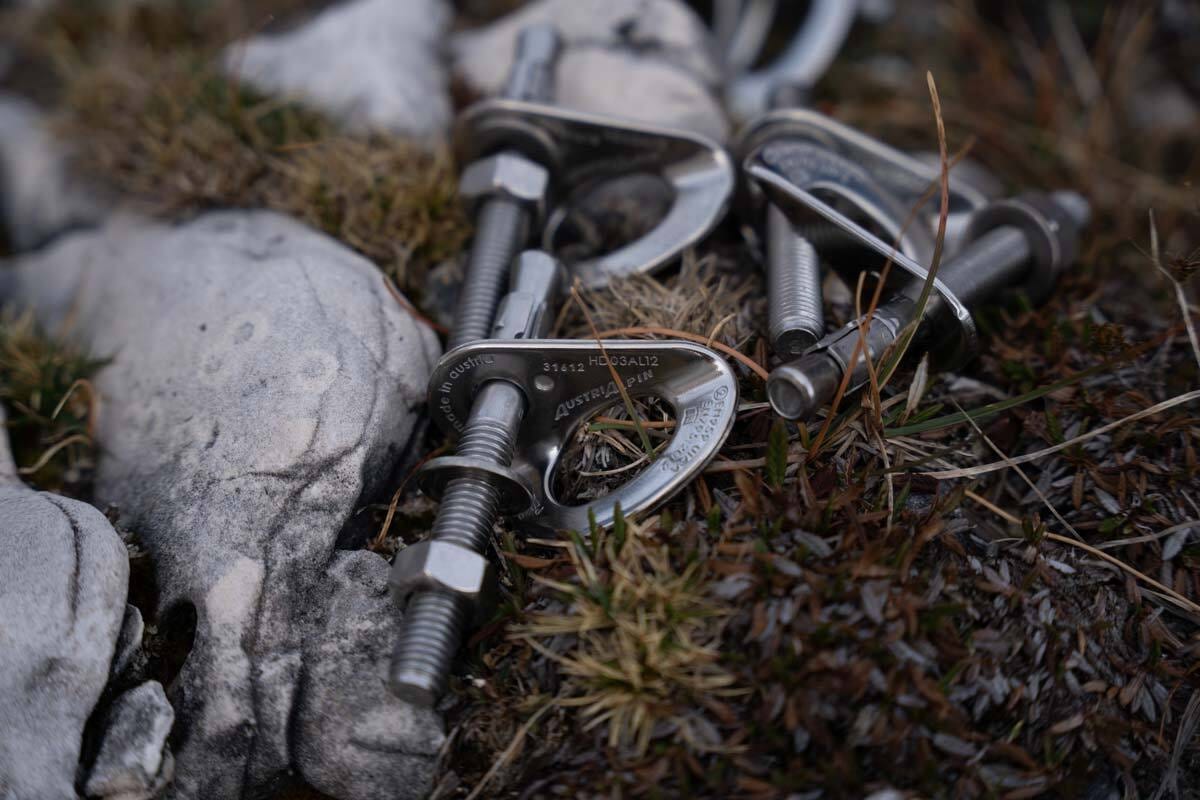
In recent years, the UIAA has dedicated significant investment, some 200,000 euros and counting, and resources to research related to rock anchors and bolts. Initially, this centred around the subject of corrosion and stress corrosion cracking failure. A significant milestone was reached when the updated UIAA Rock Anchors Standard was released in 2020. However, work in this field remains significant. While new products – certified to Standard 123 – are now available on the market, the challenge is ensuring both bolters and climbers are aware of the issues related to corrosion and the importance of using certified products.

Essential work in climber safety

Rock Anchors & Bolts

Part 2: Achievements - Rock Anchors & Bolts

Rock-climbing equipment

Map of failed rock anchors

Support SafeCom with its analysis and help add more areas to the global map linked above and thereby improve the information available to climbers about dangerous or potentially dangerous areas to climb.

Report failed rock anchors here.

Map, Orange

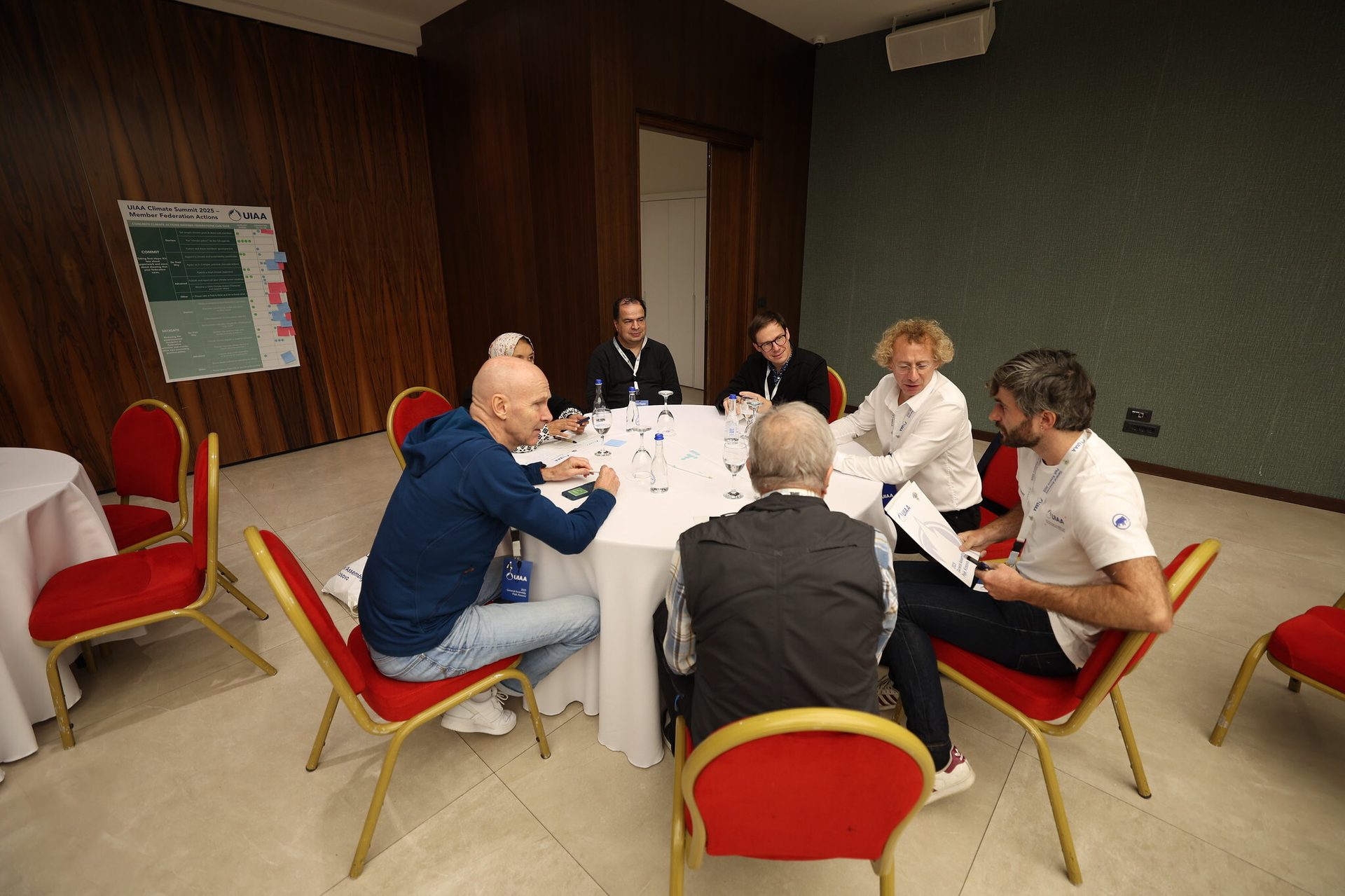
The UIAA Climate Change Summit (CCS) 2025, held alongside the General Assembly (GA) in Peja, Kosovo, represented the latest step in the federation's long-term effort to turn climate ambition into climate action. Starting in Banff in 2022, this was the fourth edition of the CCS, again incorporated within the programme of a GA.

As a logical step following the earlier Summits, the 2025 programme shifted its principal focus from awareness-raising toward supporting and promoting practical, member-driven commitments. From a generic but abstract framework for climate action to genuine, concrete actions, each tailored to the capacity and context of individual member associations.

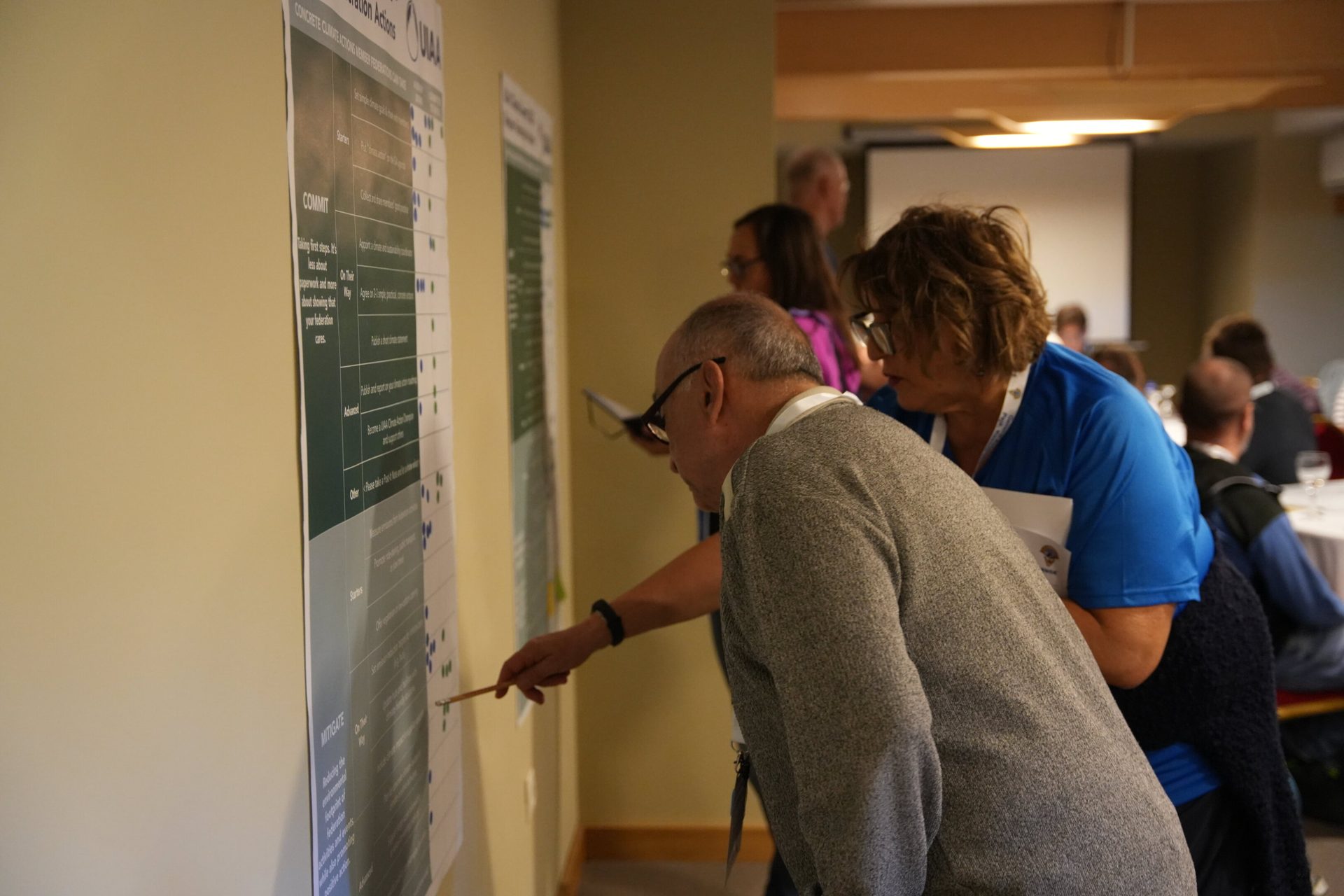
Just as in 2024, the 2025 Summit took place under the slogan "UIAA Climate Action: commit, move, together, now!", a nod to the central message that the UIAA and its member federations must take collective steps, however small, but consistently and in a coordinated manner. The Climate Change & Sustainability Action List, presented in a poster format, discussed and enriched by the Summits' participants, now outlines realistic options for member federations at different stages of their climate journey whether beginner, on-the-way, and advanced. It focused on the UlAA's four pillars: Commit, Mitigate, Adapt and Advocate/ Educate.

Turning climate ambition into climate action: report on the 2025 UIAA Climate

Change Summit

Overview of Climate Change Summit 2025

Supporting Federations towards concrete action

Climate Change Summit

The Summit opened with presentations of three flagship federation projects (from France, South Africa and Argentina) that embody the aforementioned pillars, each demonstrating how federations can turn the climate principles promoted by the UIAA into applied practice. Paul Kwakkenbos, President of the Mountain Protection Commission, recapped the UIAA commitment to the Sports for Climate Action 2050 goals, progress related to the UIAA's internal Climate Action Plan and introduced the Commitment Statement for Member Federations, a mechanism through which the UIAA wishes to translate collective agreement into measurable progress, using more structured frameworks and clearer expectations.

This year for the first time, a workflow has been created for collecting concrete federation commitments between December 2025 and September 2026. This workflow involves distributing a clarified list of possible climate actions, asking federations to choose at least three before the end of March 2026, and sharing back the results at the 2026 General Assembly.

This process shows a marked progression from past Summits: the CCS is no longer merely a discussion forum but has become a structured tool for supporting, gathering, and celebrating meaningful climate actions.

A core aim of the CCS is to help federations feel encouraged and not pressured to take action. Throughout the design of the Summit and its follow up process, the UlAA adopts an incremental approach: federations are invited to choose only what fits their context, but they are also asked to choose something, and to repeat their efforts consistently over time. The actions are presented as options, not mandatory requirements, and should reflect each federation's resources, constraints, and ambitions.

The breakout sessions embodied this approach. Each participant was invited to mark the Climate Change & Sustainability Action List poster indicating the stage their federation was at across certain themes of 'Commit, Mitigate, Adapt, and Advocate/Educate'. Designated breakout session experts then led discussions on feasibility, clarity, and interpretation of some of these topics. This process was intentionally designed to create a dialogue and allow the UIAA to refine the Action List based on feedback.

Part 2: Featured Stories - Climate Change Summit

Click This Card

Results:

What federations are doing already

The results of the workshop, compiled after the meeting, show that many member organisations already undertake meaningful climate-aligned activities. The top five

"Already Doing" actions were:

  • Promoting ride-sharing, public transport, or slow travel (10%)
  • Promoting "leave no trace" and trail clean-ups (9%)
  • Updating huts with climate-friendly solutions (7%)
  • Setting simple climate goals and sharing with members (5%)
  • Collecting and sharing members' good practice (5%)
    Also tied: ecosystem restoration and participation in national clean-up days (5% each).

These results reflect a healthy diversity although also show much progress is still required. Some federations prioritise mobility mitigation, others focus on 'on-the-ground' environmental care, while others choose to focus firstly on communication and member engagement. Together, they underscore that the global mountaineering community is already mobilising climate awareness in practical ways.

Click This Card

Results:

What federations are ready to commit to

The top five "Committed to Do" actions illustrate a similar pattern of steady ambition:

  • Planning for climate-neutral or climate-positive federation activities (10%)
  • Publishing and reporting on a climate action roadmap (7%)
  • Setting simple climate goals and sharing them with members (6%)
  • Agreeing on 2-3 practical actions for the coming years) (6%)
  • Creating youth programmes connecting mountaineering skills with climate education (5%)

These results signal that federations are willing to take structured and transparent steps as well as a commitment to to engage younger generations as partners and leaders.

Click This Card

This is a clickable card. With the help of variants and interactions, you can click this card to reveal more information on the backside.

Congrats! You just clicked this card. Here you could add some additional information, images, CTA and more!

Ideas from participants

UIAA Carbon Footprint Reports & Public Commitments

Conclusion

Participants also proposed numerous additional ideas, especially in the Adapt pillar, including:

  • Climate-related accident statistics and case studies,
  • Rockfall and climate-risk awareness measures,
  • Digital tools for seasonal and hazard-based trail color-coding,
  • Cooperation with state agencies and NGOs for waste collection, and
  • Volunteer efforts to repair damaged access paths.
  • One federation proposed that the UIAA formally join World Clean Up Day.

The UIAA recently released its 2024 Carbon Footprint Report, its seventh in total, and first issued under a new biennial reporting cycle. This update, positioned between the full calculations for the years 2023 and 2025 (to come), reflects a strategic shift towards a lighter methodology and more focused monitoring of the federation's highest-impact activities.

The UIAA's Carbon Footprint Reports and its publicly declared emission-reduction commitments form the backbone of the federation's climate efforts. Although these reports were not the central topic of the CCS, they were referenced in the introductory speeches and in the explanation of the Commitment Statement.

The 2025 Climate Change Summit demonstrated that the world's climbing and mountaineering federations are ready to move from general endorsement of climate responsibility toward concrete, measurable actions. The Summit did not push federations with rigid demands rather it cultivated a space where federations could discover their own realistic commitments, exchange experiences, and contribute to a shared Action List that genuinely reflects both global ambition and local context.

The Summit also introduced a clear, year-long workflow that will carry these commitments to the 2026 General Assembly in Kathmandu, Nepal, deepening accountability while preserving autonomy. The objective of the Summit, "UIAA Climate Action: commit, move, together, now!", was successfully met.

The subject of reporting made for an interesting debate. Some member federations are less enthusiastic about carbon accounting; others consider CO2 metrics politically sensitive or not directly relevant to their priorities. The Action List and the Summit structure explicitly acknowledge this diversity. They offer different entry points, some carbon-focused, others focused on waste, adaptation, education, or biodiversity, so that all federations can contribute meaningfully without feeling forced into actions they find uncomfortable or unrealistic.

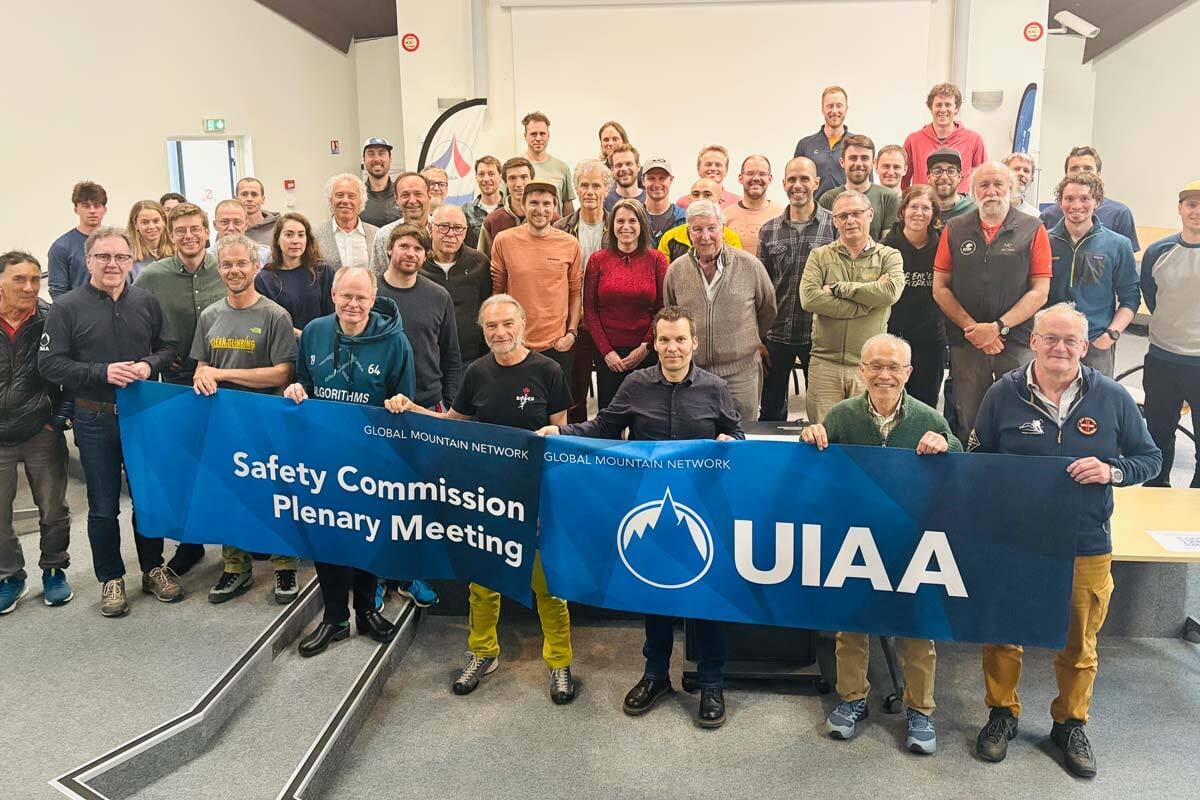
In mid-April, the UIAA Safety Commission gathered for its main annual meetings in Chamonix, France.

A diverse programme of activities were held including internal UIAA Safety Commission meetings, plenary meetings involving UIAA Safety Label holding manufacturers and independent accredited laboratories, working group meetings dedicated to specific topics as well as a Bolting workshop and two insightful public conferences.

Furthermore, the UIAA Safety Commission celebrates its 50th anniversary this year. In reality, the UIAA has developed safety standards since the early 1960s, and been engaged in safety topics since the 1930s, but 1975 marked the merging of the Ropes and Belaying Methods Commissions and creation of what today is commonly referred to as 'SafeCom',

Nearly 100 delegates attended the various meetings including UIAA President Peter Muir, UIAA General Secretary and former SafeCom President Amit Chowdhury, UIAA CEO Andre Von Rotz, 14 members of the UIAA Safety Commission (as well as ten joining online), over 30 delegates from equipment manufacturers, representatives from accredited laboratories as well as honorary and former members of the UIAA Safety Commission, experts from UIAA member associations (FFCAM, France; SAC,

Switzerland), environmental specialists and bolters from across France, Italy and Switzerland; rebolting organisations; and personnel from two UIAA Observer Members - International Slackline Association (ISA) and International Commission for Alpine Rescue (ICAR).

In addition to delivering new standards, making progress in the research and development of others, the meetings provided important opportunities for stakeholders to discuss current trends, innovations and issues in the industry.

SafeCom at 50

Part 2: Featured Stories - SafeCom at 50

This marks the culmination of extensive work, establishing criteria for static strength, elongation limits, and compatibility requirements with descending devices. The key components of the new UIAA 110 static rope standard are developed to address specific needs in glacier crossings, rescue operations, speleology and canyoning -contexts where low elongation is critical. The standard introduces new mechanical tests, including static strength with and without knots, elongation limits (max 2.5%), and compatibility requirements with rappelling devices. This compatibility requirement represents a notable safety enhancement by mandating that manufacturers specify at least one compatible device for safe use.
A UIAA standard for Via Ferrata construction (UIAA 171) was approved. This standard will expand on existing guidance by formalising load calculations, construction specifications, and mandatory equipment certification. The standard aims to serve as a reference worldwide, particularly outside the EU.

Revisions to the following existing Standards were approved: UIAA 101 (Dynamic Ropes), UIAA 106 (Helmets), UIAA 123 (Rock Anchors), UIAA 130 (Load Sharing Devices), UIAA 152 (Ice Tools).
Updates include clearer definitions of manufacturers and sub-suppliers for raw material, mandatory ISO 9001 certification, and enhanced quality control requirements, including welding process oversight. These updates aim to align with international norms and ensure greater traceability and material compliance, without excluding small high-quality manufacturers.
One of the cornerstones of the revised Standard is an improvement in the protection from impact 'off-crown' on the front, back and side. It has been tested at an angle of 10° from horizontal instead of 30° previously.

Updates to UIAA Standards

Highlights of the week including the following updates to Safety Standards:

New UIAA Laboratory

The UIAA approved the accreditation of a new safety standards testing laboratory and its first in North America. The ACT Lab in will begin testing standards soon. The UIAA now has accredited laboratories in Asia, Europe and North America.

Full details about all testing labs can be found from the link on the right.

Other topics discusses during the plenary session

Among the other topics discussed during the plenary session were:

Mountain accidents in Japan

This presentation, based on Japanese accident data, showed a noteworthy trend: a concentration of accidents among climbers aged 40-80, following an almost normal distribution curve. This finding opens avenues for targeted safety messaging and training programmes based on age-specific risk exposure. A dedicated article will be published on the UIAA website in due course.

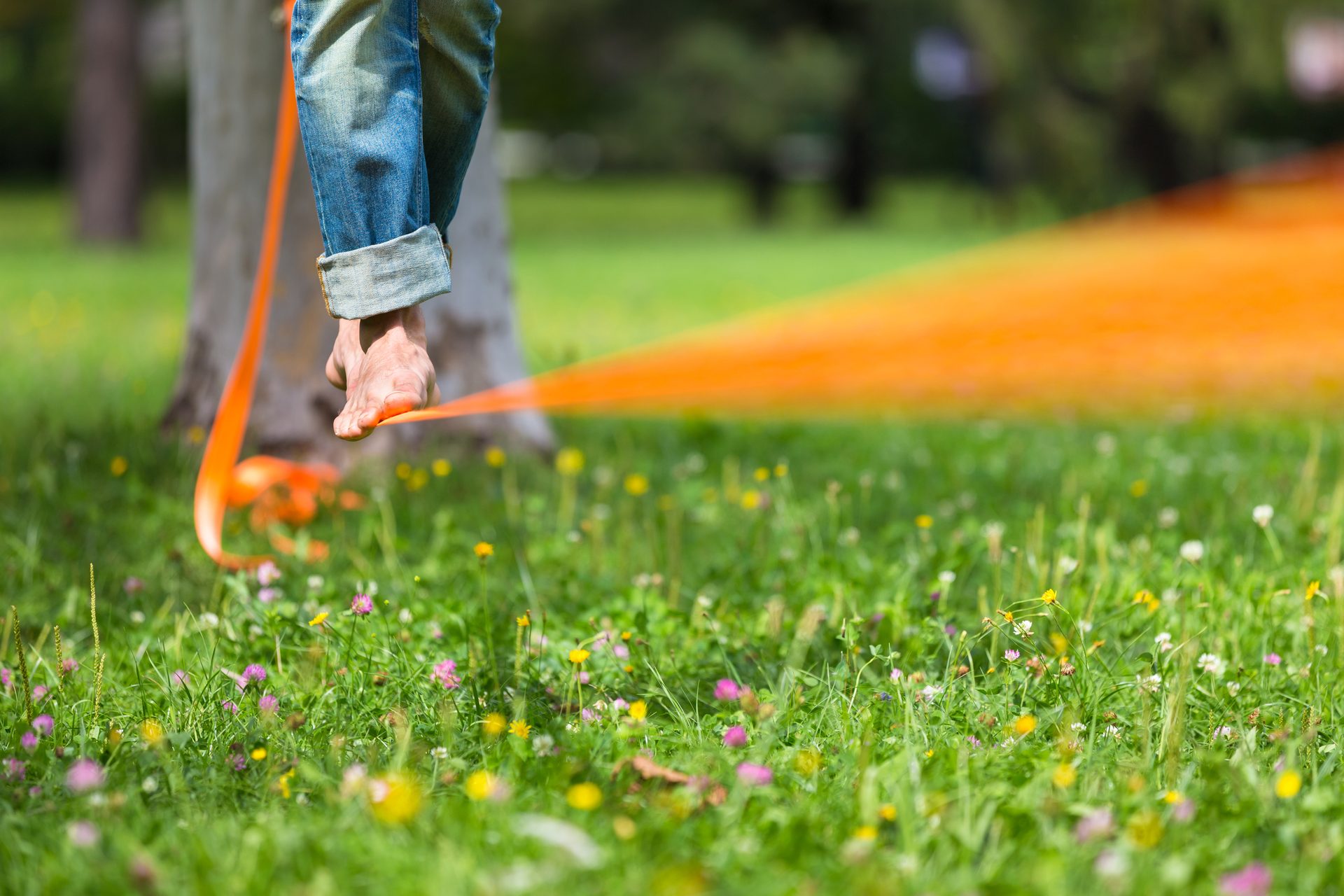
Webbing Degradation: UV Study by ISA

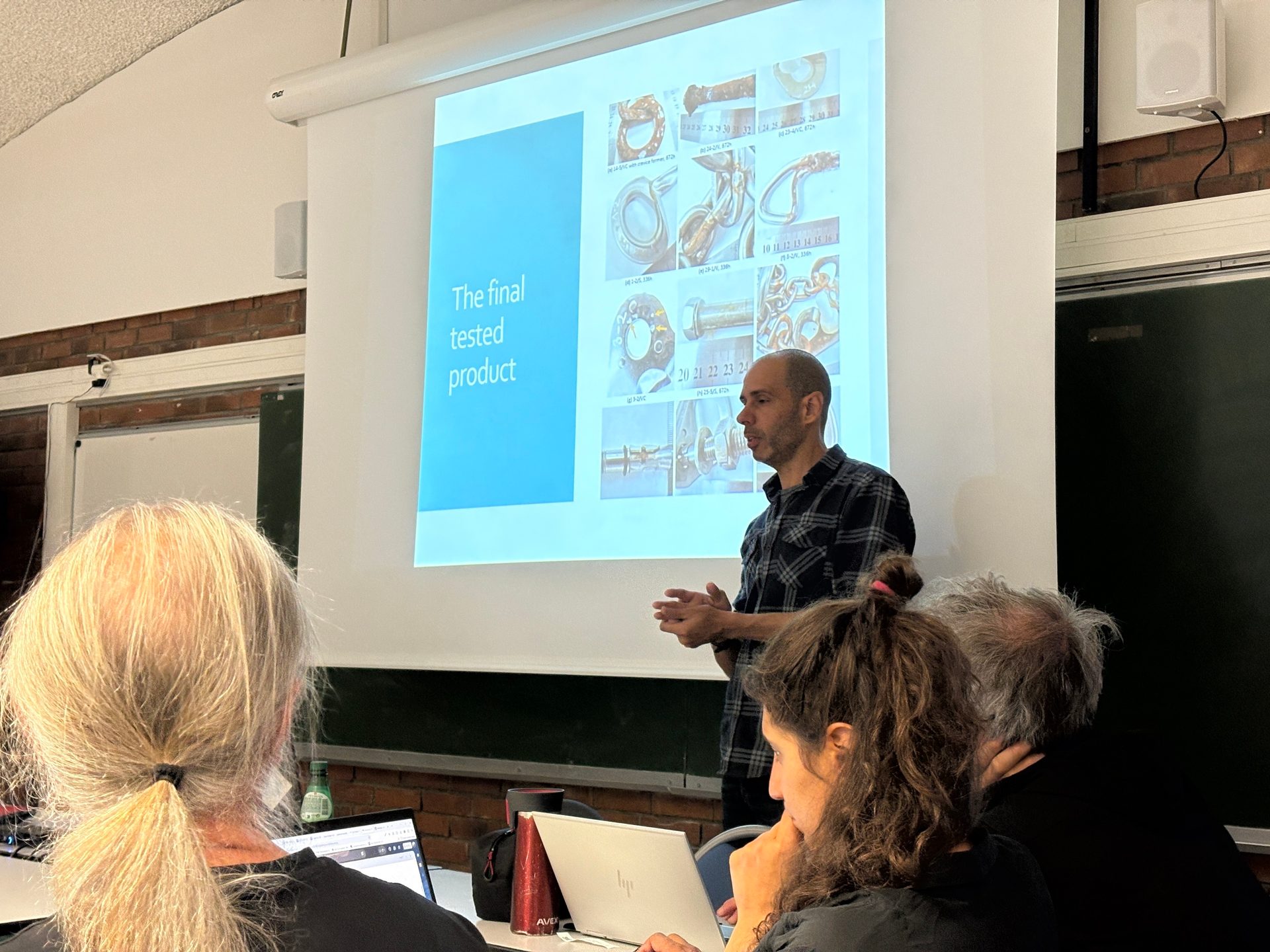
Representatives from the International Slackline Association (ISA) presented findings from two research studies led. The studies focused on UV degradation in polyamide and polyester webbings. The data indicated continuous degradation in polyamide materials and more stable behaviour in polyester, with humidity and temperature cycles as aggravating factors. Ongoing field tests are being conducted in locations including Jungfraujoch and the Bern region. Concerns were raised about aging gear remaining in use due to the high cost of technical textiles in some countries.

The group discussed the potential for quality variation between batches of the same material, underlining the importance of robust manufacturer quality control. Several participants recommended engaging webbing manufacturers in future testing and standard discussions.

UIAA Accident Working Group

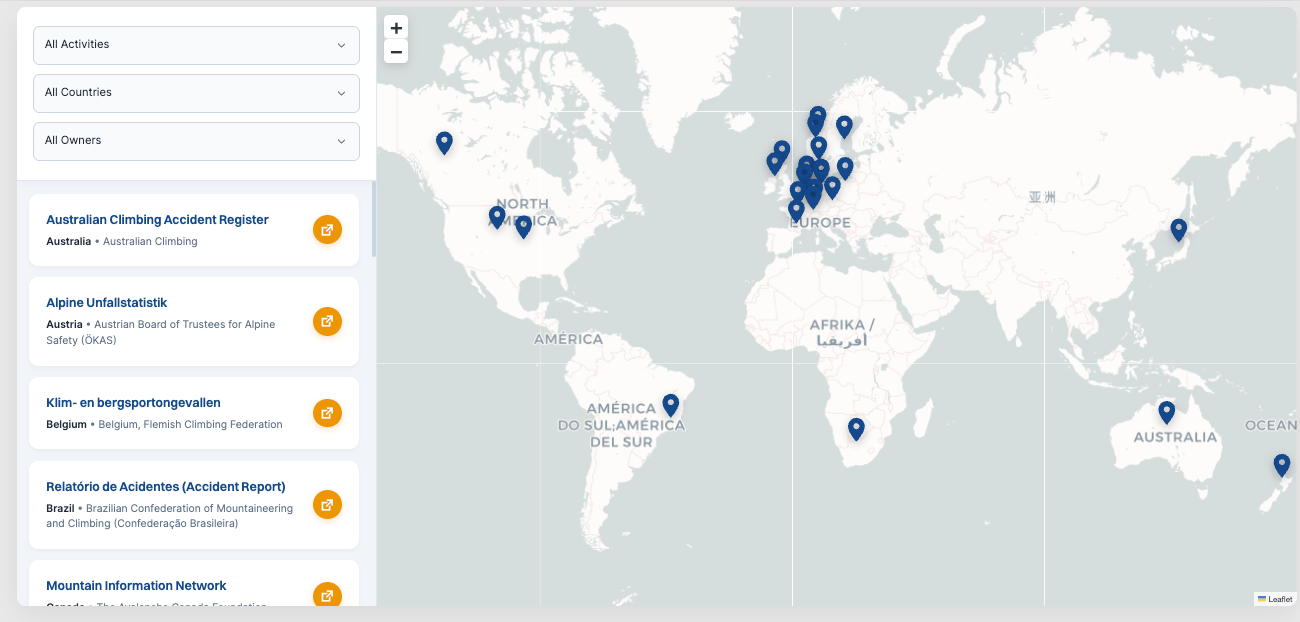
Stein Tronstad (Norwegian delegate on the UIAA Management Board) presented the work of the cross-commission Accident Database Working Group. The group has catalogued 13 national databases (now listed on the UIAA website) and is analyzing reporting practices with the aim of developing UIAA accident reporting guidelines. They are also publishing findings based on this data, such as recent papers on rope cuts and auto belay accidents. Future goals include integrating data from UIAA ice climbing competitions and expanding into avalanche-related incidents. A question was raised about why some national databases thrive while others see limited adoption.

As the declaration introduction identifies:

“These are a set of recommendations and norms, rather than rules that will hopefully resonate with climbers and mountaineers worldwide.”

These norms are the following:

We report the style by which we climb with honesty.

We help others in need, even at the expense of our own goals.

We accept other people’s styles when different from our own.

We respect the natural ecosystems in climbing areas and mountain regions.

We will not harm the experience of others while hiking or climbing.

We recognise climate change and seek to reduce our impact.

We consider the effect on others before taking risks.

We adhere to local regulations and respect local communities and cultures.

We support the right of access to the wilderness with responsibility.

The declaration was officially approved at the 2024 UIAA General Assembly in Malta and has been conceived to exist in a number of different formats.

UIAA publishes new Declaration on Hiking, Climbing and Mountaineering

Font, Advertising

UIAA Declaration

Part 2: Achievements - UIAA Declaration

The UIAA Mountaineering Commission was tasked by the UIAA Executive Committee to draft this new Declaration as the previous version (Tyrol Declaration 2002) required updating. The Mountaineering Commission was supported in the development and delivery of this new Declaration by a number of other UIAA commissions as well as the UIAA Executive Committee and Management Board.

“It is hoped that the new Declaration will provide the basis for a number of initiatives planned for the future, notably providing a platform for views and opinions on matters mountaineering and climbing. In this way, the Declaration will be a living document reflecting the views of mountaineers around the world.”

Greg Moseley, UIAA Mountaineering Commission President

To clarify the best practice for climbers and mountaineers from a mountaineering viewpoint. This particularly refers to the style of rock climbs and ascents of “alpine” peaks.

To lay out the generally accepted norms for behaviour that the UIAA considers optimal. This includes the ethics and style with which we climb and the environmental and social considerations that we should be aware of.

The purpose of the new declaration is twofold:

1

2

Mountainous landforms, Mountain range, atmospheric phenomenon, Hill, Rock, Highland, Ridge, Terrain, Valley

Please click here for more about the Declaration including background information.

Working Groups

UIAA SafeCom working groups are engaged in the following topics:

  • Rope cut resistance
  • Canyoning harnesses
  • Helmets
  • Speed ice climbing protection
  • Avalanche airbags
  • Headlamps
  • Brake assistant devices
  • Protective equipment in speed ice climbing

The objective is that the work conducted by the above working groups will lead to the updating of some existing standards and delivery of new ones over the coming years.

Public and evening conferences

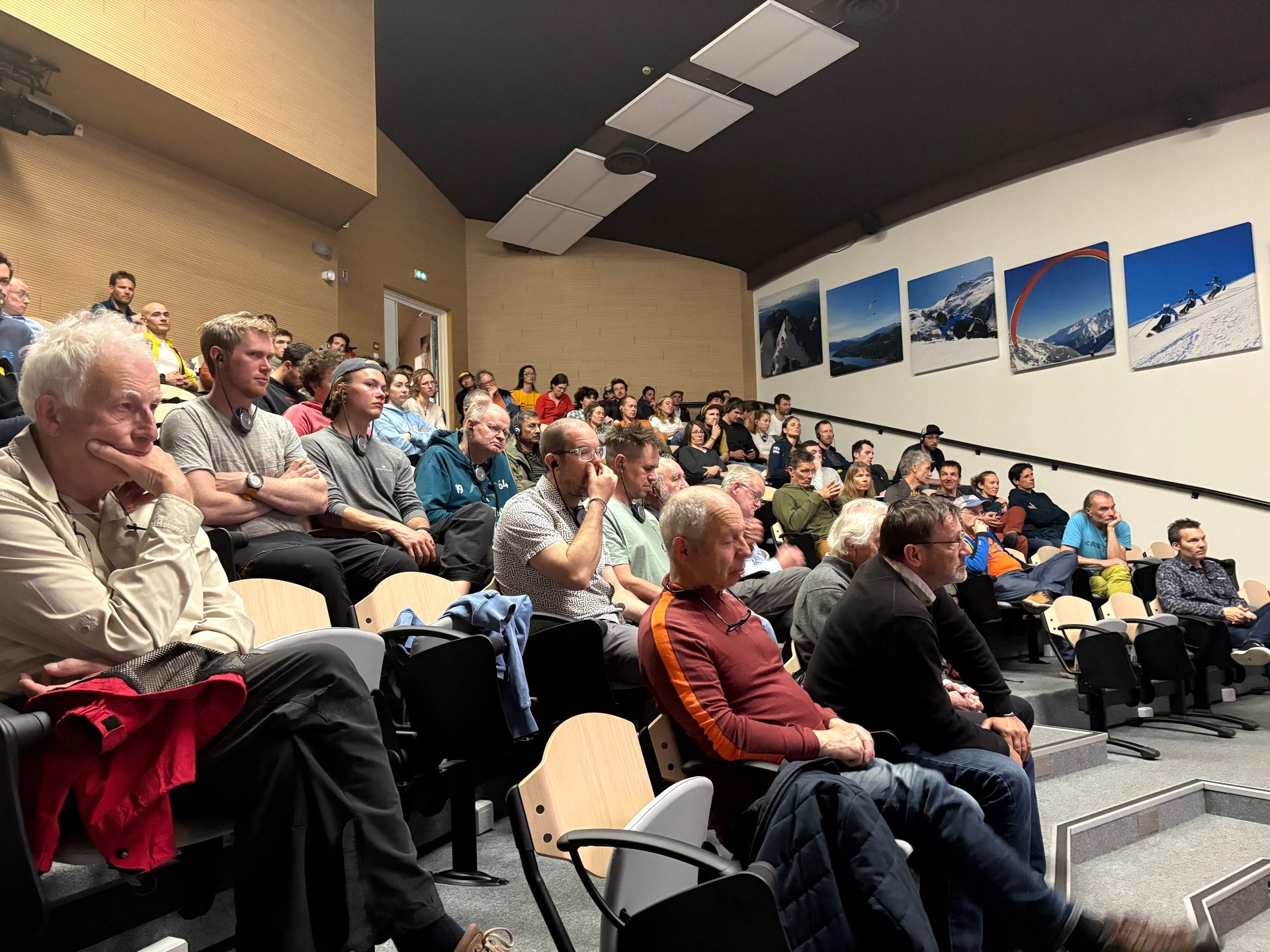
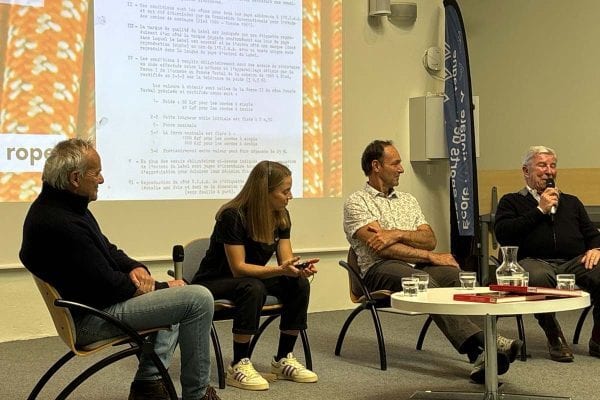
Amongst the highlights of the week were two public events under the guise 'UIAA SafeCom World Congress' on the evening of Tuesday 15 April and Wednesday 16 April. These were organised in close collaboration with ENSM, National School of Skiing and Mountaineering of France (Ecole Nationale des Sports de Montagne), and took place at ENSA's (Ecole Nationale de Ski et d'Alpinisme) HQ.The topics were:

Climbing-mountaineering and equipment innovation: a common evolution?

Speakers: Michel Beal, CEO Beal, Denis Pivot, CAMP/CEN Commission President, Alain Maurice, Head of Bureau d'étude at Petzl, Jean-Franck Charlet, professor at ENSA, former UIAA SafeCom President and SafeCom Honorary Member

UIAA and EN standards history, research, updates and future developments

Speakers: Denis Pivot, CAMP/CEN Commission President, Jean-Franck Charlet, professor at ENSA, former UIAA SafeCom President and SafeCom Honorary Member, Marco Bonaiti, CEO Kong, Julia Janotte, DAV (German Alpine Club) Sicherheitforschung (Safety Research Centre/DAV).

The events were well received by public and delegates alike and provided a rare opportunities to hear from a number of the driving forces, and indeed legends of world of climbing and mountaineering safety. The two evenings were led by Clemetine Junique, ENSM, and UIAA Safety Commission President Lionel Kiener.

Bolting workshop

Another important milestone was the hosting of a UIAA Bolting Workshop. Two members of the UIAA Safety Commission, Fred Campos and Per Forsberg presented the UAA's extensive work over the past decade in rock anchors, bolting and corrosion.

Information has been consolidated here. Contributions also came from organisations monitoring the environmental aspects of bolting as well as from rebolting projects in France and Switzerland.

Furthermore, the UIAA has collaborated with the German Alpine Club (DAV) on an English language version of the latter's bolting guide. Further details to follow. The guide can be downloaded here.

"In 1932 the UIAA was formed in Chamonix so it is appropriate that the UIAA has returned to the place of its creation. It was a successful event and perfectly demonstrated the commitment people have to safety and climbing and their skill and competence."

"In the Bolting Workshop we provided a lot of information on the equipment available, the standard they are tested to, and general background information on bolts and material which is needed when choosing the right equipment."

"Bringing together over 60 people from various federations, manufacturers and laboratories is impressive and very important. We serve as a global platform to share knowledge and practices from different countries."

"During the Bolting Workshop, we focused on the cohabitation between climbing and nature conversation and how to avoid conflicts. It has been interesting to hear the perspective of other organisations and alpine clubs on how they have worked together to find solutions and come together."

"This is the busiest I've seen a SafeCom meeting. Having conversations face to face with manufactures is great. The conversations and ideas formed help us to build up connections and drive the work that both the UIAA and the BMC, my home federation does."

"I have been active on a number of working groups, developing standards and being part of a team. It is great creating standards which don't stifle innovation and getting input from manufacturers, end users and certified bodies. It was a very beneficial meeting

Peter Muir, UIAA President

Per Forsberg, UIAA Safety Commission/Svenska Klätterförbundet (Sweden)

Lionel Kiener, UIAA Safety Commission President

Lucie Wiget, Swiss Alpine Club

Nick Galpin, UIAA Safety Commission/British Mountaineering Council

Michael McClurg, Trango

Reflections on the week

Double-click to select video

The 2025 UIAA Mountain Sports Symposium (MSS), held from 25-26 October in Peja, Kosovo, brought together over sixty participants from 27 countries to explore mountain medicine, safety, and techniques. The event was organised by the UIAA in collaboration with the Kosovo Mountaineering and Sport Climbing Federation (FBNSK), and showcased, with a particular focus on the Balkan region, the growing cross-region and international cooperation in mountain sports education and safety.

This was the second Mountain Sports Symposium organised by the UIAA following the inaugural event in Bariloche, Argentina held in April 2024.

Where mountain safety met collaboration

Mountain Sports Symposium:

Part 2: Featured Stories - MSS

Presenters and attendees ranged from mountain leaders, guides, and medical experts to rescue professionals and association representatives. Many participants hailed from Balkan countries, a region rapidly developing its mountain guiding and rescue infrastructure.

The diversity of nationalities and backgrounds help create a dynamic and inclusive environment, encouraging cross-regional dialogue and shared learning - a theme which had much to share with the aforementioned event in Argentina. The thirst for further professional development resonated strongly throughout the symposium.

Who attended the event

Over two intensive days, the MSS combined theoretical sessions and hands-on workshops.

The event opened with welcoming remarks and an introduction to Kosovo's mountain environment from Uta Ibrahimi of the FBNSK.

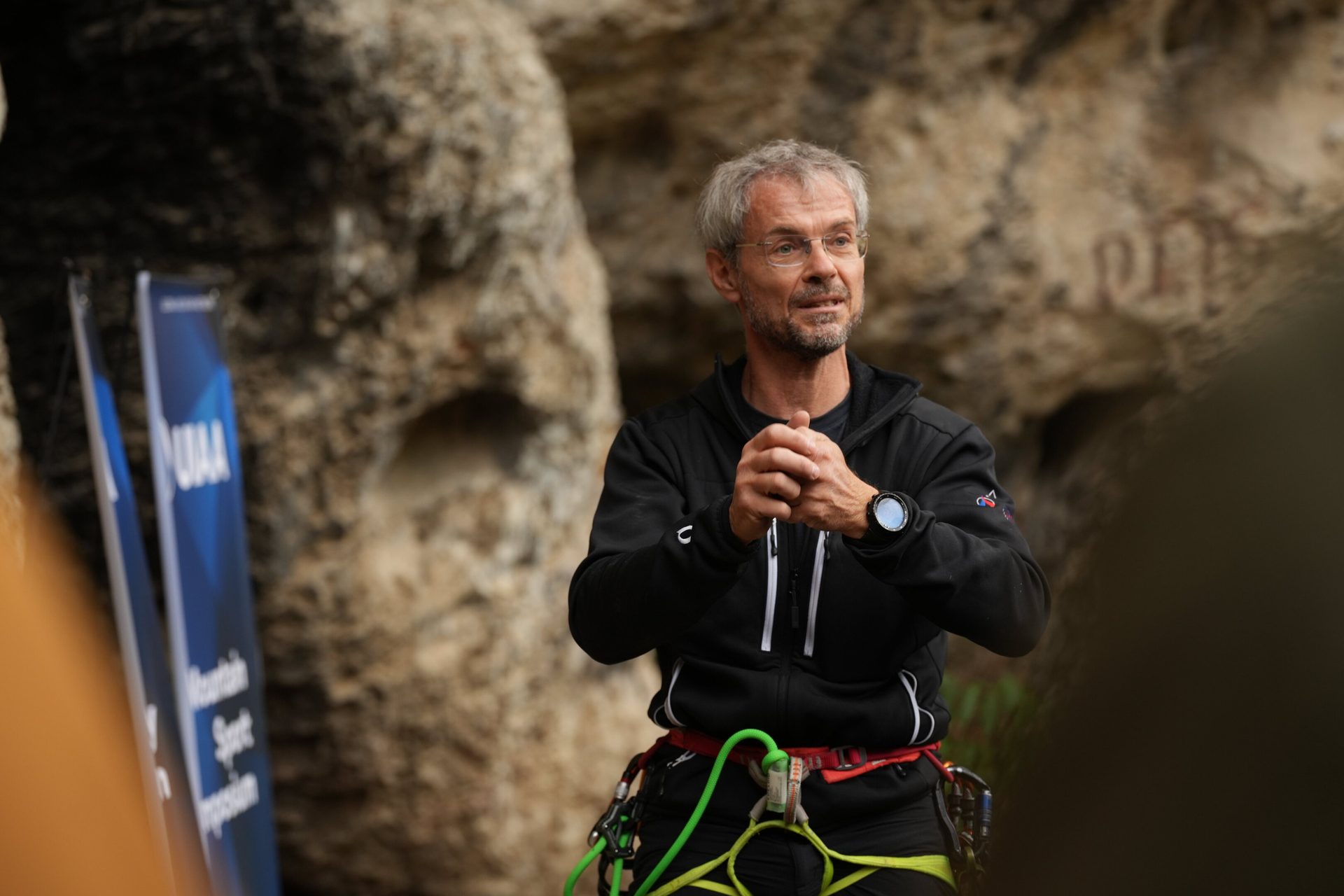
The initial presentations focused on safety fundamentals, including an explanation about the UIAA Safety Label, the importance of using certified equipment, and the topic of safety in Via Ferrata (for which there are many in Kosovo and in the Balkans). This part was led by Lionel Kiener, UIAA Safety Commission President, and Mentor Vokshi from the local federation. To note that the UIAA will shortly publish a new Safety Standard dedicated to Via Ferrata construction. Kyriakos Rossidis's subsequent presentation on the "Role of the IFMGA (International Federation of Mountain Guides Associations) / EEMGA (East European Mountain Guides Association) in Mountain Guide Education," drew particular interest from participants keen to advance toward full professional mountain-guiding qualifications.

The UIAA Medical Commission headed the next part of the programme which featured a number of topics addressed in the UIAA's first Mountain Sports Symposium held in Bariloche, Argentina in April 2024. Subjects ranged from hypothermia and frostbite to acclimatization and altitude illness, culminating in an engaging "High Altitude Trivia Game" that dispelled myths about altitude sickness in an interactive way. In addition to medical papers, the UIAA has also produced a number of video explainers on these critical subjects.

The second day of presentations placed an emphasis on rescue operations across the Balkans and introduced the work of the Kosovo Mountain Search and Rescue Service, followed by a presentation on medical requirements for avalanche rescue missions and panel discussions reviewing mountain rescue situations across Europe.

The final theory session was a significant one for the UIAA. SafeCom members Per Forsberg and Fred Campos presented the immense amount of work the UIAA has conducted in the field of bolting, rebolting and rock anchors. Their segment provided not only a comprehensive technical overview but lent on a sustainability perspective on the use of materials in high-exposure environments.

What the programme covered

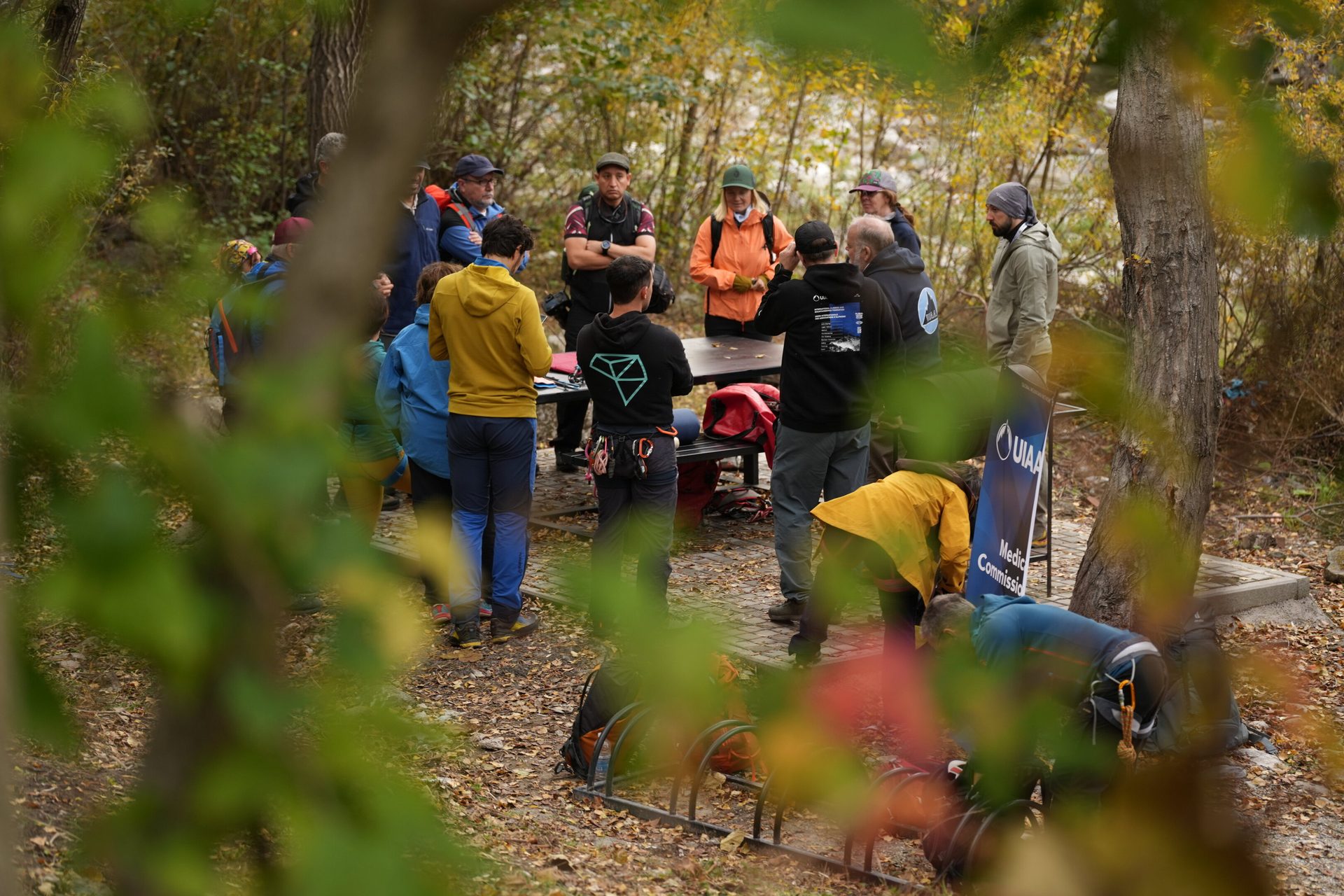
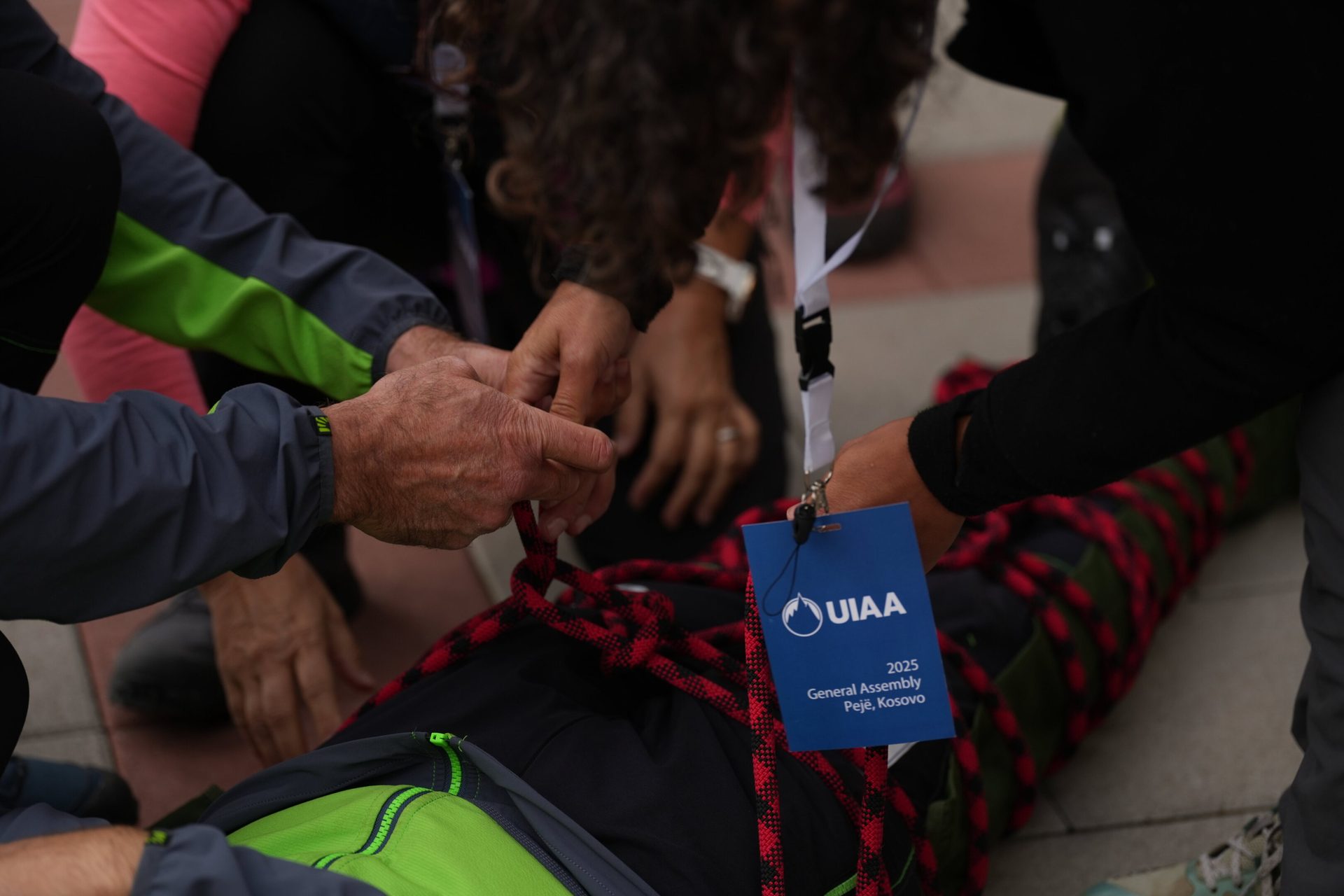
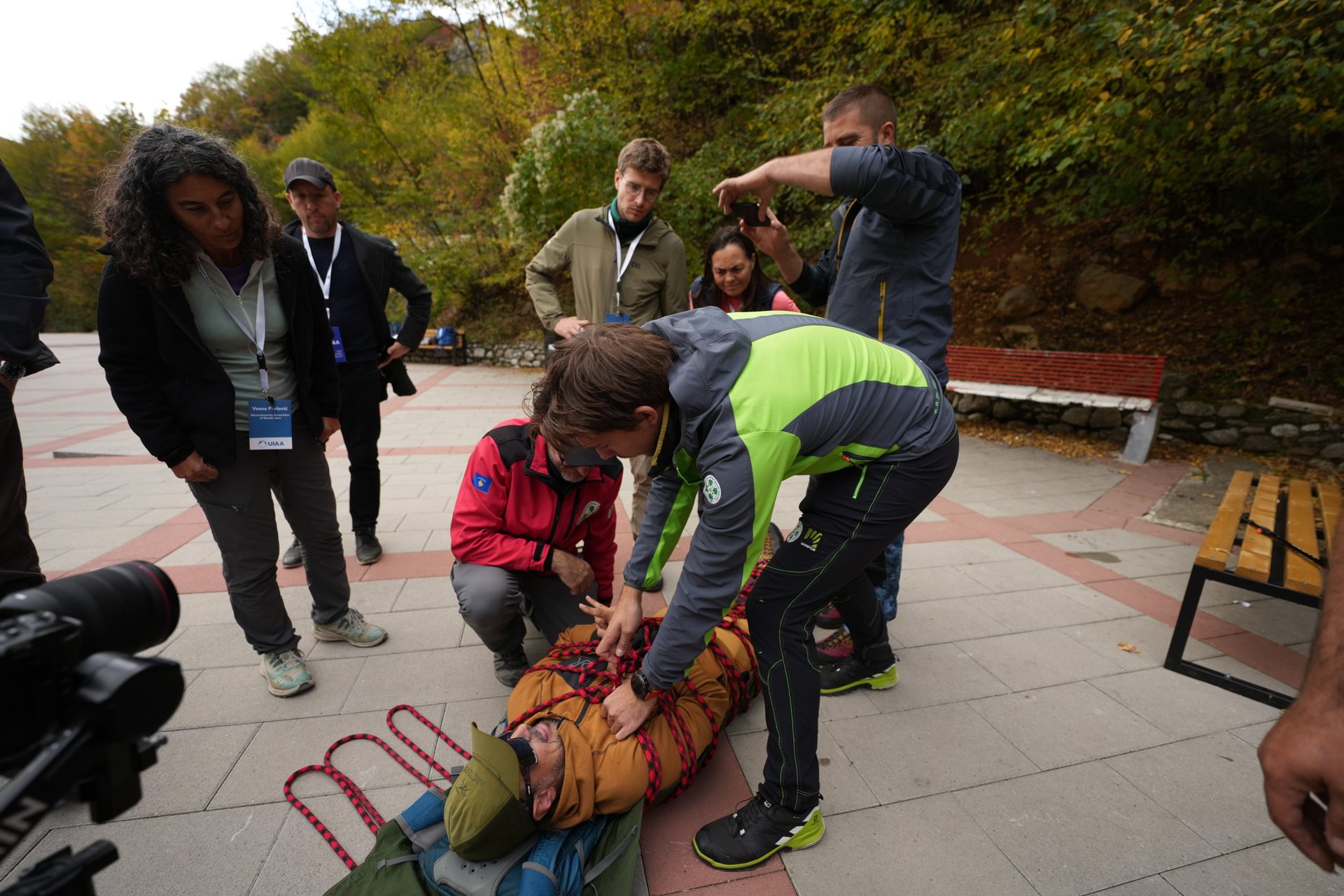
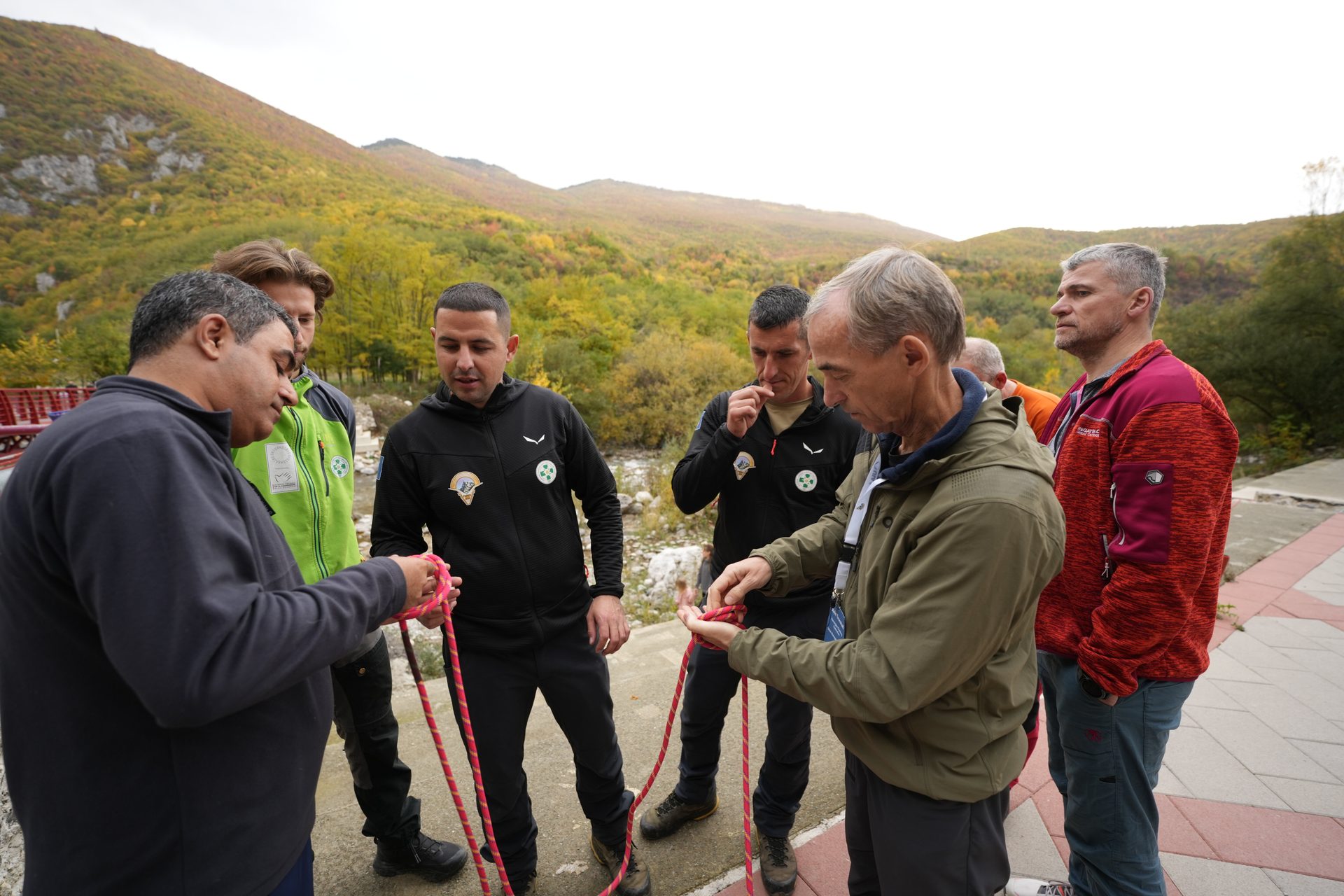
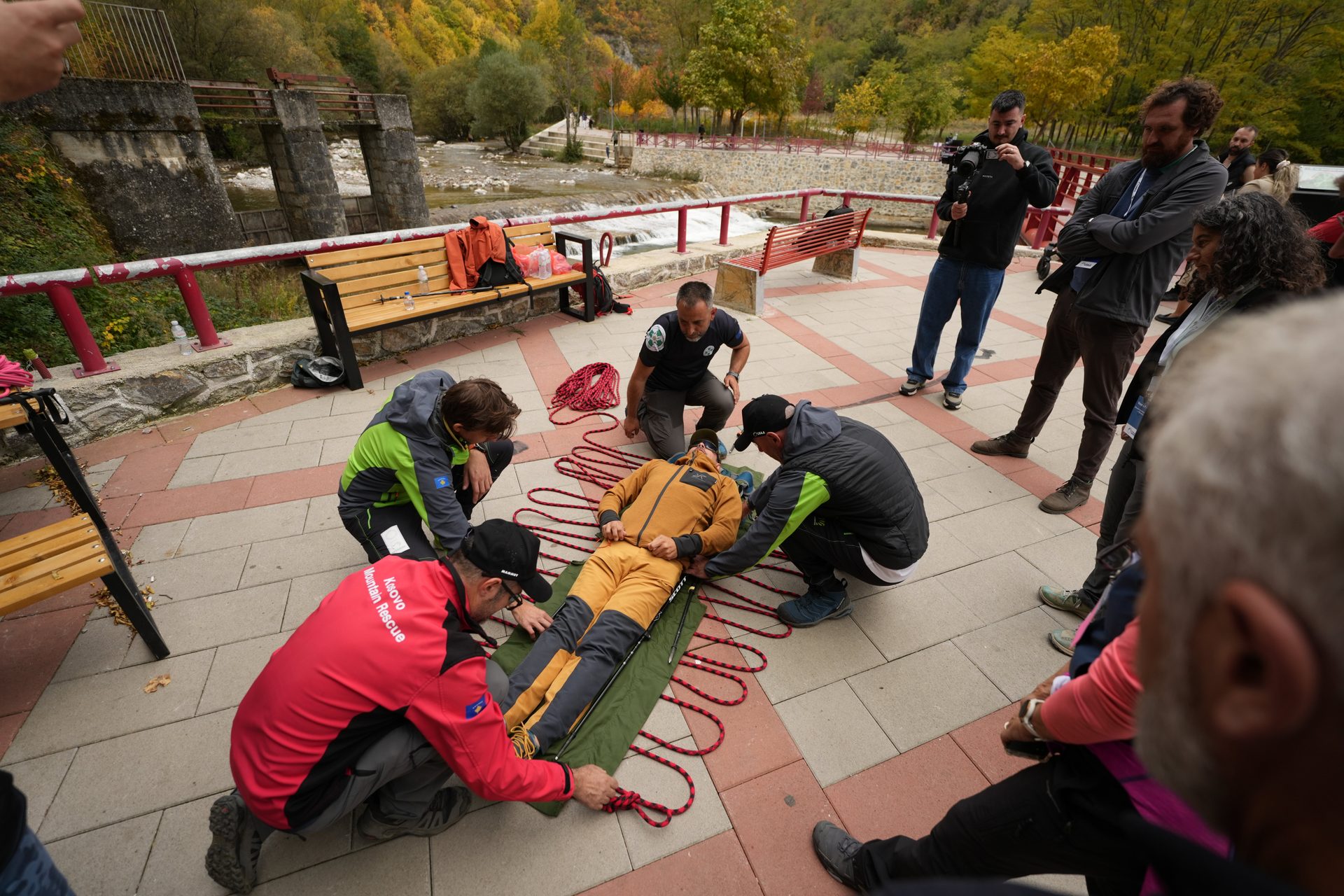
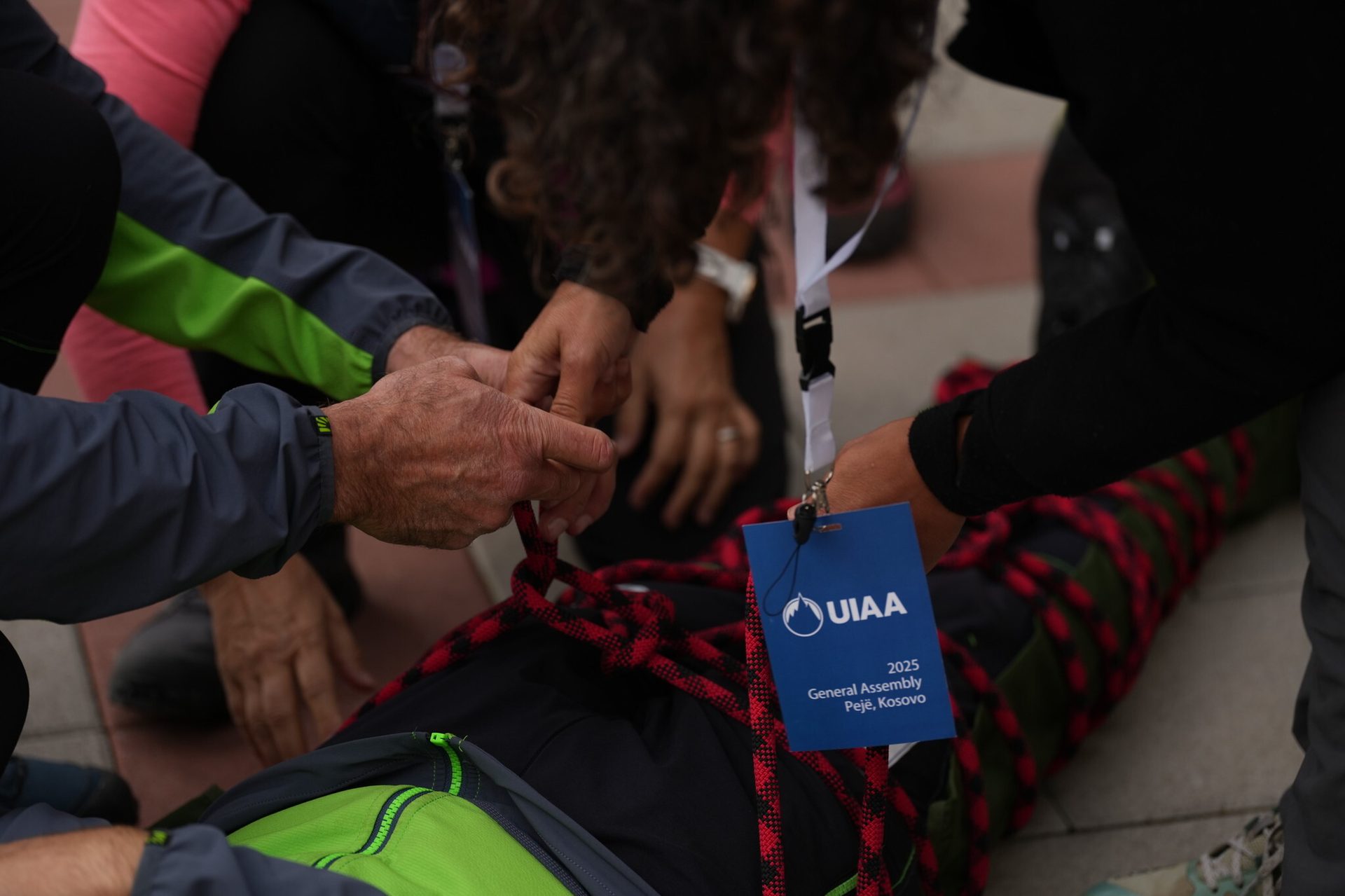
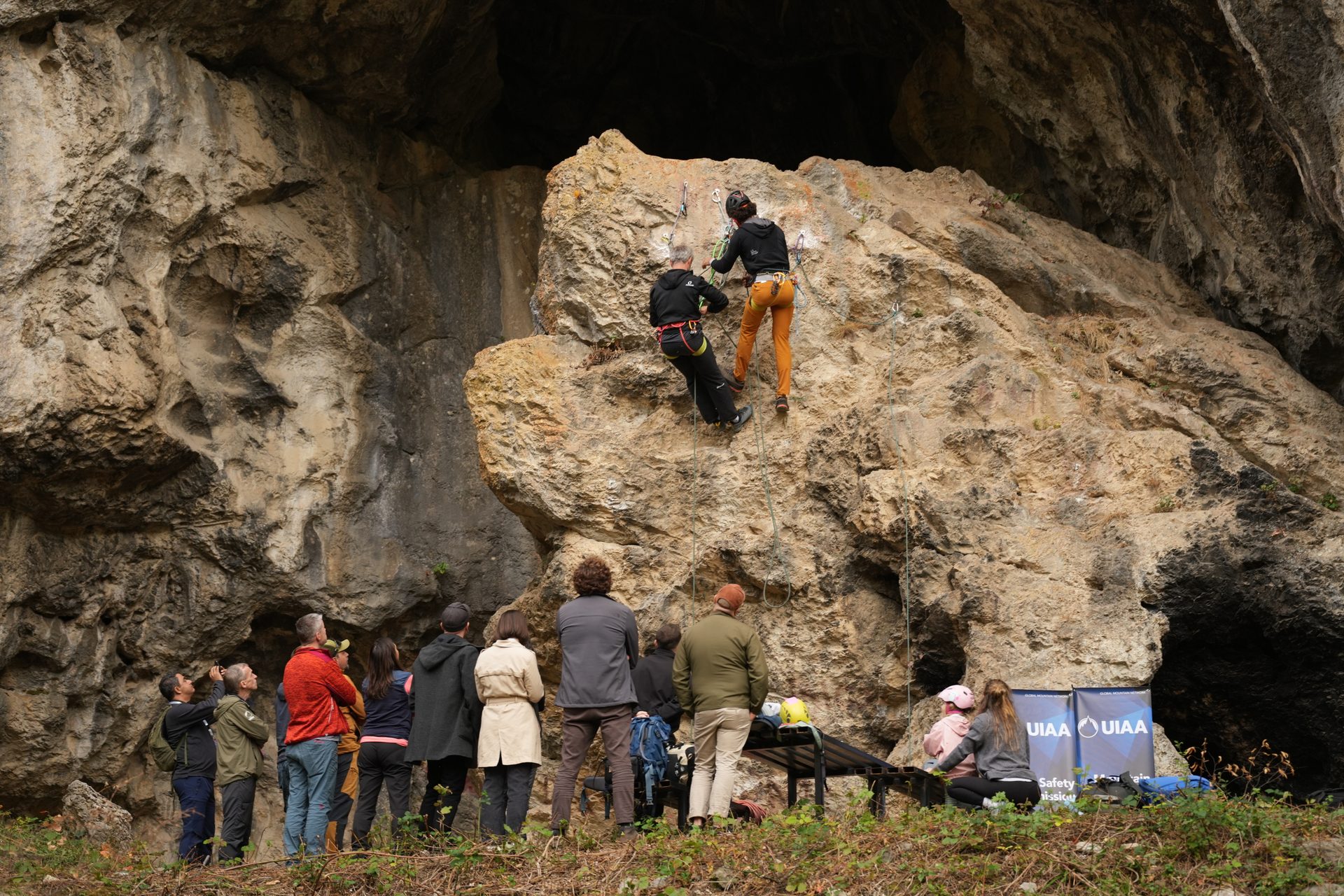
In a similar vein to the event in Bariloche last year, the rest of the programme was devoted to field-based workshops designed to turn theory into practice. Participants rotated through small-group sessions on field reduction and improvised splinting, rescue techniques, and multi-pitch climbing safety. Under the guidance of international experts, attendees practiced moving injured companions, stretcher rescues, and anchor safety techniques, all vital skills for mountain professionals and rescuers alike.

The advantage of the outdoor workshops is they raise engagement and foster collaboration between participants who might never have met otherwise.

The Symposium concluded with a ceremony where participation certificates were awarded.

Feedback collected during and after the symposium, has to date, been extremely positive. Delegates praised the organisation, content programme, and interactive opportunities.

Plans are already being discussed for future events, notably in Nepal, in October 2026, to coincide with the UIAA General Assembly and eventually in Africa, for which the UIAA is in discussions with federations and bodies through its Management Board continental representatives and member federations.

The second UIAA Mountain Sports Symposium, continued where the first finished, demonstrating that effective mountain safety education thrives on international exchange, adaptable formats, and hands-on engagement. Through a blend of best practices, technique, and experience, the event succeeded in strengthening the climbing community's capacity to operate safely, sustainably and as significantly collectively.

The UIAA thanks the PetzI Foundation for partnering the event; to Fixe for the equipment provided; all delegates and presenters and members of the following organisations - IFMGA, ICAR, UIMLA and the Kosovo Mountain Rescue Service for their support; and the UIAA Medical and Safety Commissions for the overall running of the Symposium.

Outdoor workshops

Future events

The publication of the UIAA Standard 110 for Static Ropes heralds the latest achievement of the UIAA Safety Commission. It was approved at the Commission’s 50-year anniversary meeting in Chamonix in April following five years of intense efforts from a dedicated working group, composed of delegates from various climbing, mountaineering and rescue federations, technical experts, rope manufacturers and testing laboratories.

Standard 110 will be joined shortly by Standard 171 for Via Ferrata Construction as well as updates to five existing Standards as outlined here. The delivery of these updates has been achieved in parallel with the impressive and ongoing work in the field of rock anchors and bolting for which a dedicated library of assets for climbers, bolters and gear manufacturers is available.

Introducing the UIAA Safety Standard 110 for Static Ropes

New Safety Standard

Part 2: Featured Stories - Static Ropes 110

 “The process to establish a new Standard was complex and very thorough, for example it took us several meetings to come to an agreement first on the scope, which is the root of the Standard and then eases the discussions about technical requirements and test methods.”

Lionel Kiener (SAC, Switzerland), UIAA Safety Commission President

The Technical Perspective

Standard 110 is distinguished from the other UIAA and EN standards related to climbing and mountaineering ropes. While the requirements for dynamic ropes have been well defined since 1961 in the international standard UIAA 101 (and later in the EN 892), the situation is more complex for low elongation ropes. As shown in a table in the explanatory information guide, UIAA 107 (Low Stretch Ropes) is valid for low-stretch kernmantle ropes with an elongation up to 5%. In UIAA 107, the minimal diameter is set to 8.5mm (and the maximal to 16mm).

Nevertheless, for several years, ropes smaller than 8.5mm diameter have been on the market for crevasse rescue, rappelling and haul maneuvers. These ropes are currently certified according to UIAA 102 (Accessory Cord) and EN 564, but these standards are meant for accessory cords. For example, they have no specification on static strength with terminations, nor fall arrest test and the minimal tensile strength is low for thin ropes. This situation was not fully satisfactory, the UIAA decided to homogenise the requirements with the release of a new Standard.

“Static ropes have evolved as rope technology has advanced. And the way we use these ropes has evolved. This revolutionary standard has no minimum diameter, a first for global rope standards. It focuses on performance and ensures minimum requirements focused around supporting human life – anyone using ropes only certified to an accessory cord standard is missing out on real important guarantees that come with this Standard.”

Stephen Gladieux (USA, American Alpine Club), UIAA Safety Commission Working Group Lead for UIAA Standard 110


The creation of World Ice Climbing, a self-governed Operating Unit within the UIAA, was approved at the 2024 UIAA General Assembly in Malta.

World Ice Climbing

“This is a very positive step. The approved new structure of ice climbing is going to enable the people who are experts in this field to work with a greater degree of independence. Personally I don’t think that the previous ‘Commission-type of structure’ worked for ice climbing. This is a specialised project. If you look at other organisations they have very specific structures in place to develop their sports and by experts who are fully focussed on that. This is a major step in allowing the sport to develop”

Peter Muir, UIAA President

Part 2: Achievements - World Ice Climbing

Shortly after the creation of the Operating Unit, following an extensive recruitment process, the UIAA Management Board elected the first three officials to the inaugural World Ice Climbing Board. They are:

The Board is also comprised of athlete representatives, elected by the Athlete’s Committee:

JoAnne Carilli-Stevenson                                             

Etienne Grillot                                                                     

Alexandru Paun                                                             

USA

France                                                                     

Romania

IRL

GBR

ACC - Chair

FFCAM

CAR                                                             

MI

BMC

Eimir McSwiggan                                                 

Willis Morris                                            

As per the revised UIAA Articles of Association, World Ice Climbing (WIC) is defined as such:

1

2

3

The UIAA is the sole and exclusive international body recognized by the International Olympic Committee IOC governing Ice Climbing competitions worldwide.

The UIAA General Assembly establishes a competitive Ice Climbing operating unit to be known as World Ice Climbing for the purpose of governing, directing, regulating, promoting, developing and the general furtherance of competitiveIceClimbing (its “Objects”).

World Ice Climbing operates on a self-guided and self-governed basis and on behalf of the UIAA as beneficial owner will administer, apply, preserve and develop the competitive Ice Climbing assets and funds of the UIAA.

Rock-climbing equipment, Outdoor recreation, Extreme sport, Adventure, Climbing, Mountaineer, Rope, Sports, Mountaineering

The Chair of World Ice Climbing will have an obligation to report regularly on the work of the WIC Board to the UIAA Executive Committee. WIC is also requested to present a quarterly financial update and a risk assessment twice a year to the UIAA Management Board.

One of the first major tasks of World Ice Climbing was – in collaboration with the UIAA Office and event organizers – the delivery of the 2024-2025 UIAA Ice Climbing World Tour, partnered by Outdoor Research. This includes five World Cups on three continents, a World Youth Championships and six Continental Cups.

Alongside the World Tour, the Board members first task will be the creation of several committees to continue the progression of the sport in the areas of event management,

rules and regulations, training of officials, developing the sport for the Olympic Games, and more. These committees will be populated with experts who will continue to push the sport forwards.

Over the past few seasons, a dedicated Governance Group has led the sport. The UIAA thanks all members of the Governance Group for the time and effort they have dedicated to ensuring competition ice climbing has continued to thrive over the past two seasons. This includes UIAA EC member Martin Lascano, UIAA MB members Eimir McSwiggan, Phil Powers and Andy Syme as well as Heeyong Park and Gyu Hyung Min from the Korean Alpine Federation.

UIAA Alpine Handbook

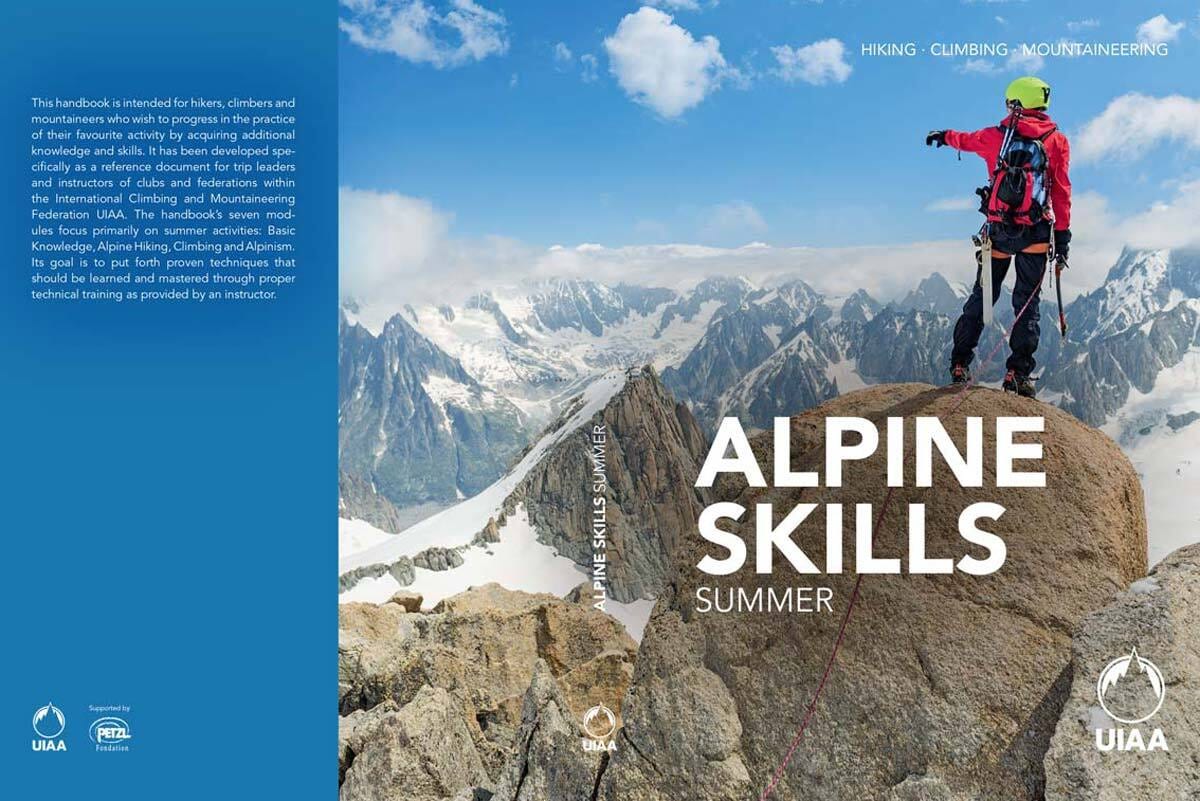
The UIAA, in partnership with the Petzl Foundation, published the digital English language version of the Alpine Skills: Summer handbook in August 2025. A global resource for safe and sustainable hiking, climbing and mountaineering, this seminal document is now available for climbers worldwide to purchase.

Now in its fourth English edition, this comprehensive guide is a trusted resource for anyone looking to enhance their skills in hiking, climbing, and mountaineering. Whether you’re a beginner eager to explore the outdoors safely or an experienced trip leader refining your technical knowledge, this handbook offers an invaluable reference designed for field use.
The handbook is a unique collaboration that draws on decades of expertise from global mountaineering communities and instructors. It combines Petzl’s renowned visual clarity with concise, practical text – making complex techniques accessible to readers of all backgrounds and experience levels.

Summer Skills digital version available to purchase via UIAA shop

Part 2: Featured Stories - Alpine Handbook goes digital

“Thanks to the Petzl Foundation for its commitment to climber safety far and wide. We are honoured to partner with such a recognized mountain leader. The Foundation’s continuing contributions to the UIAA’s priority of mountaineering safety cannot be underestimated.”

Peter Muir, UIAA President

“This hands-on, user-friendly document represents knowledge collected by Petzl over more than 30 years, and is supplemented by tried-and-true techniques from mountaineering clubs and organizations around the world. We wish to recognize and thank all the instructors and volunteers whose efforts have gone into this important reference book.”
Paul Petzl, Petzl Foundation President

Thanks largely to a very active social media campaign, sales of the Handbook were impressive. By the close of 2025, the following numbers had been registered

Glacial landform, Geological formation, Ice cap, Snow, Rock, Mountain, Nunatak, Winter, Terrain

Anyone wishing to provide information about a system not currently listed on the UIAA database can do so by contacting the Accidents Working Group.

0

Alpine Handbooks sold in total

0

Number of Member Federations whose climbers purchased Handbooks

Xenon and high-altitude mountaineering

In January 2025, the UIAA Medical Commission published the following statement:

The UIAA Medical Commission has recently received multiple reports and correspondence from mountaineers asking whether inhaling xenon has a positive effect on the body's response to adapt to the lower oxygen availability at altitude (acclimatization).

The UIAA Medical Commission is asked these sorts of questions due to their role in providing the mountaineering community with scientifically based information in the form of fact-based safety and health recommendations which are free of charge, evaluated by specialists, and commonly published in scientific journals. The Medical Commission is open to and interested in new methods and developments used by the climbing community and carefully evaluates their worth.

According to current literature, there is no evidence that breathing in xenon improves performance in the mountains, and inappropriate use can be dangerous. Although a single inhalation of xenon can measurably increase the release of erythropoietin, this increase is not sustained over four weeks use, nor is it associated with any changes in red blood cells. According to the literature, the effects on performance are unclear and probably non-existent.

Acclimatization to altitude is a complex process that affects the various organs/systems such as the brain, lungs, heart, kidneys and blood to different degrees, and is not fully understood. Since the physiological changes take days to weeks to influence the organism, from a physiological point of view, a single, one-off drug cannot be the key to improved acclimatization or increased performance. For erythropoietin in particular, the target of xenon, the effects take weeks to increase red blood cells, so use just before climbing would not be expected to make any difference in hemoglobin, hematocrit or performance.

Moreover, xenon has been on the World Anti-Doping Agency (WADA) Prohibited List of banned substances since 2014. A ban on the use of performance-enhancing substances can only be applied to sports that are subject to WADA rules, thus applying for example to competitive ice climbing but not to high-altitude mountaineering. Xenon is an anesthetic gas, and thus a medicine, with corresponding adverse effects and health risks, meaning in an unmonitored setting this could be impaired brain function, respiratory compromise, and even death. One study showed significant sedation in people using it at doses recommended for mountaineering. Even slight sedation is detrimental in the potentially dangerous setting of high-altitude mountaineering.
Xenon is rarely used in medicine and is not approved in all countries. Its use should be reserved for the operating room and procedural sedation by specialists with appropriate training in anesthesia. From a medical point of view, off-label use without a scientific basis and with unknown health risks must be rejected.

On the other hand, the well-known and established methods of pre- and acclimatization are safe and recommended. Discover more here.

UIAA Medical Commission recommends established methods for acclimatization:

Statement on xenon and high-altitude mountaineering

Part 2: Featured Stories - Xenon gas

To further back up its statement issued in January 2025, a peer-reviewed position statement of the UIAA Medical Commission has now been published within the renowned High Altitude Medicine & Biology journal.

In this statement, the Commission together with a pool of experts "summarize the current state of research and discuss possible directions of future investigations of inhaling Xenon for expeditions to high altitude and in conclusion "recommend against the use of xenon inhalation in preparation for or during expeditions to high altitude unless part of a controlled study with appropriately qualified medical support such as anesthesia personnel".

Xenon position paper published

Anti-Doping

It has been almost 18 years since the first doping controls were introduced in competition ice climbing. What began with ice climbing is now expanding to include skyrunning, further strengthening the commitment to clean sport across disciplines. Over the years, testing has been carried out among the top athletes, and ice climbing can be proud to be one of the rare sports in which a small athlete community has been tested almost in its entirety. This provides strong evidence that the fight for fair play has been consistently upheld in practice throughout these years.

Words from Peter Muir, President of the UIAA

Dr Marija Andjelkovic

President

UIAA Anti-Doping Commission

(centre)

Part 3: Commission Report - Anti-Doping

The main achievements of the UIAA Anti-Doping Commission for 2025 and its main projects and considerations for the future are detailed below:

In December 2025, all three members of the UIAA Anti-Doping Commission attended the World Conference on Doping in Sport in Busan. In addition to holding a commission meeting, particular attention was given to the adoption of the new rules and regulations to be implemented in 2026 in preparation for the 2027 World Anti-Doping Code.
Read more about the World Anti-Doping Code
An educational lecture on the 2027 World Anti-Doping Code was delivered ahead of the Ice Climbing World Cup 2025–2026 in Saas-Fee, with all competing ice climbers in attendance. The session focused on the main changes in the new Code and the updated International Standards, including sanctions, contaminated supplements, and the TUE process.
In 2025, a total of 34 urine doping controls were carried out — 24 in ice climbing and 10 in skyrunning — with equal representation of male and female athletes. In addition, nine further analyses were conducted: 4 GHRF, 4 ERA, and 1 IRMS.
Cooperation with the International Skyrunning Federation continued in 2025. The UIAA Anti-Doping Commission oversaw the organisation of testing and results management for skyrunning athletes.
Plans for 2026 remain unchanged and include both in-competition and out-of-competition testing, as well as athlete education.

Legal Affairs

“ In 2025, we continued to expand the legal database, with particular attention to decisions concerning the liability of clubs and instructors. We also welcomed two new active members, which helped broaden our work to include cases involving slackline accidents. Towards the end of the year, we began supporting the Training Commission in giving the Mountain Qualification Label Program a clearer legal framework, especially by defining the relationships between Member Federations, the UIAA and external experts. We see this as a very important step. Looking ahead, we hope to move gradually from individual cases towards more general recommendations that may be useful across jurisdictions. And, as we are all busy volunteers, I hope the positive energy within the LAC stays with us.“

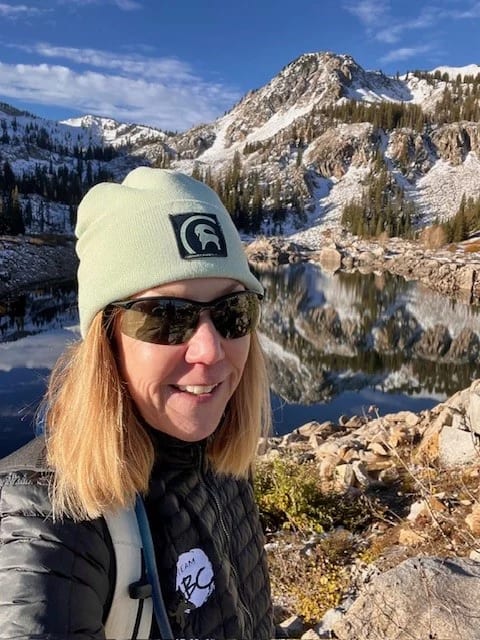
Facial expression, Smile, Happiness, Nose, Mouth, Jacket, Tooth, Winter, Fun, Recreation

Words from Peter Muir, President of the UIAA

Klara Dvorakova

President, Legal Affairs Commission

Part 3: Commission Report - Legal Affairs

The main achievements for the UIAA Legal Affairs Commission for 2025, and its main projects and considerations for the future are detailed below:

The UIAA Legal Affairs Commission launched its global database of climbing and mountaineering case-laws in 2024.

By the close of the 2025, the database included reports from 20 different cases. These are drawn from accidents which took place in 14 different countries and on five continents. The UIAA regularly highlights new cases through its monthly newsletter and communication channels. Topics covered recently included cases related to indoor climbing gyms, via ferrara and slacklining.

With more members contributing to the database, further expansion is planned in 2026.

Explore the database
The UIAA Training Commission, under new leadership is overhauling its accreditation model to resolve previous governance issues. The new model introduces a subcontracted, paid “Expert Panel” to conduct on-site assessments, while the Training Commission remains a voluntary oversight body. The Legal Affairs Commission (LAC) was asked to provide support.

Discussions centred on the need for a detailed operational and financial breakdown from the Training Commission before legal documents could be drafted, and a debate ensued on whether to use formal contracts or internal regulations to govern the relationship with member federations.
The Legal Affairs Commission provides the UIAA with support on a range of topics, one of these in 2025 centered around copyright claims.
The Commission expanded its global reach with two members: Luciano Roncaglia, lawyer originally from Argentina and now based in Switzerland, is going to represent the International Slackline Association. Lucio Correa, from Portugal, brings expertise as a sports and labour law professor, and will offer the perspective of Portuguese law to the group.

Medical

"The aim of the UIAA Medical Commission is to make knowledge about mountaineering in general, and in particular information on the prevention of illness and accidents in the mountains, freely available to all mountaineers.

Many volunteers contribute their highly specialised knowledge to teaching and, above all, to mountaineering training worldwide. A big thank you goes to them. 

Looking ahead to 2026, we will also be active at international conferences during which the UIAA will make its expertise accessible to a wide audience.

Science in general and the dissemination of knowledge are becoming increasingly complex, which is why voluntary work also poses a major challenge for everyone involved.  Sometimes exciting projects have to be put on hold because resources must be used wisely. I would like to thank the members of the Medical Commission for their cooperation and the UIAA, and in particular the Office, for their trust in the Medical Commission."

Words from Peter Muir, President of the UIAA

Dr Urs Hefti

President UIAA Medical Commission

Part 3: Commission Report - Medical

Having spearheaded the inaugural UIAA Mountain Sports Symposium in Bariloche, Argentina in 2024, the UIAA Medical Commission worked in close partnership with the UIAA Safety Commission in devising the programme and courses which made up the second Mountain Sports Symposium held in Kosovo in October 2025.

Please refer to Chapter 2, Featured Stories, for full details.
A MedCom Working Group continues to work on a new paper focused at children at altitude with the paper due for delivery in 2026 or 2027.
As detailed in Chapter 2, Featured Stories, the UIAA Medical Commission led a UIAA project regarding the use of xenon gas in high-altitude mountaineering which culminated in the publication of a peer-review paper.
Read full paper
Several members of the UIAA Medical Commission supported the organisation of the International Forum on Rescue in Difficult Environments, held in Genoa, Italy, from 19-21 March. Indeed, the event was organised by Luigi Festi, a UIAA MedCom member from CAI, and a tireless promoter of mountain medicine.

Read more here
In the spring of 2026, advice - in an FAQ format - for older mountaineers will be published. Recommendations will come from a practical point of view and a scientific review of evidence.

Topics covered include blood pressure, joint replacement, back surgery, retirement anxiety and dementia.
MedCom will play a significant role at the ISMM Congress in Hathersage, UK in May: speaking and workshopping on women in the mountains, children at altitude, warming mountains and mountain safety.

The conference and meetings will also provide the opportunity for the UIAA to capture a significant amount of advice material for social media campaigns.
FAQs
A third edition of the Mountain Safety Symposium will take place as part of the UIAA GA in Nepal, October 2026

MedCom will again support the workshops and training as well as the delivery of the courses.
A number of developments are planned to enhance the medical areas of the UIAA website, including:

- Reworking of advice papers . This will include publication of UIAA advice published in peer reviews; restructuring the current library; giving greater emphasis to the newer and more important papers
- Diploma in mountain medicine. Creation of a world map to display UIAA-affiliated courses
- FAQs. Continued development of short-form FAQs, older mountaineers to join the existing one on Women in Mountaineering

Below is a summary of the main achievements of the UIAA Medical Commission in 2025:

Mountaineering

“Following on from the decisions taken at the 2024 General Assembly, where various “strategic” initiatives” were defined, 2025 was a year of consolidation with two new working groups being set up.

The Hiking and Trails working group had actually been started the previous year following on from the Italian Alpine Club (CAI) initiative. Alberto Vicari has proved an energetic and resourceful leader of this WG and much has been accomplished. One interesting project is to consolidate the grading system for Via Ferratas worldwide as this is a fast-growing aspect of our sport. In 2026, a ‘joint-venture” with the Safety Commission is envisaged to ensure that all aspects of via ferratas are covered.

The other major strategic priority is rock climbing and to better cover this aspect, two new working groups have been started - one to deal with ensuring that the UIAA is giving a high priority to the broader aspects of rock climbing and a second one to encourage rock climbing festivals. These two groups are just getting into their stride.

As in previous years, the Commission has dealt with a number of more or less controversial incidents throughout 2025. The “new” system whereby, the Commission President deals with these incidents, obviously assisted by other members of the Commission and the Communications staff, has worked well and is contributing to the raising the profile of the UIAA worldwide.”

Words from Peter Muir, President of the UIAA

Greg Moseley

President, UIAA Mountaineering

Commission

Part 3: Commission Report - Mountaineering

The main achievements of the UIAA Mountaineering Commission for 2025 and its main projects and considerations for the future are detailed below:

The new “UIAA Declaration on Hiking, Climbing and Mountaineering” intended as an update of the highly-regarded Tyrol Declaration of 2002, was officially published at the close of 2024.

The intention is for the document to be a 'living resource' with case studies built around its various norms and member federations encouraged to become adopters.

Both these targets were achieved in 2025.

UIAA member associations have fully embraced the Declaration. The Alpine Club of Canada (ACC) was the first to print the Declaration and make both the paper and its poster version available in a cross section of its clubhouses. The Corean Alpine Club (CAC) was the first federation to translate the Declaration, followed by a version in French and as of October 2025, an Arabic translation courtesy of UIAA associate member Fujairah Adventures Centre (based in the United Arab Emirates).

Translations of the poster, essentially a short-form version of the Declaration depicting its nine norms, have been produced in an incredible 33 languages. These have been courtesy of a number of UIAA member associations as well as the UIAA Office.
UIAA members adopting the UIAA Declaration
In an excellent example of cross-Commission collaboration, the Mountaineering Commission supported the UIAA Medical Commission with the well-received statement regarding the use of xenon gas in high mountains. Please refer to Chapter 2 - Featured Stories for further information.
Full statement
A UIAA statement addressed the decision to open up “new” areas and more peaks in the 6000 and 7000 metre range in western Nepal. Some 97 peaks, in the provinces of Karnali and Sudurpashchim, will be free of climbing permit charges.

The UIAA Declaration lays out the tenets for ethical behaviour in mountain regions. This initiative which encourages visiting newly opened regions may provide recreation, both physical and spiritual, for generations of climbers in the future and is supported by a number of points made in the Declaration.
Full statement
The UIAA Declaration was created in part to lay out the generally accepted norms for behaviour that the UIAA considers optimal. This includes the ethics and style with which we climb and the environmental and social considerations that we should be aware of. The extract quoted above comes from the section ‘Balancing Risk, Success and Failure’.

Partly due to the impact of climate change, discovering a body – especially on the upper slopes of the high mountains – is becoming an increasingly common occurrence. Documenting these findings, thanks primarily to advancements in camera phone technology, has never been easier. In some instances documentation may be both necessary and warranted. It has also led to an increase in content posted on social media channels where, for example, videos of climbers walking past (and even over) the bodies of the dead and dying, has created a moral debate and raised the question of respect for human dignity.

The following statement addressed the UIAA position.
Full statement
Hiking is a key strategic priority of the UIAA. Leadership of this Working Group has been entrusted to Alberto Vicari (CAI) and he and his enthusiastic team have been making good progress on a number of fronts. A UIAA-wide survey to establish the status of hiking in UIAA member associations and a project aimed at developing a universal grading system for via ferratas is underway. Podcasts are also planned.
In terms of rock climbing, activities have been split into two distinct areas: support for rock climbing festivals worldwide including a UIAA classification and promotion of rock climbing festivals on the UIAA website and communication channels. A second working group is focused on putting in place a robust strategy for the development of rock climbing and UIAA-led projects. Co-operation and “joint-ventures” with other commissions will form a big part of this work and web page devoted to this is in the planning stage. A significant acceleration on both these working groups is expected in 2026.
This Working Group has been resuscitated under the interim leadership of Victor Saunders. Surveys to establish a longitudinal view of access issues have been carried out and replies received from a significant proportion of member associations. While access issues are often “local” in character, there are occasions when support from a world organisation can be useful.
Read full story
The Expedition Working Group steering body is developing aims and targets for this WG prior to populating it with the appropriate individuals. Part of the priorities will be the Mountain Workers Initiative.
Read more here
The Accident Database Reporting Working Group continues to deliver excellent work. Having established their database of worldwide reporting systems in 2024, the group led by MB member Stein Tronstad, has focused on delivering case studies from the database. Two of these, addressing different stories in Norway (sharp edges and rope cuts, indoor climbing gym accidents), achieved a combined audience on social media of over one million views (see Communication report in Chapter 1).
MountComm members contributed to the UIAA Mountain Voices podcasts most notably an episode focused on the achievements of Victor Saunders, Commission Vice President, and his climbing partner Mick Fowler and their 2024 first ascent of Yawash Sar in the Karakorum. The same episode also featured the contribution of Commission President Greg Moseley who introduced the UIAA Declaration and specifically the nature of ethics in today’s mountaineering.
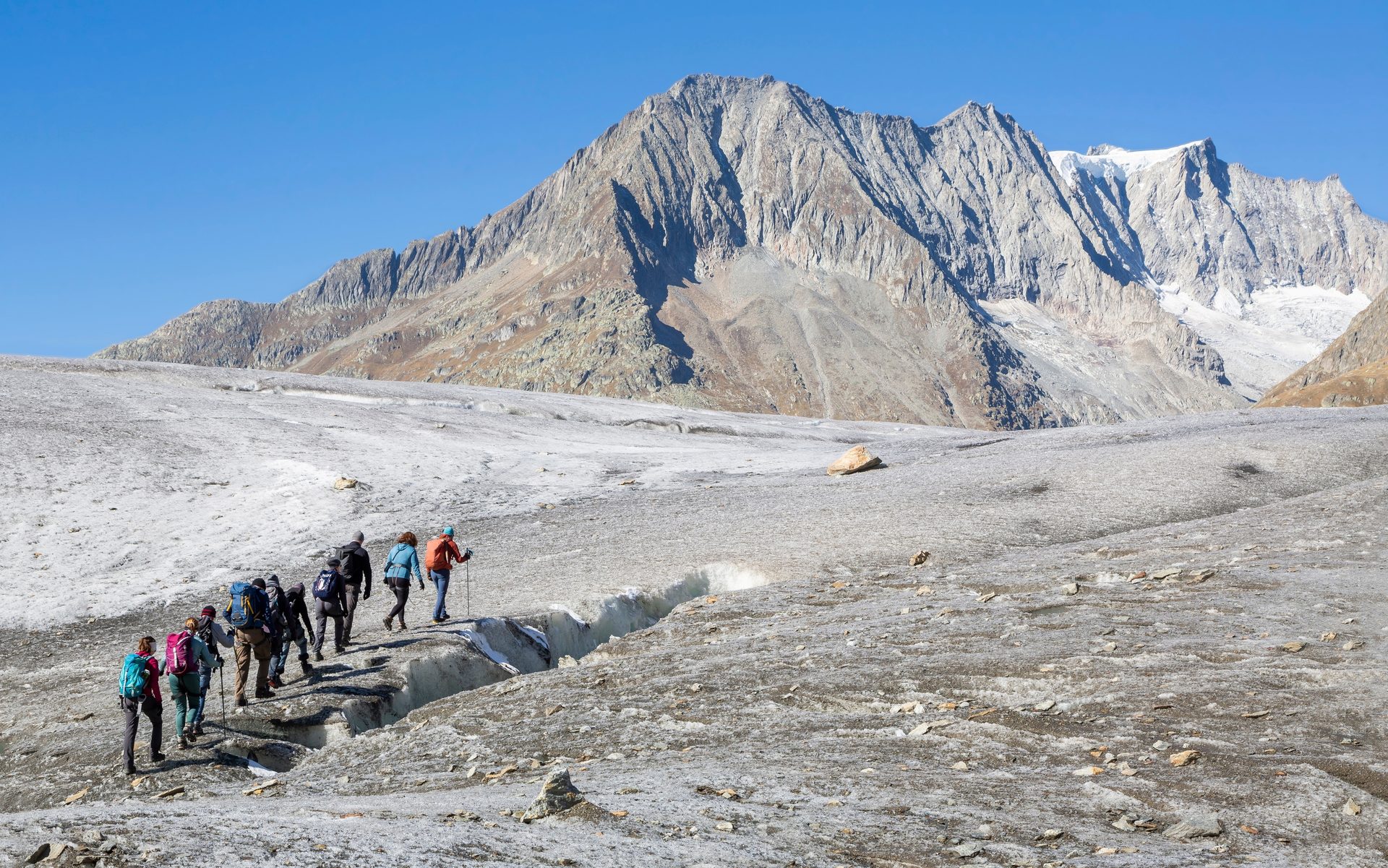
Discover the Mountain Voices podcast

Mountain Protection

"The UN International Year of Glacier Preservation was present in many of our MPC activities across the globe – the year being a clear signal that, despite global geopolitical turmoil, we need to continue focusing on the long-term preservation of the cryosphere as one of the most important elements of our world’s ecosystems, at the same time playing such an important role in the environment were UIAA members worldwide enjoy their adventures, sports and friendships.

We progressed steadily with our efforts to combine the UIAA commitment to the UNFCCC Sports for Climate Action with our mountain protection mandate in the following ways: Please see further details in this report.

The relaunch of the UIAA Mountain Protection Award in 2025 after a year’s re-calibration turned out to be very successful with unchanged enthusiasm from all over the world with more than 25 applicants, and winners connecting mountain protection with local and regional community involvement and advocacy for these causes. In 2026, we will build and extend the award with MPA-nominees community learning and exchange.

We would like to close with a big thank you to all members of the Mountain Protection Commission and the Climate Change Taskforce for their commitment and collaboration during the year 2025. It is based on their time, expertise and contributions that we can continue working on sustainable actions for mountain protection.

"

Vision Care, Facial expression, Eyewear, Smile, Glasses, Nose, Happiness, Mouth, Sunglasses, Winter

Words from Peter Muir, President of the UIAA

Paul Kwakkenbos

President, UIAA Mountain Protection Commission

Mary Sanseverino

Vice President, UIAA Mountain Protection Commission

Part 3: Commission Report - Mountain Protection

As noted in one of the big achievements in Chapter 2 – the relaunch of the UIAA Mountain Protection Award - the year 2025 proved to be very active for the UIAA Mountain Protection Commission.

A total of 20 projects operational in 19 different countries were showcased as part of the 2025 UIAA Mountain Protection Award, partnered by Lenovo.

As of 2025, the MPA functions on a two-year cycle with one year being an adjudication and award year; with the alternate year having a focus on community building and associated knowledge sharing.

The 20 nominated projects, drawn from a total of 24 applications, were showcased on the UIAA website and social media channels. The online showcase can be viewed from the link below.

Projects include five applications which come directly from UIAA member associations, three former Award winners in Mountain Wilderness (France), Asociación 7a Escalada (Peru), and Gear Tips (Brazil) as well as from the Kilian Jornet Foundation, an initiative recently profiled in a Mountain Voices podcast episode. The spread per continent is as follows Africa (3 projects), Asia (3), Europe (9), North America (1) and South America (4).

As detailed in Section 2 - Flagship Shelters for the Environment by UIAA member association Fédération française des clubs alpins et de montagne (FFCAM) was announced as the winner of the 11th edition of the UIAA Mountain Protection Award (MPA) at the UIAA General Assembly (GA) in Kosovo.

The Best New Initiative was also announced at the GA, and awarded to Walking the Tra Tra by Mountain Club of South Africa.
View the 2025 projects
In September of 2025 the Mountain Protection Commission & Climate Change Taskforce partnered with the Mountain Partnership Secretariat (part of the UN Food and Agriculture Organization) to bring UIAA climate, sustainability, and ethics actions to the International Mountain Conference in Innsbruck, Austria. The UIAA was a good fit both the conference and the Mountain Partnership; we look forward to more opportunities to work together.
As part of its Climate Action Plan for Member Associations, the UIAA is committed to sharing a number of case studies about the climate journey of its member associations spread across 70 different countries. These case studies fall into the fields of commit, mitigate, adapt, educate & advocate. Case studies come from associations of different sizes, from those with full-time staff and a budget dedicated to the implementation of a climate action plan to smaller federations run entirely on a volunteer basis.

This latest case study comes from the Federació d’Entitats Excursionistes de Catalunya (FEEC)/Catalan Mountaineering and Climbing Federation, a UIAA full member since 1932 and counting an impressive membership of over 86,000 individuals across Catalonia. One of the cornerstones of the FEEC project is the Green Label initiative, which is detailed in full below.
Climate change case studies
To mark the United Nations declaring 2025 as the International Year of Glaciers’ Preservation, the UIAA committed to playing an active role throughout activities in 2025 and beyond. A Mountain Voices podcast episode, released on 21 March (World Glacier Day) formed part of that commitment. In this episode a number of glacier experts shared their stories:

Part 1
Will Gadd, renowned Canadian mixed and ice climber
Mary Sanseverino, mountaineer, independent mountain studies researcher, Vice President of the UIAA Mountain Protection Commission

Discussion on the importance of International Year of Glaciers’ Preservation, the need to engage people with the subject on an emotional level, and a focus on repeat photography and the plight of glaciers in Canada, notably the Athabasca in the Canadian Rockies

Part 2
Filmmaker Craig Leeson discusses his film The Last Glaciers, the most comprehensive film ever produced about the relationship between climate change, mountain environments, and glaciers. Craig explores what he learned about glaciers during the near decade long process of making the film which captures the fragility of the natural world, the impact humans have on our life support systems, and the friendships, personal challenges, and tragedies experienced by the explorers.

Part 3
Tom Harris, an experienced mountain guide, charts the specific story of the Fox Glacier, located on the wild west coast of New Zealand, and the impact of climate change on guiding as a profession.

Listen to the episode
The United Nations General Assembly proclaimed 2025 as the International Year of Glaciers’ Preservation to raise awareness on the vital role glaciers, snow and ice play in the climate system and water cycle, as well as the far-reaching impacts of rapid glacial melt. It aims to promote global collaboration, strengthen scientific research, and promote policies and actions to protect glaciers and cryospheric systems.

Glaciers and ice sheets hold around 70 percent of the world’s freshwater. Their accelerated melting represents not only an environmental crisis, but a humanitarian one, threatening agriculture, clean energy, water security and billions of peoples’ lives. Their retreat, driven by rising global temperatures, is a stark indicator of the climate crisis. Melting glaciers and thawing permafrost increase risks such as floods, glacier lake outburst floods, landslides or enhanced erosion and sediment, endangering downstream populations and critical infrastructure.

Economically, sectors like agriculture, hydropower, mountain tourism and transportation feel the strain of glacier changes. For many Indigenous Peoples, glaciers are sacred, and their disappearance signifies a loss of identity and connection to nature.


The following article provides an overview of UIAA, and partner initiatives, held for IMD 2025.
Full story
The last edition of the MPA, held in 2023, was won by the Gear Tips Recycling project from Brazil. Gear Tips was rewarded for creating a system to properly collect and recycle gas cartridges, in an effort to promote sustainable waste management and disposal.

Ahead of the opening of the 2025 Award, and as part of its commitment to supporting all showcased projects throughout their lifecycle, the UIAA caught up with Gear Tips founder Pedro Lacaz Amaral to discuss the project’s progress over the past 18 months.
Full story
In November, the UIAA released its 2024 Carbon Footprint Report, its seventh in total, and first issued under a new biennial reporting cycle. This update, positioned between the full calculations for the years 2023 and 2025 (to come), reflects a strategic shift towards a lighter methodology and more focused monitoring of the federation’s highest-impact activities.

Carbon Footprint Reports
The UIAA and MPC progressed steadily with its efforts to combine the UIAA commitment to the UNFCCC Sports for Climate Action with our mountain protection mandate in the following ways:

• Measures taken within the UIAA office and its activities around carbon footprint calculation;
• Sustainable actions in the World Ice Climbing competition and other events;
• Targetted climate action and sustainability communication to Member Federations and the wider mountaineering world (e.g. Mountain Voices podcast, UIAA social media, newsletter, website development, etc.);
• Guidance and support for UIAA Member Federations;
• The Climate Change Summit during the 2025 General Assembly and the introduction of the Climate Action Pledge;
• Invitation and follow up with Member Federations to commit to additional climate and sustainability actions in 2026 via the Pledge.
Sustainability initiatives for 2026 include:

• Communication on the UIAA joining The Sports for Nature Framework
• Mountain Protection Award focus on year 2 of cycle - community engagement
• Official 2025 MPA ceremony to be hekd at the Alpine Museum in Bern, Switzerland in October
• Support for the UIAA General Assembly in Nepal
• Joining the Food and Agriculture Organization’s Mountain Partnership Secretariat as a steering committee member
Key achievements 2025:
• Launch of the Climate Action Pledge among member federations; explicitly phrase the (actions) around the pledge in the bigger context of our UIAA Sustainability Charter - including focus on (positive) sustainability actions as part of / in parallel with climate actions and emission reduction

Milestones
• Successful & useful Climate Change Summit at GA in Kosovo (see Chapter 2)
• First time a climate related budget was submitted
• 8th Carbon Footprint Report published (see earlier story in this section)
• Climate Action Plans: progress towards emissions reduction

Plans for 2026:
• Engagement around the Pledge
• Next edition of Climate Change Summit in Nepal
• Creation and implementation of Sustainability Guidelines for all UIAA events

Publication of Sustainability Charter

The story of the release of the Sustainability Charter is covered in Chapter 2.

Climate Change Taskforce

Eight MPC delegates continue serving the UIAA Climate Change Taskforce and actively contributed to its outputs. As is customary, one of the ways the UIAA marked11 December’s International Mountain Day was to release its annual Carbon Footprint Report. For full details on the 2023 report and its main findings click here.

The third edition of the UIAA Climate Change Summit was celebrated under the slogan “UIAA Climate Action: commit, move, together, now!” and held in Malta as part of the 2024 UIAA General Assembly. Attending delegates had the opportunity to dive into two of the climate action pillars: commit, mitigate, adapt and educate & advocate in more detail and exchange on key elements and challenges with fellow member federation representatives. Each of the breakout sessions was facilitated by members of the UIAA Climate Change Taskforce.

During the interactive sessions Climate Change Taskforce members picked up on many ideas, best practices and further needed support from the UIAA membership. The latter will help shape future output from the UIAA to assure we can all move along the climate action journey together. As a symbolic gesture and to close of this year’s Climate Change Summit, GeneralAssembly attendees got to sign a banner to highlight their active commitment to climate change action.

International Year of Glaciers´ Preservation

One of the main commitments for the MPC in 2025 is to support the United Nations-declared International Year of Glaciers’ Preservation (IYGP). Furthermore, starting from 2025, March 21 is recognised as the World Day for Glaciers. The global initiative aims at raising awareness about the critical role of glaciers, snow and ice. Through its activities, the UIAA and its members (federations) unquestionably have man impact and is impacted by glaciers, which it would like to honour through giving glaciers a voice throughout 2025. A dedicated working group within the UIAA Mountain Protection Commission has been created. In collaboration with UNESCO World Network of Mountain Biosphere Reserves, and Mountain Partnership, the UIAA is preparing a number of engagement opportunities and member federations as well as glacier lovers are invited to join activities and celebrate IYGP jointly. The UIAA’s activities officially commenced on International Mountain Day 2024 with the release of the first of its 12 case studies dedicated to glacier preservation. These stories will be distributed weekly from January to March across the UIAA social media channels and focus on the plight of glaciers indifferent areas of the world and from the perspective of a range of individuals–photographers, mountain guides, geologists, climbers and mountaineers and glacier experts.

Mountain Protection Award

The UIAA Mountain Protection Award returns in 2025 after the decision was made in 2023 to make this flagship mountain sustainability project a biennial event. The UIAA MPC has worked hard in 2024 to restructure the Award with a number of exciting new features and changes to be part of its 11th edition with registration opening on 1 March. One positive development is global technology powerhouse Lenovo signing a two-year partnership to support the UIAA’s work in mountain protection and the MPA as presenting partner.

Climate Action Plans: Case Studies

As part of its commitment through its Climate Action Plans, the UIAA has highlighted a number of important climate-related case studies. These include:

  • The Alpine Club of Canada’s State of the Mountains Report
  • The German Alpine Club’s significant investment in climate change programmes
  • The Swiss Alpine Club’s analysis of the impact of climate change on its mountain huts
  • Furthermore, the UIAA shared the State of the Cryosphere 2024 - Lost Ice, Global Damage report, where over 50 leading cryosphere scientists warn of vastly higher impacts and costs to the global economy given accelerating losses in the world's snow and ice regions. Contributions included those from MPC members and partners.

Focus for 2025

A key focus of the UIAA Mountain Protection Commission in 2025 is to make the Sustainability Charter come to life, through its website, engagement workshops, and webinars with UIAA member federations, and internally with UIAA Commissions and competition events.

Similarly, the Climate Change Taskforce will be bringing the climate action plans in various formats to the UIAA members as well as seek one-on-one discussions and prioritization actions with UIAA Commissions.

To answer a common request from the Climate Change Summit, the UIAA, throughout 2025, will continue to share best practices from its individual members as means of supporting all UIAA member associations in their own environmental sustainability and climate action journeys.

2025 heralded the International Year of Glaciers' Preservation. The UIAA marked the occasion with a series of communication initiatives.

Safety

“The highlight of 2025 was undoubtedly the 50th anniversary of the safety commission, celebrated in Chamonix with special guests and public conferences. It was the ideal time to remember the creation of the Commission and celebrate the eternal and clear goal to standardise and improve the safety of climbing and mountaineering equipment.”

Personal protective equipment, Vision Care, Eyewear, Glasses, Sunglasses, Goggles, Smile, Winter, Snow, Vacation

Words from Peter Muir, President of the UIAA

Lionel Kiener

UIAA Safety Commission President

Part 3: Commission Report - Safety

In mid-April, the UIAA Safety Commission gathered for its main annual meetings in Chamonix, France.

A diverse programme of activities were held including internal UIAA Safety Commission meetings, plenary meetings involving UIAA Safety Label holding manufacturers and independent accredited laboratories, working group meetings dedicated to specific topics as well as a Bolting workshop and two insightful public conferences.

Furthermore, the UIAA Safety Commission celebrated its 50th anniversary in 2025. In reality, the UIAA has developed safety standards since the early 1960s, and been engaged in safety topics since the 1930s, but 1975 marked the merging of the Ropes and Belaying Methods Commissions and creation of what today is commonly referred to as ‘SafeCom’.

Nearly 100 delegates attended the various meetings including UIAA President Peter Muir, UIAA General Secretary and former SafeCom President Amit Chowdhury, UIAA CEO Andre Von Rotz, 14 members of the UIAA Safety Commission (as well as ten joining online), over 30 delegates from equipment manufacturers, representatives from accredited laboratories as well as honorary and former members of the UIAA Safety Commission, experts from UIAA member associations (FFCAM, France; SAC, Switzerland), environmental specialists and bolters from across France, Italy and Switzerland; rebolting organisations; and personnel from two UIAA Observer Members – International Slackline Association (ISA) and International Commission for Alpine Rescue (ICAR).
Full review of this event
The publication of the UIAA Standard 110 for Static Ropes heralds the latest achievement of the UIAA Safety Commission. It was approved at the Commission’s 50-year anniversary meeting in Chamonix in April following five years of intense efforts from a dedicated working group, composed of delegates from various climbing, mountaineering and rescue federations, technical experts, rope manufacturers and testing laboratories.

Standard 110 will be joined shortly by Standard 171 for Via Ferrata Construction as well as updates to five existing Standards as outlined here. The delivery of these updates has been achieved in parallel with the impressive and ongoing work in the field of rock anchors and bolting for which a dedicated library of assets for climbers, bolters and gear manufacturers is available.
Full story
Another important milestone was the latest revision, version 5, of one of the UIAA’s most important standards – UIAA 123 Rock Anchors.

In recent years, the UIAA has dedicated significant investment, some 200,000 euros and counting, and resources to research related to rock anchors and bolts. Initially, this centred around the subject of corrosion and stress corrosion cracking failure. A significant milestone was reached when the updated UIAA Rock Anchors Standard was released in 2020. However, work in this field remains significant. While new products – certified to Standard 123 – are now available on the Market, the challenge is ensuring both bolters and climbers are aware of the issues related to corrosion and the importance of using certified products. A dedicated website page pools together resources on the subject including important information for climbers and bolters.
Full story
A UIAA standard for Via Ferrata construction (UIAA 171) was approved. This standard will expand on existing guidance by formalising load calculations, construction specifications, and mandatory equipment certification. The standard aims to serve as a reference worldwide, particularly outside the EU.

Revisions to the following existing Standards were approved in 2025: UIAA 101 (Dynamic Ropes), UIAA 106 (Helmets) - to improve off-crown protection, UIAA 123 (Rock Anchors), UIAA 130 (Load Sharing Devices), UIAA 152 (Ice Tools).

Rock anchors website page
The UIAA approved the accreditation of a new safety standards testing laboratory and its first in North America. The ACT Lab in will begin testing standards soon. The UIAA now has accredited laboratories in Asia, Europe and North America.

Full story
Another important milestone of the meeting in Chamonix was the hosting of a UIAA Bolting Workshop. Two members of the UIAA Safety Commission, Fred Campos and Per Forsberg presented the UIAA’s extensive work over the past decade in rock anchors, bolting and corrosion. Information has been consolidated here. Contributions also came from organisations monitoring the environmental aspects of bolting as well as from rebolting projects in France and Switzerland.

SafeCom also supported a bolting workshop at the UIAA Mountain Sports Symposium in Kosovo (see Chapter 2) and is organising a bolting/rebolting workshop in Kalymnos as part of its Annual meeting in May 2026.
In early May, featuring the input of members of the UIAA Safety Commission, a dedicated episode of the UIAA podcast Mountain Voices was released regarding the topic of bolting.

Furthermore, the UIAA has collaborated with the German Alpine Club (DAV) on an English language version of the latter’s bolting guide. The guide can be downloaded here.
Listen to episode
In collaboration with the German Alpine Club (DAV), the UIAA Safety Commission (SafeCom) supported the translation and publication of a new bolting guide.

The document titled ‘Bolts: A guide to installing and replacing bolts on climbing routes’ was originally published in German by the DAV. During the recent UIAA SafeCom meetings in Chamonix, France – which marked 50 years of the Commission’s history – the English language version of the guide was officially published.
Full story
Throughout 2025, the UIAA increased its efforts to chart information related to climbing equipment recalls and warnings with more entries posted to the dedicated database and updates shared on social media. A dedicated channel has been set up on the UIAA Instagram account to cover recalls and warnings.
View database
A number of canyon harnesses of unrelated makes and models were reported to have broken in the period between July 2017 and December 2018. The incidents happened in mainland France and in La Réunion, fortunately without any serious injuries. In response to these failures, a UIAA Safety Commission working group including manufacturers, alpine clubs and testing laboratories carried out extensive studies on the long-term effects of canyoning harness performance in the aggressive environment of canyons. Initial details related to this research were provided in July 2023. This latest article details the testing process, the results, conclusion and advice for canyoners.

Full story
In addition the the topics covered above, SafeCom is also focused on the following topics in 2026:
• Rope (lack of) resistance over an edge
• Avalanche transceivers
• Guidelines for rental equipment
• Protective Equipment in competition speed ice climbing
• Accident database in collaboration with MountCom (see Mountaineering Commission report)
• Brake assistant devices

Below is a summary of achievements from the UIAA Safety Commission in 2025 as well as plans for the coming years:

UIAA & IFMGA collaboration

As reported in the 2024 UIAA Annual Report, the UIAA and the International Federation of Mountain Guides Associations (IFMGA) stepped up collaboration on topics of mutual interest. Developments in 2025 included:

  • UIAA attended IFMGA Technical Meeting in Arco, Italy
  • IFMGA presented at UIAA Mountain Sports Symposium in Kosovo(see Chapter)
  • Nomination of the first IFMGA delegate onto the UIAA Safety Commission
  • Close discussions regarding UIAA Training Commission reorganisation, notably on topics of accountability, between the UIAA and IFMGA
  • The UIAA and IFMGA collaborated on content for the upcomingUIAA Canyoning Handbook
  • IFMGA to contribute to 2026 UIAA Mountain Voices podcast episodes

Team

2024 Achievements:

  • SafeCom was able increase of its collaboration with likeminded bodies like the International Commission for Alpine Rescue (ICAR), the UIAGM (International Federation of Mountain Guides Associations), UIAA member federations and other authorities. This was achieved greater interaction on projects of mutual benefit.
  • SafeCom, as part of one of the UIAA's driving strategic principles - The Mountain Safety of Excellence - has continued to diversify its services: not only (re)writing standards, but also establishing guidelines and producing clearer technical information.
  • SafeCom is working to the finalisation of new standards on avalanche transceivers, static ropes and via ferrata construction. Late in 2023, the Commission delivered a significant position statement on Electromagnetic Interference in Avalanche Transceivers. This was a subject addressed in a special episode of the UIAA podcast Mountain Voices.
  • In recent years, the UIAA has dedicated significant investment, some 200,000 euros and counting, and resources to research related to rock anchors and bolts. Initially, this centred around the subject of corrosion and stress corrosion cracking failure. A significant milestone was reached when the updated UIAA Rock Anchors Standard was released in 2020. However, work in this field remains significant. While new products - certified to Standard 123 - are now available on the Market, the challenge is ensuring both bolters and climbers are aware of the issues related to corrosion and the importance of using certified products. In 2024, the UIAA put together a dedicated website resource hosting all information related to the project.

  • On the subject of bolting, the UIAA supported the organising of the first member association bolting workshop, held in the Republic of North Macedonia over the summer.
  • SafeCom continues to work on updating standards, imminent is an update to the rock anchor standard with the addition of aspects related to quality control and welding control.
  • SafeCom held its main annual meeting in Padova, Italy in May. The event was hosted by the Italian Alpine Club (CAI). Among the topics covered was the accrediting of a new testing laboratory and the progress made in the delivery of new standards and revision of others. See a report here on the new Standards expected in the coming years.
  • First published in 2022, a video explainer about the UIAA Safety Label is now available in over 20 languages. Full details of the translations can be found below. UIAA member associations and Safety Label Holders are encouraged to share the video on their platforms.

Training

The Training Commission Working Group has been hard at work throughout 2025.  The Training Commission's focus, methodology, and visibility have been carefully reorganized, and we are proudly relaunching our activities, our website, and our commission members.  Our immediate horizon involves communicating the availability of the training commission to resume accreditations, to begin updating our MQL standards, and begin our search for a Vice-President of the Training Commission.

Words from Peter Muir, President of the UIAA

Ron Funderburke


UIAA Training Commission President

Part 3: Commission Report - Training

Owing to the UIAA Management Board's decision to allow a period of time to restructure the UIAA Training Commission as its associated activities and qualifications, there is no Commission report for the year 2025. The full report will return in 2026. Please see the official statement for further context.

Youth

The Youth Commission is on its way to restarting activities soon. In preparation for that, an extensive survey was carried out with the member federations to understand more about their youth structures and activities. As a positive result, we can already say that the participation was huge and quite a few federations have established youth structures and are actively organising several different kinds of activities.

We also asked for nominations so that we can start with a new team on the upcoming challenges. Here we can also give an encouraging message: we have received nominations from four continents and will start soon to analyse the results of the survey with the whole team. This will set the basis for the future engagement and main objectives of the commission. To get in dialogue with the youth coordinators of all member federations, we plan to have a regular exchange plenary. On one side, we can inform in these sessions about our topics and on the other side we can hear about the ideas and activities of all the federations.

Michael Nagel, Youth Commission President

Words from Peter Muir, President of the UIAA

Part 3: Commission Report - Youth

Owing to the UIAA Management Board's decision to allow a period of time to restructure UIAA youth activities and programmes, there is no Commission report for the year 2025. The full report will return in 2026. Please see the following communication for further context.

Part 4: Competition Sport

World Ice Climbing

ISF

World Ice Climbing

“The 2025-2026 season will be the first full campaign overseen by the World Ice Climbing Board. It seems that ice climbing is going from strength to strength as we push forward with our project to get the sport into the 2030 Winter Olympics in France. Our now regular World Cups on three continents should be great and as always it is fantastic to see the Continental Senior and Youth Series develop even further this year with some excellent looking events offering even more competition opportunities for even more athletes.”

Words from Peter Muir, President of the UIAA

JoAnne Carilli Stevenson

World ice Climbing Board Chair

Personal protective equipment, Winter sports, Ski helmet, Extreme sport, Recreation

Part 4: Competition Sport - Ice Climbing

The World Ice Climbing Board which came into being just before the start of the 2024-2025 UIAA Ice Climbing World Tour assisted with the delivery of a great season and were able to make a lot of positive connections both at the events and at the interim meetings in order to accelerate progress on a number of key objectives.

The 2024-2025 Ice Climbing World Tour concluded with the following events held across ten countries: five World Cups, one World Youth Championships, six Continental Cups and three Continental Youth Cups.
220 senior athletes and 62 youth athletes (356 unique athletes) were registered for events by UIAA member associations from 23 different countries.
The World Tour winners, best performers after five World Cup rounds were also crowned in Edmonton.

The World Tour winners were:
Sina Goetz (SUI) in women’s lead
Benjamin Bosshard (SUI) in men’s lead
Selenge Nyamdoo (MGL) in women’s speed and
Mandakhbayar Chuluunbaatar (MGL) in men’s speed

The Continental titles, awarded for the European continental series, went to:

Haruko Takeuchi (Japan)
Jonathan Brown (Switzerland)
Across streaming platforms and the UIAA social media channels, the 2024-25 World Tour achieved the following results: 7.3 million unique views of video content (over double from 2023-2024) and over 20 million views of YouTube shorts and Instagram reels. There was also a 40% increase in YouTube subscribers.
The first ‘full season’ since 2019 brought with it a big increase in the number of World Cup athletes as well as a greater number of new athletes attending all the continental events and really enjoying a full season. Having half the season in North America aided the development of a number of athletes from that region.

The new governance structure for ice climbing - World Ice Climbing is now in place and has created committees to take on the various essential projects that are required for the continued development of the sport.

A focus on increasing this number of federations on the ICWT - development of targeted federations who may have been involved in the past or have indicated they wish to be involved is key, with good support from the WIC board and also pushing key Alpine nations to get involved in the World Tour.

Work on developing the use of ice on lead structures in order to conform to the Winter Olympic Charter and increase the UIAA’s eligibility. A return to the icier structures of World Cups in the past, but retaining the technical difficulty developed in recent modern routesetting.
In August 2025, the UIAA and Fixe, a renowned brand specialising in climbing and mountain gear, signed two collaboration agreements. One focused specifically on the UIAA Ice Climbing World Tour.

The technical staff and teams at each World Cup event will use Fixe ropes, carabiners, anchors, harnesses, and helmets, with the brand covering all organisational needs in these product categories. Additionally, the world’s top ice climbers will use Fixe ropes, carabiners, and belay stations throughout the circuit.

Each event will also feature numerous Fixe gear giveaways and raffles for spectators. One of Fixe’s ropes will be named the official rope of the international circuit, with the specific model to be announced soon.

“The 2025-2026 UIAA Ice Climbing World Tour will celebrate a return to the roots of the sport and continue to expand its global reach. Athletes and fans alike can look forward to an exciting year of competition which includes four World Cups and a World Youth Championships and elevated by the agreement with a new official technical partner in Fixe to ensure the highest safety standards.”
JoAnne Carilli-Stevenson, Chair, World Ice Climbing Board
Read more here
The calendar for the 2025-2026 UIAA Ice Climbing World Tour was defined in the summer of 2025. It includes four World Cup events on three continents, seven Continental Cups and a World Youth Championships. The number of participating athletes and member federations is expected to increase.
In December 2025, the UIAA released the following communication:

The UIAA – International Climbing & Mountaineering Federation – and World Ice Climbing acknowledge the IOC’s decision to adjust the timeline regarding the French Alps 2030 Olympic Winter Games discipline and additional sports programme. The verdicts related to additional sports will now be taken in June 2026, alongside confirmation of the events and athlete quotas.

The UIAA reaffirms its candidacy for the inclusion of ice climbing as an additional sport for 2030.

This revised timeline offers a favourable opportunity to further the dialogue already underway with the French Alps 2030 Organising Committee (OCOG), the host territories, all stakeholders involved in the bid, and of course the IOC.

This period will also coincide with the staging of the 2026 international ice climbing circuit, the UIAA Ice Climbing World Tour, offering a unique opportunity to showcase the richness, intensity and Olympic potential of the sport.
Read more here
More support is required for organisers of the newer events to make sure that they have everything in place and that they are fully aware of exactly what is expected of them.

The UIAA needs to work closer with event organisers to increase the environmental sustainability of the world tour events - however we are making some steps forward in this regard.

Further development of the rules and also the training protocols for 2026 is required to make sure we have the fairest possible events run to the best set of rules with the officials making consistent decisions at all events.

Making sure that our sport conforms to the Olympic charter. This will be especially important for the 2026 season - complying with all of the IOC’s requirements will be a key priority. This will also require looking at the possible development of new formats.

Report by

ROB ADIE
UIAA Sport Events Coordinator

International Skyrunning Federation

With major developments implemented in 2024, 2025 saw the continued expansion of these projects and the introduction of new ones.

Words from Peter Muir, President of the UIAA

Personal protective equipment, Winter sports, Ski helmet, Extreme sport, Recreation
While there was still some snow on the ground, the first-ever SkySnow European Championships took place in March in Italy and, in April, the Asia-Pacific Championships in Japan.

South America, Europe and North & Central America featured the biennial Skyrunning Continental Championships with Peru, Italy and Mexico, playing host.
As ever, excitement ran high with skyrunners aged 15-22 battling for the 75 medals at stake. Thirty countries across five continents faced each other in the Abruzzo mountains in Italy, birthplace of the championships. The ninth edition was testimony to the highly competitive level with all teams scoring points. Once again, Spain, followed by Italy and Norway, secured the biggest share.
Concomitant with the Youth World Championships, the ISF Annual General Assembly was held in the same spectacular location. Twenty member countries were present or represented by proxy. President Marino Giacometti highlighted positive developments of the CC Label, the Ranking, the ISF Card and License, the progress of the ISF Strategic Plan and global revenues. The ISF today counts a total of 50 nations, associate members, and aspirant members.
The eighth edition of the Youth Skyrunning World Championships landed in Bar, Montenegro, on 28-30 June, where the wild mountains and technical terrain provided a severe challenge for the young runners. New stars emerged from Japan, Norway, UK and Germany. In particular, the 14-year-old twin girls from Japan who stole the show. The younger they are the faster they go! Twenty-eight countries fought for the 75 medals with Spain, Japan, United Kingdom, Norway, and Germany leading the medal count.
The third Masters Skyrunning World Championships dedicated to athletes over forty, headed to Bulgaria in October, met by torrential rain, adding to the challenge. Teams from 23 countries participated. An incredible 17 countries took home medals attesting to the ever-increasing competitiveness of countries relatively new to skyrunning
Anti-doping tests have been a key component in skyrunning since the first World Championships in 1998. This commitment continues, reinforced by the inclusion of a questionnaire for athletes applying for the compulsory ISF Licence required for participation in official teams. Incorrect answers? No license!
The Skyrunner® National Series, a spin-off of the Skyrunner® World Series, is operated directly by the ISF with their members. Ten countries participated in 2025. Selected race and Series’ winners qualify for the Skyrunner® World Series SkyMasters, the final.
Work is in progress for the further development and structure of ISF members for eventual IOC recognition. Members without NOC (National Olympic Committee) recognition are encouraged to develop their associations to become federations and gain NOC status to raise the probability for acceptance. The ongoing IOC Road Map remains a long journey, but climbing upwards is not new to skyrunning.

Part 4: Competition Sport - International Skyrunning Federation Report

Report by

MARINO GIACOMETTI
President, International Skyrunning Federation

Advert - Altezza (UIAA Supporting Partner)

Finance Report

Income 2025

Expenses 2025

Part 5: Membership, Finance and People - Finance Report

Finance Report by

Yolanda de Both, Andre von Rotz

UIAA Finance & Audit WG

Membership

The UIAA closed 2025 with

99 member associations:

Full members

Observer members

Different countries

Total individual members

Unit member

Associate members

1
1
1
1
1
1

Please note these figures reflect the four membership changes at the 2025 UIAA General Assembly. These memberships are active as of 1 January 2026.

Change in membership

Denmark: Following an agreement between two federations, Dansk Bjerg – Og Klatreklub is no longer a UIAA member and the Danish Climbing Federation becomes the Active/Full Member for Denmark as of 1 January, 2026.

New active/full members
The following federations were elected as active/full members of the UIAA:

Armenia: Armenian Mountaineering & Hiking Federation (AMHF)
Estonia: Eesti Matkaliit (EM)
Syria: Syrian Association for Mountain Activities (SAMA)

New associate members
The following federations were elected as associate members of the UIAA:

Iraqi Kurdistan: Kurdistan Mountaineering & Climbing Federation (KMCF)
USA: USA Ice Climbing

New observer member
The following association was elected as an observer member of the UIAA:

Germany: Albrecht von Dewitz Stiftung

Part 5: Membership, Finance and People - Membership List

Executive Committee

UIAA Presidents

Count Charles Egmond d’Arcis

Edouard Wyss-Dunant

Albert Eggler

Jean Juge

Pierre Bossus

Carlo Sganzini

Pietro Segantini

Ian McNaught-Davis

Alan Blackshaw

Pierre Humblet (acting)

Mike Mortimer

Jordi Colomer (acting)

Frits Vrijlandt

Peter Muir

1932–1964

1965–1968

1968–1972

1973–1976

1976–1984

1985–1989

1990–1995

1995–2004

2004–2005

2005-2006

2007–2011

2011-2012

2012–2020

2020-

Vision Care, Eyewear, Chin, Smile, Cheek, Eyebrow, Glasses, Forehead, Happiness, Skin
Smile, Chin, Cheek, Eyebrow, Forehead, Skin, Happiness, Jaw, Collar, Neck
Vision Care, Eyewear, Chin, Glasses, Cheek, Eyebrow, Head, Forehead, Smile, Skin
Facial hair, Chin, Cheek, Eyebrow, Forehead, Skin, Face, Nose, Jaw, Neck
Formal wear, Facial expression, Sleeve, Red, Shoulder, Fashion, Collar, Happiness, Smile, Blazer
Smile, Hair, Chin, Head, Happiness, Forehead, Skin, Jaw, Mouth, Neck
Facial expression, Chin, Cheek, Eyebrow, Sleeve, Forehead, Skin, Collar, Jaw, Neck
Peter Muir
President
Canada
Alpine Club of Canada
Martin Lascano
Vice President
Federaciòn Argentina de Ski y Andinismo
Simon Alden
Member
ClimbMT
Amit Chowdhury
General Secretary
Indian Mountaineering Foundation
Saray Khumalo
Member
Mountain Club of South Africa
Yolanda de Both
Treasurer
Royal Dutch Climbing and Mountaineering Association
Yongfeng Wang
Member
Chinese Mountaineering Association

Part 5: Membership, Finance and People - Executive Committee

This list is correct as of the 2025 UIAA General Assembly.

Management Board

Chin, Eyebrow, Forehead, Skin, Collar, Smile, Jaw, Happiness, Wrinkle, Neck
Facial hair, Chin, Smile, Beard, Cheek, Eyebrow, Forehead, Happiness, Skin, Moustache
Facial expression, Formal wear, Chin, Sleeve, Collar, Forehead, Face, Jaw, Temple, Smile
Vision Care, Eyewear, Smile, Chin, Glasses, Cheek, Eyebrow, Forehead, Happiness, Skin
Facial expression, Dress shirt, Chin, Smile, Skin, Collar, Jaw, Happiness, Plaid, Tooth
Facial hair, Dress shirt, Formal wear, Sleeve, Collar, Forehead, Jaw, Blazer, Moustache
Smile, Chin, Cheek, Happiness, Eyebrow, Forehead, Skin, Wrinkle, Jaw, Neck
Facial expression, Chin, Sleeve, Skin, Forehead, Collar, Jaw, Wrinkle, Mouth, Neck
Personal protective equipment, Hard hat, Geological formation, Helmet, Headgear, Adventure, Recreation, Mountaineer
Bouchra Baibanou
Africa
Morocco
Royal Moroccan Ski and Mountain Sports Federation
Joachim Driessen
Netherlands
Royal Dutch Climbing and Mountaineering Club
Jean Miczka
Europe
France
Fédération Française des clubs alpins de Montagne
Nima Nuru Sherpa
Nepal
Nepal Mountaineering Association
Young Hoon Oh
Asia
Korea
Korean Alpine Federation
Andrew Syme
United Kingdom
British Mountaineering Council
Willy Montenegro
Central & South America
Chile
Federación De Andinismo De Chile
Stein Tronstad
Norway
Norwegian Climbing Federation
Phil Powers
North America
United States
American Alpine Club
Eimir McSwiggan
Ireland
Mountaineering Ireland
Allen Brent
Oceania
New Zealand
New Zealand Alpine Club

Continental Representatives

Representative Members

Eyewear, Chin, Cheek, Eyebrow, Head, Forehead, Glasses, Skin, Face, Collar
Smile, Chin, Cheek, Head, Happiness, Eyebrow, Forehead, Skin, Wrinkle, Face
Facial hair, Smile, Cheek, Eyebrow, Forehead, Skin, Happiness, Neck, Jaw, Wrinkle
Davide Avagnina
Italy
Italian Alpine Club
Josef Klenner
Germany
German Alpine Club
Claude Nicati
Switzerland
Swiss Alpine Club
Pavlos Georgiades
Cyprus
International Skyrunning Federation

Largest Federation Repesentatives

Unit Member Representation

Part 5: Membership, Finance and People - Management Board

This list is correct as of the 2024 UIAA General Assembly.

Anne Arran (BMC, UK), Kul Bahadur Gurung (NMA, Nepal) and Steve Long (BMC, UK) all served the Management Board throughout 2024 and until the GA. The UIAA thanks them for their commitment and dedicated to the MB.

Office

Ice climbing, Outdoor recreation, geological phenomenon, Adventure, Snow, Mountaineer, Winter, Helmet, Mountaineering
Smile, Hair, Chin, Cheek, Happiness, Eyebrow, Forehead, Lips, Skin, Beauty
People in nature, Sleeve, Jacket, Recreation, Hood, Smile, Windbreaker
Mountainous landforms, Mountain range, Outdoor recreation, Adventure, Backpack, Bag, Jacket, Mountaineer
Facial hair, Chin, Cheek, Eyebrow, Forehead, Skin, Face, Beard, Jaw, Neck
Smile, Chin, Cheek, Happiness, Eyebrow, Forehead, Lips, Skin, Hairstyle, Jewellery
Facial hair, Face, Nose, Beard, Headgear, Moustache, Cap, Wrinkle
Pamela Ravasio
PROJECT MANAGER pamela.ravasio@theuiaa.org
(Maternity Cover)
Started at the UIAA in 2026
Robert Adie
SPORT EVENTS COORDINATOR rob.adie@theuiaa.org
Started at the UIAA in 2017
Carol Kahoun-Kauer
PROJECT MANAGER carol.kahoun@theuiaa.org
Started at the UIAA in 2016
Peter Bourne
COMMUNICATION MANAGER peter.bourne@theuiaa.org
Started at the UIAA in 2015
Philippe Quintart
MOUNTAIN SAFETY PROJECT MANAGER philippe.quintart@theuiaa.org
Started at the UIAA in 2024
Tom Tushaw
SOCIAL MEDIA tomtushaw@theuiaa.org
Started at the UIAA in 2021
Stephanie Valdes
OFFICE MANAGER office@theuiaa.org
Started at the UIAA in 2013
Detailed profiles of the Office staff are available on the updated UIAA website.
André von Rotz
CEO - andre.vonrotz@theuiaa.org
Started at the UIAA in 2025

The UIAA Office is located in Bern. The staff working in Switzerland are responsible for running the daily operations of the UIAA. It is the staff’s duty and commitment to serve UIAA members and to support, coordinate, plan and implement the activities and decisions of the Executive Board, the Management Committee and UIAA Commissions. On an operational level, the UIAA continues to benefit from a close collaboration with the Swiss Alpine Club (SAC).

Part 5: Membership, Finance and People - Office

Part 5: Membership, Finance and People - Commission Lists

Commission lists are correct as of the 2025 UIAA General Assembly.

Honorary Members

Count Charles Egmond d’Arcis

Edouard Wyss-Dunant

Hans Von Bomhard

Ugo di Vallepiana

Guido Tonella

Franz Hiess

Fritz Wiessner

Jaromir Wolf

Sir Edmond Hillary

Walter Bonatti

Dr. Pietro Segantini

Robbert Leopold

Dr. Carlo Sganzini

Georges Moissidis

William Lowell Putnam

Dr. Fritz März

Nassos Tzartzanos

Jordi Pons Sanjines

Pit Schubert

Kazuo Saito

Ang Tshering Sherpa

Claude Eckhardt

Tamotsu Nakamura

Reinhold Messner

Injeong Lee

Doug Scott

Frits Vrijlandt

1964

1968

1969

1975

1980

1983

1987

1990

1992

1995

2000

2001

2002

2003

2003

2007

2008

2010

2012

2013

2014

2016

2019

2020

2023

Part 5: Membership, Finance and People - Honorary Members

Court report

The UIAA Court is this internal and independent judicial body of the UIAA (AoA23). When requested, its task is to solve any possible disputes between the UIAA, UIAA members and UIAA bodies, and between UIAA member organisations. This is a first instance internal arbitration court where possible disputes must be brought before any appeal to an external one, in this instance the Court of Arbitration for Sport at Lausanne (AoA 23 3) and 24)).

This is not the sole mission assigned to the UIAA Court. It is also the independent judicial body founded to decide upon the alleged violations of the UIAA Code of Ethics (Article 4). Additionally, the UIAA Court is also the Ethics Panel in charge of conflicts of interests, should the Executive Committee be unable to reach a decision. At the 2024 General Assembly in Malta the UIAA Court became the Appeals Body for the Disciplinary Committee in the new World Ice Climbing structure, except in doping matters.

The UIAA Court is considering changes to its operations to improve its efficiency. In this context the Court could recruit the expertise of new tenured (effective) or substituted (deputy) members to complete its team. Any federations who have experienced female and/or male arbitrators, lawyers or managers, are invited to propose a candidate to the UIAA Court.

Part 5: Membership, Finance and People - Court

Report by

PIERRE HUMBLET

President, UIAA Court

Pierre Humblet, President, UIAA Court

Mohammadali Abdollahi

Franz Stämpfli-Glatthard

Francoise Jaquet

Marco Del Zotto

CMBEL, Belgium

IMSCF, Iran

 SAC, Switzerland

 SAC, Switzerland

Facial expression, Chin, Cheek, Forehead, Mouth, Temple, Eye, Wrinkle, Moustache
Pierre Humblet
President UIAA Court
Belguim
CMBEL

Court members (as of GA 2026):

2025 Continental Report: Africa

Report by

PAUL CARSTENSEN

UIAA Management Board,
(Outgoing) Continental Representative for Africa
Mountain Club of South Africa, MCSA

The continent of Africa comprises a number of mountain clubs and national federations: The Mountain Club of South Africa (MCSA), the Mountain Clubs of Namibia, Zimbabwe, Malawi, Kenya, Uganda, Kilimanjaro (in Tanzania), Morocco and the Climbing Club of Zambia. Only the MCSA and Morocco, through the Federation Royale Marocaine de Ski et Sports de Montagne are members of the UIAA. However, Namibia is a direct member of the MCSA. The UIAA, at a continental level, is working towards increasing membership.

2025 Achievements

African project wins UIAA Mountain Protection Award Best New Initiative

The Mountain Club of South Africa’s Walking the Tra Tra project was awarded the 2025 UIAA Mountain Protection Award (MPA) Best New Initiative prize. The project is rooted in the Cederberg mountains located approximately 300km north of Cape Town and in the Tra Tra valley. Walking the Tra Tra brings together mountain sport, environmental care, and support for local cultural expression. The project is built through direct collaboration with Cederberg residents, local youth, and partnering landowners. By responding to community needs the initiative strengthens land-based livelihoods and helps grow eco-tourism opportunities in a way that honours the vision and requests of those who live there.

The project bridges two dramatically contrasting landscapes in South Africa: the vast, arid expanse of the Tankwa desert, stretching for hundreds of kilometres, and the lush, water-rich Tra Tra valley, which winds its way upward toward its source – the Cederberg mountains.

“This is no doubt a big project in a remote country. The project encourages trail runners and walkers to engage with two special physical and cultural landscapes, to not look at the landscape from afar, but to be part of it. This builds awareness and personal experience of the need for sustainability and of changes being wrought by climate change, such as impacts of drought on local Indigenous people.”
– UIAA Assessment Team

Discover more about the project here.

Part 6: 2025 Continental Report: Africa

At the UIAA General Assembly in Kosovo, Bouchra Baibanou, Royal Moroccan Ski and Mountain Sports Federation, was elected as the Continental Representative for Africa.

The UIAA thanks Paul Carstensen, outgoing MB representative for Africa, for the commitment and dedicated he brought to the role throughout his four-year tenure.

Bouchra Baibanou is one of two African female representatives on the UIAA Management Board, joining the Executive Committee's Saray Khumalo.
in April 2025, Warren Eva became the first South African to reach the top of Annapurna.
Further details
The MCSA was represented at the Southern African Mountain Conference 2025, held at the Champagne Sports Resort in the Maloti-Drakensberg. Over 320 delegates from Southern Africa, Europe and North America convened to share best practice in alpine research, management and governance. MCSA was a contributing sponsor to SAMC2025.
Full story
Further details on activities from the Mountain Club of South Africa can be discovered via its regular newsletters available from the link below.
More information

2025 Continental Report: Asia

Report by

YOUNG HOON OH
Management Board, Continental Representative for Asia Korean Alpine Federation, KAF

The continental body, the Union of Asian Alpine Associations (UAAA), founded in 1994, is the leading mountaineering and climbing organisation in Asia. It represents climbers and mountaineers on one of the largest continents in terms of population and density of high mountains.

The UAAA itself has 18 members and organised its own General Assembly in Ulaanbaataar, Mongolia in June, 2025.

Asia member highlights:

Many Asian member federations are relatively small and have shorter histories compared to those in other regions. As a result, their volunteers have primarily focused on various initiatives to support climbing and mountaineering. These efforts include enhancing the public image of the sports, developing new climbing areas and trails, and organizing training programme, among other activities
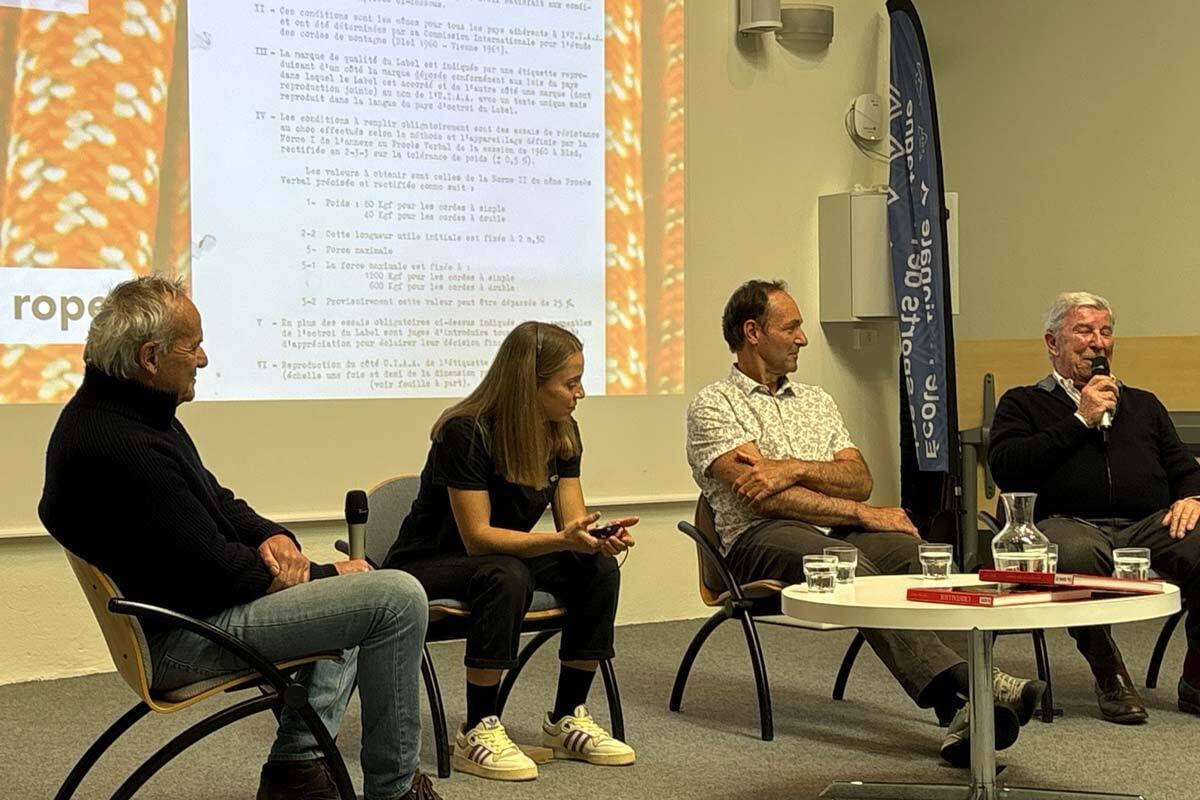
Training programmes, both organizing and facilitating local sessions, remain a core focus for nearly all member federations across Asia. For example, the Nepal Mountaineering Association (NMA), one of the oldest Asian members, introduced curricula for the Professional Mountain Guide (PMG) and Professional Mountain Leader (PML) programs in 2025. These programs received official accreditation from the Government of Nepal. While the NMA has been offering specialized training since 1979, these new programmes represent some of the most comprehensive to date and reflect evolving expectations for Nepali mountaineers. The PML program includes courses such as Basics (5 days, August), Fundamental Skills (19 days, August), Winter Skills (11 days, March), and Instructor Training (5 days, July). The PMG program features Fundamental Skills (13 days, June) and Summer Skills (30 days, September). In total, 93 individuals earned certificates through these programs in 2025.

Established in 2006 and joining the UIAA in 2025, the Kurdistan Mountaineering and Climbing Federation (KMCF) has been actively engaged in ongoing crag development projects. The Kurdistan Region of Iraq currently boasts five limestone crags, developed over the past decade by KMCF volunteers, offering more than one hundred single-pitch routes and several multi-pitch routes. Notably, four of these crags were developed within the last two years, with approximately fifty new routes bolted in 2025 alone. Additionally, several major peaks and walls have been identified for future development projects. To meet the demand for sport climbing instruction, KMCF partnered with the US-based Professional Climbing Instructors Association (PCIA) to host a training course, resulting in certifications for seven local climbers.

The Bangladesh Mountaineering Federation (BMF), a full UIAA member since 2013, proudly celebrated the remarkable achievement of Ikramul Hasan Shakil in May 2025. Shakil successfully completed the “Everest Sea to Summit” challenge, covering over 1,300 km on foot from Cox’s Bazar, a coastal town in southern Bangladesh, to the summit of Mount Everest. His journey included walking, biking, and swimming across 3 km of Jamuna River. He became the first Bangladeshi to accomplish this feat and the seventh to reach the highest point on Earth. This milestone received widespread attention in Bangladesh and significantly boosted the profile of mountaineering in the country, while also raising awareness about plastic pollution and climate action internationally.

Part 6: 2025 Continental Report: Asia

2025 Continental Report:

Central & South America

Please note that this report is pending and will be added in due course.

Part 6: 2025 Continental Report: Central & South America

C & S America member highlights:

During 2024, a series of mountain and training activities took place in Argentina, including:

UIAA Management Committee Meeting:

Held in April 2024 in Bariloche (see Section 2 of this report)

First International Course on Mountaineering, Medicine, Techniques, and Mountain Safety:

Held in Bariloche in April 2024 (see Section 2 of this report)

High Summit Process:

Among the most important summits and expeditions carried out in Argentina, a series of attempts and repetitions were made in the central Andes, the most important of which were:

  • Quehuar Volcano Expedition (6, 150m)
  • Tuzgle Volcano (5,530m)
  • Cerro Clavadillo (5,500m)
  • Nevado Incahuasi (6,621m)

Activities Planned for 2025:

Third edition of recognition FASA: For the third time, the award is being given to the best mountain activities, including bouldering, sport rock climbing, high-altitude mountaineering, literature, alpine climbing, and more. More information here.

During 2024, FEDPE continued developing its mountain training programme and Himalayan expeditions, including the following:

Daughters of the Mountain Expedition - Himalaya:

This project consisted of leading Peru's first female expedition to Manaslu, where they managed to reach Camp 4, after being forced to abandon the expedition due to a major storm that hit the area.

Planned Activities for 2025:

  • Maintain the sports training programme
  • Increase the number of mountain and rescue specialists
  • Initiate the UIAA Training Standard Certification process

FEDANE has maintained an interesting cooperation program with the Chilean Mountaineering Federation (FEACH) has allowed clubs from both countries to undertake joint ascents, alternating between Ecuador and Chile. This collaborative effort has led to summits on Chimborazo, Cero el Plomo, Cotopaxi, Juncal, and more.

Federación Argentina de Ski y Andinismo (FASA)

Federación Deportiva Peruana de Escalada (FEDPE)

Federacion Ecuatoriana de Andinismo y Escalada (FEDANE)

EACH has focused its efforts on sports development and the training of mountain instructors, for which it has carried out the following projects:

FEACH Instructor Recertification:

During 2024, in conjunction with the Spanish Federation of Mountaineering (FEDME), the recertification process that began in 2022 was carried out, allowing for the updating and recertification of 55 mountain guides/instructors, from Level 1 to Level 3, thus achieving the inclusion of Winter High Mountain instructors for the first time. This process benefited from the invaluable cooperation of the Chilean Army Mountain School, which provided the facilities at the Portillo Barracks, located at over 3,000 meters above sea level in the middle of the Andes Mountains.

Chilean Ice Climbing Championship Project:

In 2024, the first attempt at an Ice Climbing Championship was held in the Juncal sector of the Andes Mountains. This event brought together nearly 30 ice climbing specialists, who demonstrated their skills and paved the way for a larger event in the coming years.

Himalayan Summits:

During 2024, a series of forays to Himalayan summits took place, including the summit of Ama Dablam by Nicolás Horta, who became the youngest Chilean to summit that summit solo. This expedition joins Loreto Biazevic's expeditions to Everest and Janice Rot and Nicolás Horta's projects on Lhotse.

Tragically, FEACH mourns the loss of Carlos Gatica, UIAA N2 Mountain Guide Instructor, who died in a climbing accident in the Cero Manquehue area in June.

Accreditation of University Mountain Professionals:

FEACH has deepened its work with DUOC, and during 2024, more than 80 students were accredited on its mid-mountain courses. The process of creating a High Mountain Diploma for the most advanced students who wish to pursue professional guiding began. This project should be underway during the last quarter of 2025

Federacion de Andinismo de Chile (FEACH)

As in previous years, the FAG has maintained its programme to promote mountaineering and mountain challenges, successfully organising a series of high-impact sporting activities, among which the following stand out:

  • Maya Award: Awarded to mountaineers who reach the summit of the 13 highest volcanoes in the country.
  • Walter Peter Award: Awarded to mountaineers who complete a circuit of the 25 highest volcanoes in Guatemala.
  • Quetzal Award: The highest mountaineering award in Guatemala, awarded to mountaineers who reach the summit of the 47 highest volcanoes in the country.

Federación Nacional de Andinismo de Guatemala (FAG)

Challenges for 2025

Outstanding Member Association 2024

The region's challenges for 2024 focus on achieving sports development that allows for the growth of the athlete base, as well as the consolidation of federated entities in those countries that are not yet part of the UIAA process. These processes must have the support of countries with the greatest mountain development and be promoted by the UIAA.

Logo: Federación Nacional de Andinismo DE GUATEMALA with blue climber and mountain silhouette.

Given the great work and collaboration with federations in the Region, this year the Guatemalan Mountaineering Federation is elevated as the 2024 Outstanding Member.

Report by

Willy Montenegro Garcia

UIAA Management Board, Continental Representative for Central & South America
FEACH, Chile

2025 Continental Report: EUMA

Report by

JOSEF KLENNER
President, EUMA (German Alpine Club, DAV)

European Mountaineering Association (EUMA) is an umbrella organisation of 36 European mountaineering associations from different countries with approximately 3,266,106 million members.

EUMA strives to include mountaineering in European Union priorities as an important factor of quality of life and to be recognised as the dialogue partner for mountaineering by EU institutions.


4th European Trails Conference

An important event took place in Macugnaga in Piedmont in October. With significant participation and support from Club Alpino Italiano, EUMA and ERA hosted the 4th European Trails Conference. About 70 participants and experts from 15 countries presented concepts, expertise and know-how on all aspects of trails. Climate change, the management of tails and AI took a special place in it.

International Mountain Conference Innsbruck

In September, the University of Innsbruck hosted the International Mountain Conference. Due to previous participations, EUMA had its own thematic area this time, in which experts from the EUMA environment could present topics on alpine infrastructure such as huts and paths, mountain sports and climate change. The high number of participants confirmed the relevance of the selected presentations.

European Union and European Week of Sports

The contacts with the European Union have been further developed. Talks took place at ministerial level of the Commission Education, Youth and Sports (EAS) to present and explain the specific concerns of mountain sports known to the EU. The EU representatives underlined that mountain sports should take a firm place in the strategies in the future.

As a start to an ongoing participation process, EUMA's participation in the European Week of Sports was agreed. Under the EU slogan #BeActive, 10 member associations took part in the 10 flags on 10 summits in 10 countries campaign.

The participation in the European Week of Sports was the reason for EAS to offer a partnership agreement to EUMA, in which EUMA now officially appears as a partner of the EAS – Week of Sports. The document was signed by EU Commissioner Glenn Micallef and EUMA President Josef Klenner in Copenhagen on 23 September, 2025.

Part 6: 2025 Continental Report: EUMA

European Trails Charter

On the occasion of the conference in Macugnaga, the final work and vote on the European Trails Charter took place, which was written as a joint position and demand paper by EUMA and ERA. This is the first document existing at European level that deals with all aspects of trails and addresses demands to the EU, national governments, regional organisations and individual users.

Immediately after the decision, EUMA sent the charter to all member associations and external partners. The relevance of this document is obvious from several approving comments, including from the EU.

2025 Continental Report: Europe

Europe is the largest continental body in terms of UIAA membership with 58 members from 40 countries represented in this geographical area. It has some of the world's most diverse and iconic mountains and long rock faces with around three million federation members represented. Approximately two and a half million come from alpine or mountainous countries in Western Europe with a long history in climbing and mountaineering: notably in Austria, France, Germany, Italy, Spain and Switzerland.

Part 6: 2025 Continental Report: Europe

European member highlights:

Institutional event

Scientific event / research news

Federation developments and sport events

Member highlights

Community and regional initiatives

Mountain Partnership – Seventh Global Meeting (Andorra, 2026)

The Seventh Global Meeting of the Mountain Partnership, a United Nations voluntary alliance dedicated to sustainable mountain development, brings together governments, NGOs, and mountain stakeholders from across the world. The 2026 edition in Andorra focuses on strengthening cooperation on mountain sustainability, climate resilience, and the role of mountain communities in global environmental agendas. It also serves as a platform to align policy approaches between regional mountain systems and international frameworks.

Regional Mountain Conference 2026 (Austria)

This conference gathers researchers working on mountain systems across disciplines, including climate change, ecology, tourism, and socio-economic transitions. It promotes exchange between European and global mountain research communities and supports interdisciplinary approaches to mountain sustainability challenges.

Western Alps hut adaptation study

Recent research on mountain huts in the Western Alps highlights that climate change is increasingly affecting infrastructure, safety, and maintenance needs. The study stresses that stronger collaboration between hut operators, alpine clubs, and public authorities is essential to improve resilience. Shared governance, coordinated funding mechanisms, and knowledge exchange are identified as key conditions for adapting hut networks to future environmental pressures (Mountain Research and Development, 2025).

Ski mountaineering – Olympic debut

Ski mountaineering prepares to make its Olympic debut at the 2026 Winter Games in Italy. This marks a significant step in the international visibility of the discipline and reinforces the role of European federations in its development.

Club Alpino Italiano (CAI)

The CAI successfully supported the adoption of a parliamentary motion in Italy aimed at improving the monitoring of mountain tourism flows. The motion explicitly recognises CAI as a reference institution for collecting, interpreting, and sharing data on trail and route usage. This reinforces its role in managing national hiking networks and improving safety, maintenance, and evidence-based planning in mountain areas.

Fédération Française des Clubs Alpins et de Montagne (FFCAM)

The FFCAM General Assembly approved a new solidarity-based funding mechanism inspired by models used in other European alpine associations. A small contribution per membership will be allocated to environmental and climate-related actions, aiming to reduce the organisation’s carbon footprint and strengthen its sustainability strategy.

 Federació d’Entitats Excursionistes de Catalunya (FEEC)

The UIAA collaborated with the FEEC on a climate change case study. The FEEC is a UIAA full member since 1932 and counting an impressive membership of over 86,000 individuals across Catalonia. One of the cornerstones of the FEEC project is the Green Label initiative, which was explored in detail here.

Bohinj Ski Touring Festival (Slovenia, 5–8 March 2026)

This first ski touring festival in Slovenia combines ski touring activities, guided trips, competitions, workshops, and public events. It also includes a dedicated conference on outdoor tourism, addressing land use, environmental protection, and sustainable development of nature-based tourism. It reflects the growing structuring of ski touring culture in Europe, linking recreation, education, and research.

Ireland upland management programme (Reeks region)

A three-year pilot scheme coordinated by Mountaineering Ireland introduces financial support for landowners maintaining popular hillwalking routes. The programme aims to reduce path erosion, improve visitor management, and enhance environmental protection through training and collaborative governance structures.

Slovenia–Croatia alpine cooperation (Biokovo meeting)

The annual meeting between Slovenian and Croatian alpine federations reaffirmed cross-border cooperation on mountain activities, infrastructure maintenance, and the promotion of shared alpine values. The meeting concluded with joint field activities and symbolic recognition of contributions to regional alpine development.

Other news – avalanche risk in Europe

The 2025/26 winter season recorded a significantly higher number of avalanche fatalities compared to previous years, with 143 deaths reported across Europe (EAWS). Italy, Austria, and France were the most affected countries. While this represents a sharp increase compared to recent winters, experts underline that long-term trends since the 1980s show a general decrease in fatalities, despite growing participation in winter mountain activities. The season was characterised by unstable snowpack conditions combined with periods of high tourist exposure during favourable weather windows.

Report by

JEAN MICZKA

UIAA Management Board,
Continental Representative for Europe
FFCAM, France

2025 Continental Report:

North America

2025 was an impactful year of continued progress and community growth. The ambitious three-year goals set in 2022 focused on strengthening the ACC's base and connecting on a deeper, more relevant level with our sections and members.

The ACC is proud to have made significant strides in expanding member engagement, enhancing program accessibility, and strengthening its commitment to environmental stewardship. New training initiatives and expanded youth outreach have brought fresh energy to our club, while investments in facilities have improved experiences for members and hut users alike.

The State of the Club remains strong and vibrant on the cusp of our 120th anniversary, with over 16,000 members and 26 sections across the country, including the newly formed Sault Ste-Marie Section. The ACC's dedicated volunteers, staff, and partners have worked tirelessly to foster a welcoming and inclusive environment through communication and programming

The ACC's self-funded model, combined with targeted fundraising, supports a strong financial position and long-term sustainability. This allows the federation to better resource its sections and invest in infrastructure through renovations and new capital projects. Shadow Lake Lodge is thriving under its updated model, and the ACC is proud to celebrate the completion of the Robson Pass (Byron Caldwell) Hut—a significant milestone following years of dedication and effort.

The Alpine Club of Canada in 2025

Alpine Club of Canada / Club Alpin du Canada logo featuring a green knot symbol.

During 2025, the ACC undertook a comprehensive, stakeholder-driven strategic planning process that has shaped a renewed long-term vision and ten-year ambitions for the Club. These center on strengthening national cohesion, building leadership capacity at all levels, improving organizational processes, and clarifying the ACC's role in environmental stewardship and access. The ACC remains focused on diversifying revenue and evolving its funding model, including a review of its fee structure.

The ACC launched new IT platforms in December, offering an enhanced user experience for its members and the public. During the year, the federation will work on strengthening our ties with its sections and developing tools to better share knowledge and training among our volunteer leaders across the country. Its new hut at Robson Pass will open in late May to our members, and the ACC plans to make progress towards greening the backcountry with an alternative energy system at the Illecillewaet hut.

The ACC are grateful for the dedicated staff, volunteers, and donors who support its work. At the heart of all its progress lies what matters most: a shared passion for the mountains and a deep respect for the craft that brings us together.

2026, the year ahead

Part 6: 2025 Continental Report: North America

The annual review of the American Alpine Club can be viewed through its highly engaging and information Impact Report. View the Impact Report by following the prompt below.

https://americanalpineclub.org/news/2025/10/21/aacs-2025-impact-report

American Alpine Club (AAC)

Report by

PHIL POWERS

UIAA Management Board, Continental Representative for North America
American Alpine Club (ACC)

2025 Continental Report: Oceania

The 2025 year again saw growth around Oceania in the numbers of people getting outdoors and taking part in climbing and hiking activities. This growth has been a trend in both Australia and New Zealand since the Covid lockdowns in 2020-21. Much of this activity is done independently outside of organised clubs or in small informal groups organised through social media channels. Demand for professional instruction continues to grow and it was great to see the Australian Climbing Instructors Association welcomed as an Associate UIAA member and the first Australian member at the end of 2024.

Part 6: 2025 Continental Report: Oceania

General Trends

The year saw a continuation of the trend towards seeking out new climbs in more remote areas which may require several days of difficult travel just to reach the bottom of the climb. New technologies, lightweight materials and ever-increasing skill levels are making possible impressive new climbing routes and trans-alpine journeys in spectacular regions such as the Darrans in Fiordland.

This trend is being encouraged by glacial retreat, which is seriously challenging access in the traditional alpine climbing areas such as the Aoraki- Mount Cook national park.

Overcrowding

Issues of crowding in the most popular areas continue to receive attention. For instance, in New Zealand the land manager, the Department of Conservation (DoC), is having to explore various mechanisms to manage tourist numbers visiting key National Park locations such as Aoraki-Mount Cook village and is increasingly moving to manage the usage of the more popular huts in New Zealand’s extensive hut network. The pre-booking of bunks is familiar to many UIAA members but is relatively new and somewhat controversial amongst the New Zealand outdoor community.

Having said that, there are literally hundreds of simple DoC backcountry huts located throughout New Zealand’s remote and wild country that are not bookable and provide “shelter from the storm” for those undertaking challenging mountaineering and trans-alpine trips. This unique network is under threat from government budget cuts and an underfunded DoC, and the outdoor community has responded with an impressive outpouring of organised volunteer activity to go in and clean and repair these much-loved huts and associated track network. Club owned huts and lodges, and particularly the high alpine huts owned by the NZAC, continue to be challenged by high maintenance costs. Access to some of these huts is now almost always by helicopter, with glaciers being increasingly problematic. This of course raises issues around carbon emissions and has led to a small but growing ethos of “walk in, walk out”, no minor matter in such a challenging alpine landscape.

Focus: Australia

For several years we have reported on the ongoing debate and controversy around access to a number of Australia’s top rock climbing areas particularly Gariwerd (Grampians National Park) and Dyuritte (Mt Arapiles) in the state of Victoria. These issues are centred on limitations being placed by Park authorities on access to crag areas with thousands of routes, including many areas with a long-established global climbing reputation. The reason for the bans is concern at climbing’s impact on cultural values and claimed damage to traditional sites including ancient rock art. It seems some progress was made in 2025, with local communities heavily dependent on climbing and supportive of careful protection of cultural sites being invited to talk through the issues with parks authorities and local indigenous corporations with a view to finding common ground.

The climbing community continues to be divided in approach between those working to engage with the relevant aboriginal groups and another more activist group pushing to take more direct action. The issue gets inevitably linked, and used as a case study, in the larger Australian debate about traditional aboriginal owner s’ land and justice issues. As we have previously noted, there is no easy or quick resolution to an issue which goes to the heart of Australia’s history of colonial settlement.

Report by

STUART GRAY & ALLAN BRENT

Oceania Representatives on the UIAA Management Board
New Zealand Alpine Club

Focus: New Zealand & Beyond

For New Zealand, the management plans for many National Parks and other Conservation areas used by climbers, mountaineers and hikers remain overdue for revision and updating, in part due to an underfunded DoC and in part to similar cultural dimensions. Significant areas of conservation land have been held in an interim status for almost 40 years, and never been formally reviewed and designated as Conservation Park or National Park, which would lead to more specific controls on land use applying.

Proposals put forward for the legal classification of large areas of land of high conservation and recreation value on the wild west Coast of the South Island are being legally challenged by environmental organisations as inadequate and leaving these areas unprotected from development. What is clear and widely accepted is the close involvement of Māori tribes in oversight and management of conservation land.
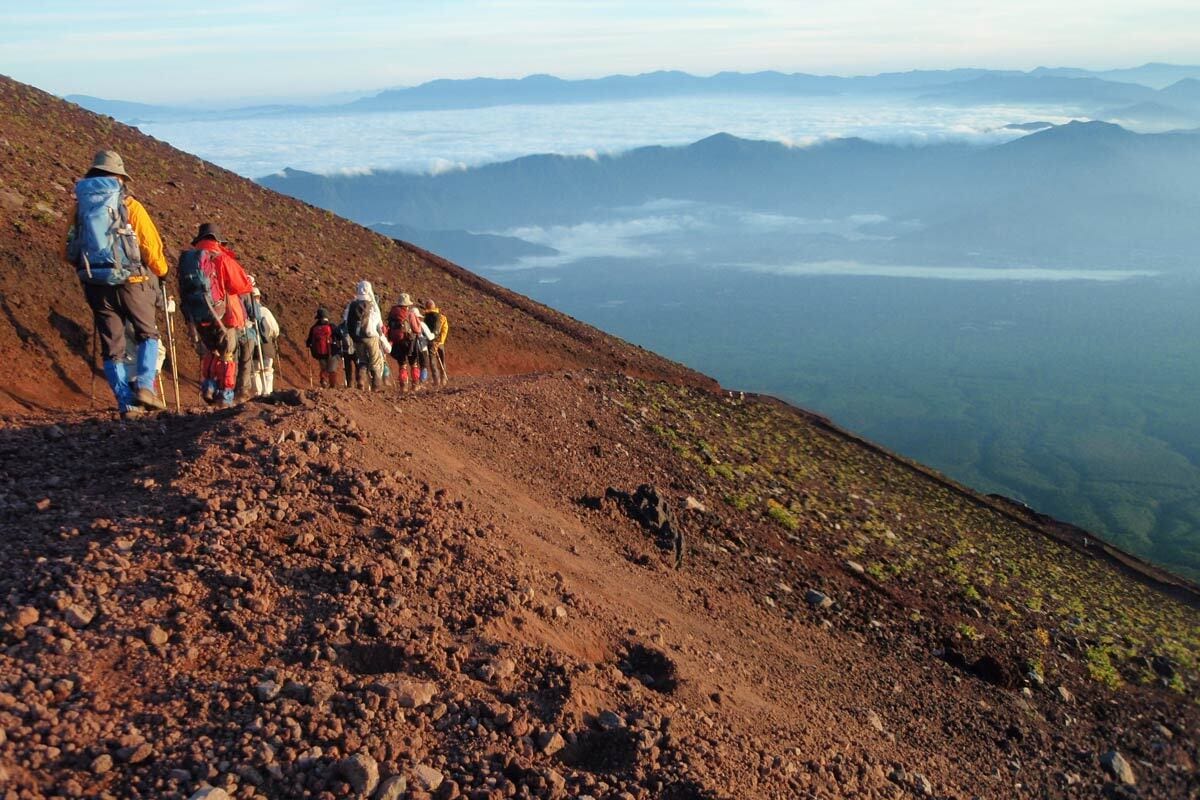
The growing interest in climbing and hiking is also being seen in small South Pacific island countries such as New Caledonia and Fiji where local clubs are established and actively developing local crags and trails.

Thank you Stuart

2025 was Stuart Gray’s last year as the Oceania Representative on the UIAA Management Board and the General Assembly in Kosovo voted Allan Brent of NZAC as the new Representative. Allan is also incoming President of Federated Mountain Clubs of New Zealand, a peak umbrella organisation for mountain recreation which includes NZAC as its largest member.

Climbing and mountaineering in Oceania continues to grow and attract new participants and it continues to adopt to meet the challenges before it.

Sponsors & Partners

Sponsors

Supporting Cause

Supporting Partner (Apparel)

Supporting Partners

Presenting Partner - Sustainability

Supporting Partners - Sustainability

International Observer Members

Team
Logo, Symbol
Font, Advertising

Sponsors and Partners

The UIAA secured a number of new partnerships across the calendar year 2025. Please refer to the press releases published for each new collaboration.

The UIAA and Fixe strengthen ties with two major sponsorship agreements

The UIAA and Fixe, a renowned brand specialising in climbing and mountain gear, have signed two collaboration agreements:

  • The agreements reinforce both parties' commitment to innovation, safety, and the development of climbing at an international level.
  • The technical team and staff of the UIAA Ice Climbing World Tour will use Fixe ropes, carabiners, anchors, harnesses and helmets.

The UIAA and Namah Ropes agree partnership

The UIAA is delighted to announce a new partnership with Namah Ropes.

With a strong focus on safety and sustainability, Namah combines modern engineering with time-honoured craftsmanship to deliver products that meet the highest global standards, including the UIAA Safety Label certification.

In terms of the partnership, Namah Ropes will become a Supporting Partner - Safety of the UIAA.

UIAA and Altezza Travel agree sustainability partnership

The UIAA and Altezza Travel, a leading Mt Kilimanjaro operator, are delighted to announce a two-year sustainability partnership.

The UIAA and Altezza Travel have agreed to collaborate and promote activities in the field of sustainability. This includes two of the UIAA's most prominent projects - the biennial Mountain Protection Award and the federation's Climate Action Plans.

2025 Continental Report:

Oceania

Part 5: 2025 Continental Report: Oceania

COMING SOON

Front cover

Mount Sinai , Shutterstock

President's Report

UIAA/Amelie Stettbacher

Strategic Priorities

Karakorum , Arne Fuglvog

General Assembly

UIAA/Amelie Stettbacher/Peter Bourne/Simon Alden

Bariloche Course

UIAA/BQP Films – FASA/Laureana Fuentes/Peter Bourne

Sustainability Charter

Mont Blanc, Shutterstock

Rock Anchors & Bolts

Shutterstock

Summit Series

Aconcagua, Shutterstock

All tiles, Shutterstock

UIAA Declaration

Uli Biaho, Arne Fuglvog

Legal Database 

Shutterstock

World Ice Climbing

Louna Ladevant, UIAA/Julia Roger-Veyer

Accident Reporting Systems

UIAA/BQP Films

Anti-Doping

UIAA Ice Climbing World Cup/Edmonton, Slobodan Mišković

Legal Affairs

UIAA/Monica Dalmasso

Medical

iStock

Mountaineering

Petit Dru, Shutterstock

Mountain Protection

Lofoten, Norway, Shutterstock

Training

UIAA/BQP Films

Youth

Christian Biard

World Ice Climbing

Julia Roger-Veyer / Rhea Kang / Kaspar Kellerhals /

Slobodan Mišković / Nils Paillard

ISF

  • All the way from Brazil, one of skyrunning’s fastest growing countries, 16-year-old Elis Juliana Simão João competing in the VERTICAL at the 2024 Youth Skyrunning World Championships. ©ISF
  • Italy’s Benedetta Broggi on her way to a bronze medal in the VERTICAL at the 2024 Skyrunning World Championships.  ©iancorless.com
  • Anna Strakova, 50, from the Czechia, took a gold in the Masters Skyrunning World Championships in Portugal. ©DamianoBenedettoPhoto
  • Start of the SKYULTRA at the 2024 Skyrunning World Championships in Soria, Spain. ©iancorless.com
  • Italian Marcello Ugazio on the lung-busting ascent of the Monte Lussari Vertical, 2024 SkySnow World Championships. ©Damiano Benedetto Photo
  • Sweden took both the gold and the silver in the SKY at the 2024 Skyrunning World Championships, thanks to Louise Jernberg and Barbro Fjällstedt respectively. ©iancorless.com

  • Yuya Okada from Japan takes the gold in the O45 category, 2024 Masters Skyrunning Championships in Vouzela, Portugal ©Damiano Benedetto Photo
  • Hungarian Erzsébet Prokopp racing in the SKY, 2024 Masters Skyrunning Championships. ©Damiano Benedetto Photo
  • Spain’s Alain Santamaría took three gold medals for the VERTICAL, SKY and combined titles. ©iancorless.com

Membership

Denali Range, Shutterstock

Africa

Todgha Gorge, Shutterstock

Asia

IMF

Europe

Alps (Austria), Shutterstock

FFCAM Archives

North America

ACC Archive

El Capitan, Shutterstock

Central & South America

FEACH/FEDME

Oceania

Kosciuszko National Park, Shutterstock

Photo credits (please note photo credits are not correct and will be updated for the final version)

Logo

Editorial: & Conception Peter Bourne

Design: Abi van Twisk / KIN Studio

For a full archive of UIAA Annual Reports please click here